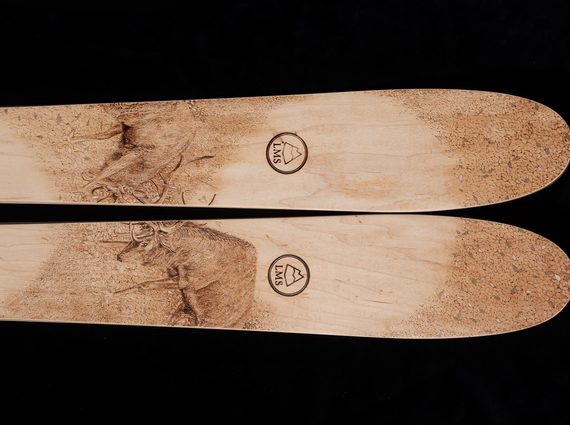
Modern and Contemporary History
Our Modern and Contemporary History collections represent cultural, social, political, military and rural history in Scotland from c.1750 right up to the present day.
The collections document the impact and legacies of Enlightenment, industry and empire that marked the transformation of Scotland during the later-eighteenth and nineteenth centuries. They chart a line through the major international conflicts and profound social shifts of the twentieth century, telling stories about continuity and change in Scottish life right up to the present day.
Notable collections include: Scottish decorative arts, from precious jewellery to glass and ceramics; unrivalled bagpiping collections and the material culture of working life, from ploughs to weavers’ tools. We hold extensive material representing military history and rural life, reflecting the strength of the foundational collections of the National War Museum and National Museum of Rural Life.
Our innovative contemporary collecting programme is focused on representing the twenty-first century with an emphasis on what is distinctive about Scotland in a globalised world, and of the regional and cultural differences within the country. We also actively collect objects that shed light on how the past continually shapes the present.
Meet the team

Dr Sarah Laurenson
Principal Curator of Modern and Contemporary History
Dr Calum Robertson
Senior Curator, Modern & Military History
Dr Ailsa Hutton
Curator, Modern and Rural History
Dr Mhairi Maxwell
Curator, Modern and Contemporary History
Oliver Taylor
Assistant Curator, Modern and Contemporary History
Dr Julie Holder
Assistant Curator, Modern and Contemporary History
Modern and Contemporary History stories
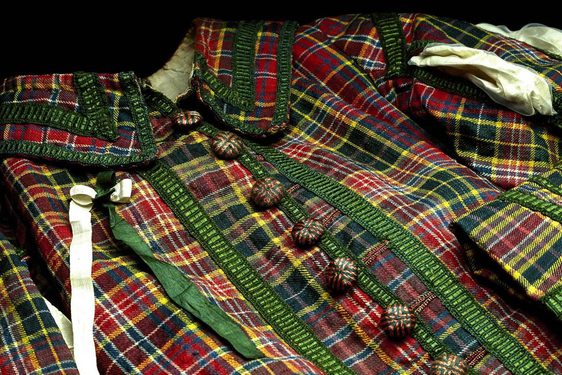
Jacobites and tartan: Symbolism and style
Fashion and textiles, History and cultures, Scotland
Tartan has long been one of the most recognisable symbols of Scotland. The cultural significances of tartan are often reflections of and responses to the social context in which it was produced and worn. The 18th century tartan garments…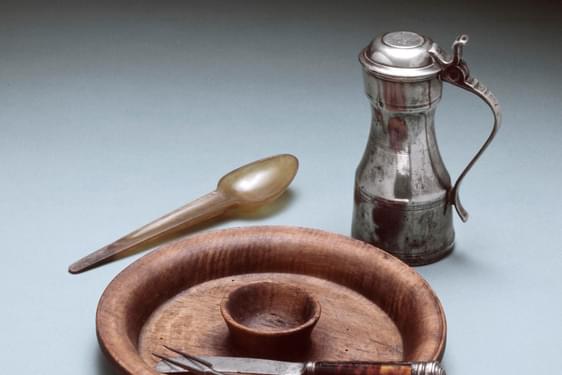
The 'tappit hen': A drinking vessel used during the lifetime of Robert Burns
History and cultures, Scotland
These pewter drinking vessels were common in eighteenth century Scotland’s public houses because they were relatively cheap to make and could withstand use and, perhaps, abuse.The name ‘tappit hen’ is derived from the distinctive…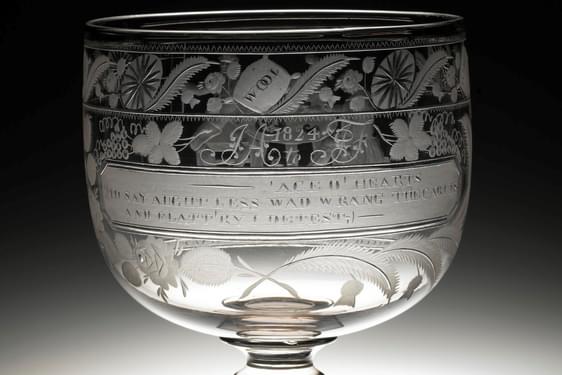
Celebrating Robert Burns: Glass goblet engraved with words by Burns
History and cultures, Scotland
A large glass goblet such as this would have been used as a punchbowl. Clues about its use can be found amongst the words and images engraved into the glass.On one side there is a quote from Robert Burns’ poem ‘Epistle to Davie, A Brother…