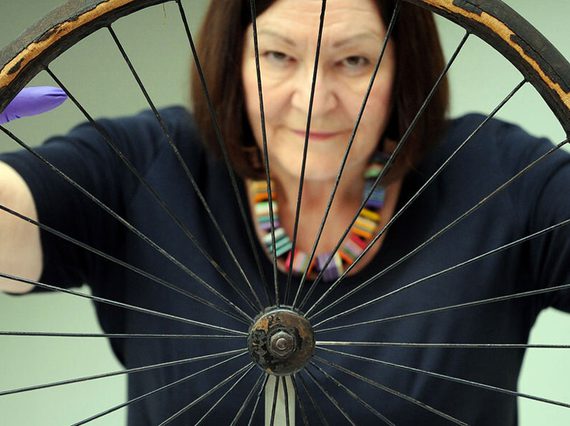
The Dunlop tyre: Air apparent
News Story
This revolutionary pneumatic tyre was donated to the museum by its maker, John Boyd Dunlop, in 1910. But who really invented the pneumatic tyre? And who really benefitted?
The race for invention
Almost every road vehicle on the planet now uses pneumatic rubber tyres. Mid-19th century rubber tyres were prone to severe road wear and tear, and did very little to improve comfort or speed. Pneumatic tyres commercially appeared on the market in Scotland in 1895, coinciding with the appearance of the first car. Crucial innovations in rubber and tyre design paved the way for this breakthrough.
In 1844, American chemical engineer Charles Goodyear invented vulcanised rubber, a chemical process to strengthen natural rubber making it more durable, flexible, and waterproof.
In 1845, Scottish inventor Robert William Thomson invented the first pneumatic rubber tyre, a process of inflating vulcanised rubber with pressurised air. The first pneumatic tyre was developed specifically to improve horse-drawn carriages. However, it was considered too expensive to manufacture at the time.
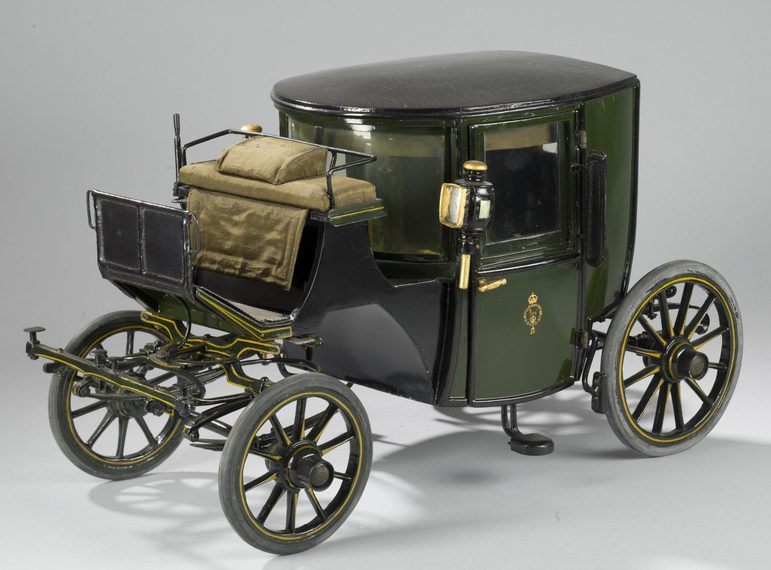
This model represents the Brougham carriage used by Thomson to demonstrate his tyres. The Brougham was a new lightweight design by Edinburgh-born Lord Brougham.
Between the 1820s and 1850s, there were several developments of clunky human-powered vehicles, such as basic two-wheeled devices, tricycles (three wheels), and quadracycles (four wheels). Versions of the bicycle that we recognise today, an accessible and commercial means of transport, didn't appear until the late 1860s.
In 1888, Scottish inventor and veterinary surgeon John Boyd Dunlop developed the first practical pneumatic tyre, with the use of inner tubes. This made them more viable for both bicycles and then later on, automobiles. In effect, Dunlop reinvented the pneumatic tyre, without knowing of Robert Thomson’s invention some 40 years earlier.
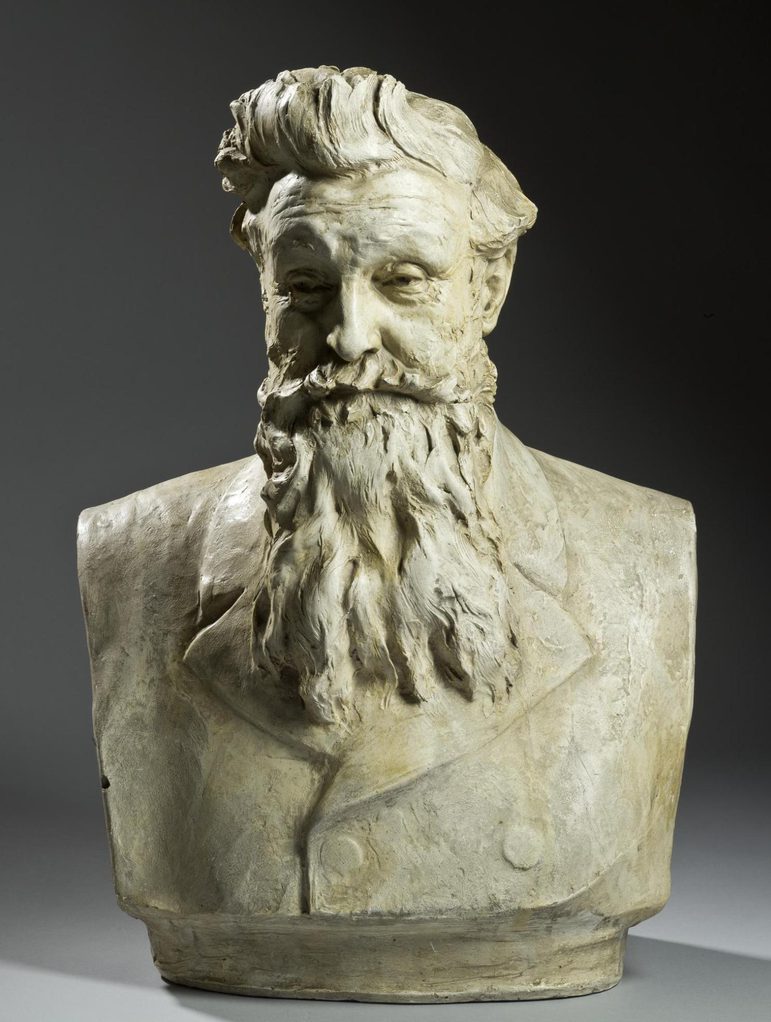
This bust of John Boyd Dunlop, by Glasgow sculptor Henry Snell Gamley, is also in our collection. Museum reference T.1999.175.
Dunlop and his tyre
This bicycle tyre, gifted to the museum by Dunlop himself was made in Edinburgh from Arbroath sailcloth and India rubber. It is Dunlop's own prototype tyre.
Dunlop started to develop it after his son Johnnie complained about the discomfort he experienced riding his tricycle to school. Using his knowledge and experience of working with rubber, Dunlop attached an inflated tube of rubber to a wooden disc, 96 cm wide. He compared the rubberised wheel against one of his son's existing metal wheels by rolling them across his yard. The rubberised wheel proved far superior. Dunlop then tested the tyre by fitting it to his son's front wheel, much improving the ride.
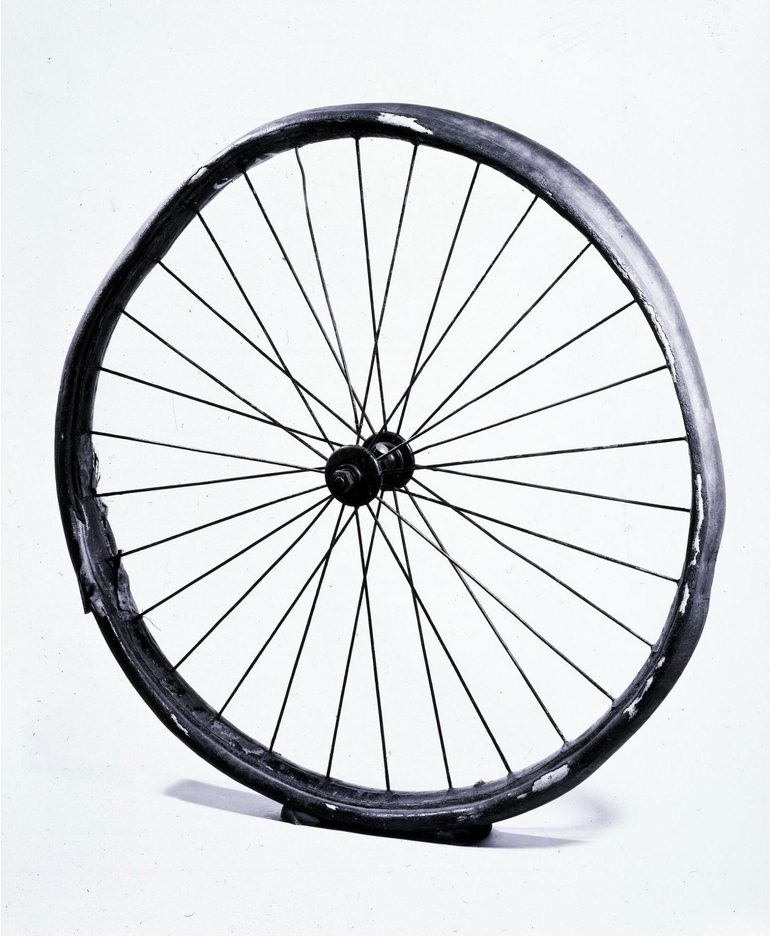
Rubber tyre donated to the museum by John Dunlop himself, 1888. Museum reference T.1910.27
Dunlop moved on to developing larger tyres, testing them and receiving a patent in 1888. He persuaded cyclist Willie Hume, to trial his new tyres at a famous cycle race at Queen's College in 1889. Willie won the race, beating two sons of a wealthy financier and cycling enthusiast, Harvey Du Cros.
Du Cros convinced Dunlop to join in a new business venture, acquiring the patent to the invention and The Dunlop Rubber Company was formed. Devastatingly, Dunlop lost his patent rights in 1890, when it was discovered that, unbeknownst to him, the pneumatic tyre had been patented by fellow Scot Robert Thomson in France in 1846 and then the US in 1847.
Dunlop sold his rights to the company but it continued to use his name. The business was eventually sold and continued as Dunlop Pneumatic Tyre Company without the inventor's involvement. Today Dunlop is a global trademark brand, and is completely disconnected from its inventor.
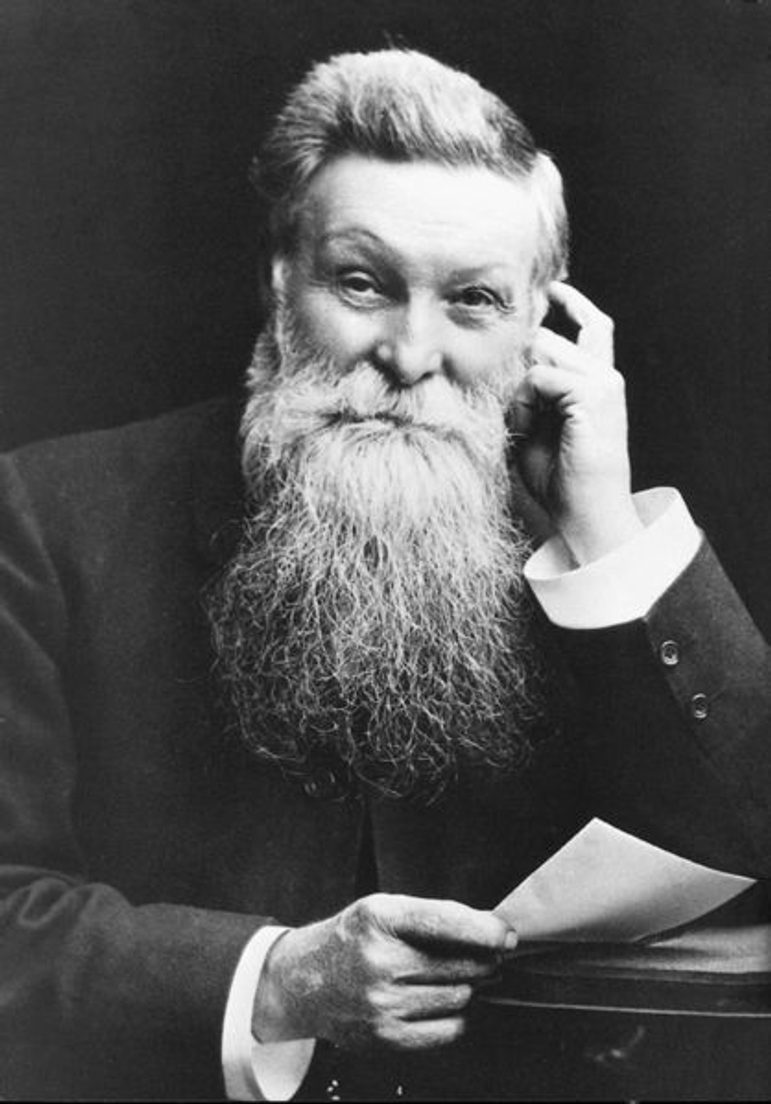
John Boyd Dunlop 1840 – 1922.
Patently forgotten
Even more disconnected from this story is the original inventor of pneumatic tyres, Scotsman Robert Thomson. A gifted and self-taught engineer, he developed and patented many inventions in his lifetime including: the first refillable fountain pen, steam buses, road steamers, the reversible washing mangle, a portable steam crane, steam boilers, a much safer method for denoting mine explosives and of course, the pneumatic tyre.
At the young age of 23, he patented his 'Aerial Wheels'. Before the invention of the bicycle or the internal combustion engine, Thomson's focus was the improvement, efficiency, and comfort of horse-drawn carriages. He created a rubberised canvas tube of air, encased in strong leather, and bolted to the wheel. Thomson successfully applied for a patent and tested his product in Hyde Park, London, in 1847. It was fitted to several horse-drawn carriages, which greatly improved passenger comfort and significantly reduced the noise. Though a success, rubber was very expensive at the time, road conditions were poor, and the breadth of potential applications didn't appear for another 40 years.
In essence, Thomson was ahead of his time, and much under-rated. He had a relatively modest lifestyle and was largely forgotten by the time he died in 1873.
Paving the way
Both of these Scottish inventors contributed and prepared the ground for the boom in road transport, motor sports, and aviation. Without the comfort, speed, and efficiency afforded by pneumatic tyres, urban and rural transport would have remained indefinitely rough, noisy, and inefficient.
Despite the fame associated with Dunlop's name, neither man fully benefitted from their inventions.
You might also like

10 video games with Scottish connections
Science and technology
Scotland is home to some of the most innovative and influential game makers.From the invention of the ZX Spectrum computer in the 1980s, to world-building influenced by the Scottish landscape, Scotland can be found in many corners of the…
Concorde: The story of supersonic passenger flight
Science and technology
For almost 30 years, anyone who could afford the ticket could shoot across the globe at twice the speed of sound. How? By flying on Concorde, the world’s only successful supersonic passenger aeroplane.
The only known painted portrait of Alexander Dalrymple
Art and design, Science and technology, Scotland
This portrait is one of the only known images of Scottish-born Alexander Dalrymple. But who was Dalrymple, and what can this painting tell us about this significant figure in Britain’s maritime history?