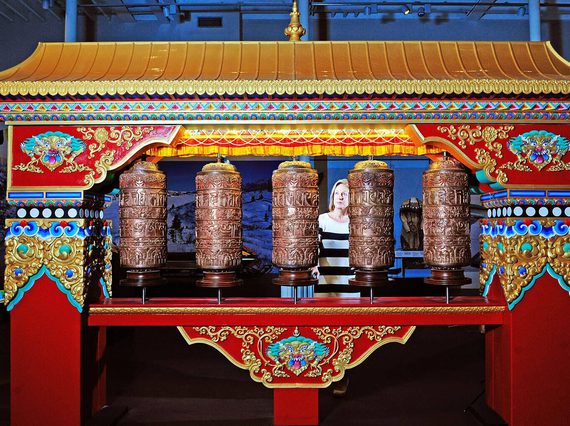
The making of a Tibetan prayer wheel house
News Story
The Tibetan Prayer Wheel House offers visitors a tangible experience of a common feature of Tibetan culture. The turning of prayer wheels is a practice for developing compassion. It is central to Tibetan Buddhism.
This prayer wheel house was manufactured using traditional materials and techniques in the Kagyu Samye Ling Tibetan Buddhist Monastery in southern Scotland.
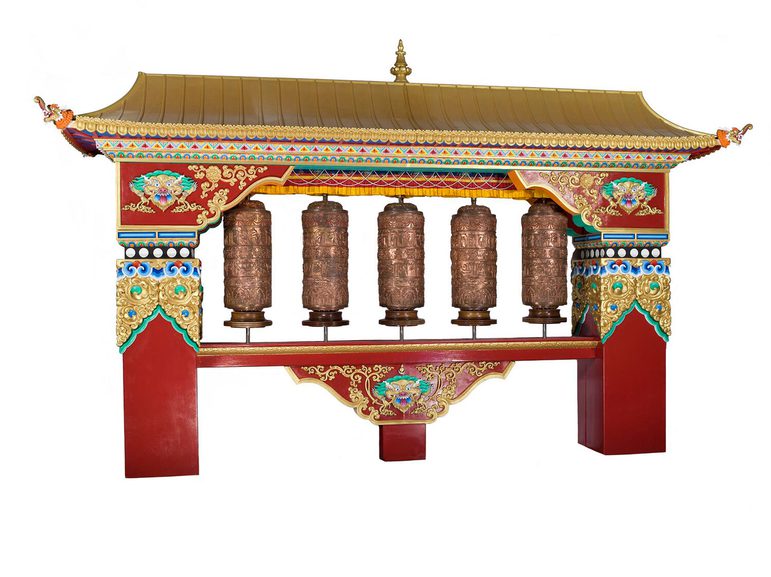
Tibetan Prayer Wheel House, National Museums Scotland.
What do prayer wheels mean to Tibetan Buddhists?
Prayer wheels are unique to Tibetan Buddhism. They come in all sizes and are used throughout Tibet by individuals of every social rank and status.
The turning of the wheels activates the blessing of the mantras within. This creates good karma and removes obstacles to enlightenment for the benefit of all beings. Each clockwise revolution releases the mantras and is equivalent to reciting the same number of mantras within the prayer wheel.
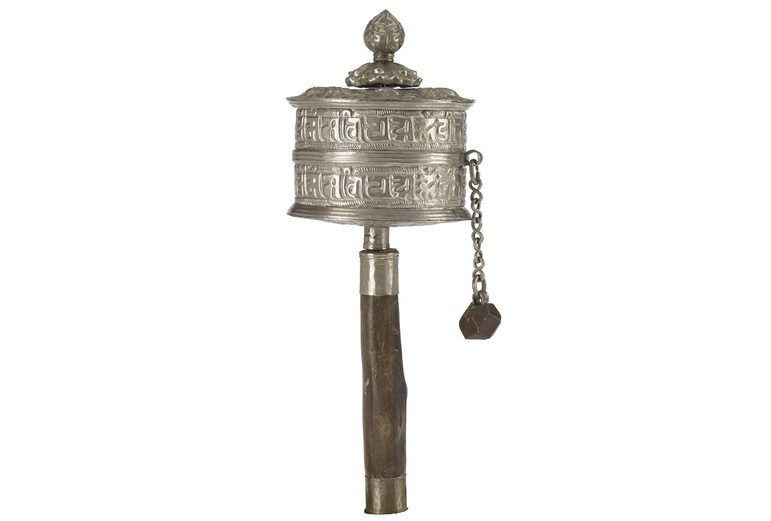
Mani lag khor (hand prayer wheel), circular silver case embossed with Tibetan script, with printed prayers inside, with metal weight hanging from chain, rotating on wooden handle, used by Tibetan Buddhists to release prayers into the air. Tibet, Lhasa, 19th century AD. (A.1909.442)
Planning the Prayer Wheel House
Over the course of 2008 and 2009, a series of meetings between the museum and the monastery took place. The design, ornamentation, and materials to be used, as well as the size and number of the prayer wheels, were discussed.
During the design phase, designer and Buddhist, Yeshe Palmo worked together with Mark Bradley, one of the Buddhist craftsmen at Kagyu Samye Ling. Several sketches of proposed prayer wheel designs were drawn before one was finally agreed on with the museum.
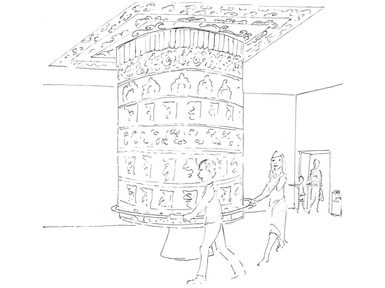
Early concept sketch for the Prayer Wheel House.
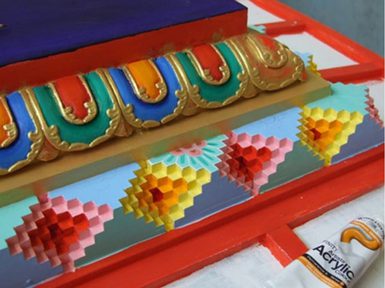
Painting the Prayer Wheel House.
Inside the Prayer Wheel House
Inside each prayer wheel cylinder is a tightly wound roll of printed mantras. Mantras are short Buddhist invocations of several syllables. Each of the 1,400 paper sheets within each cylinder is printed with about 23,000 of these mantras. This means that each cylinder contains 32,200,000 printed mantras!
In order to be effective, the consecration of the mantra sheets required a blessing. Yeshe Palmo and Mark Bradley sprinkled saffron water and consecration substance on every sheet of the mantras. The consecrated sheets were then wrapped tightly around the central axis of the cylinders, before being inserted into the cylinders. Finally the cylinders were sealed and another Buddhist, Akong Rinpoche, blessed the prayer wheels.
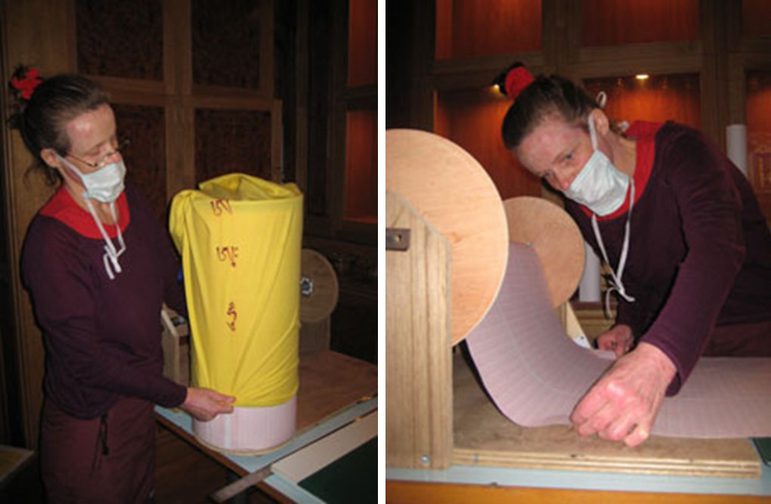
Wrapping the sheets around the axis and pulling a cover over the roll.
Creating the Tibetan prayer wheel house
In this film, Buddhists from Tibet and from the Samye Ling monastery talk more about the prayer wheel tradition, and how our prayer wheel house was made.
The Prayer Wheel House (museum reference V.2009.13) is on display in the Living Lands gallery at the National Museum of Scotland.
You might also like
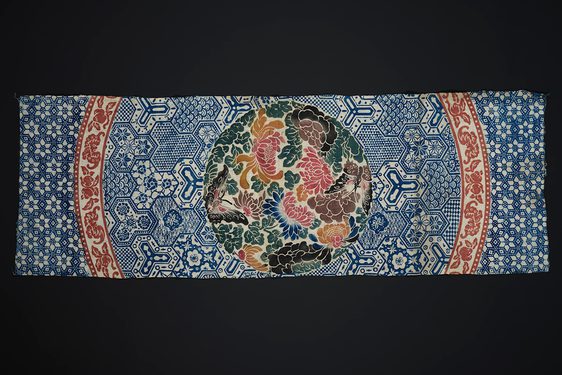
The material lives of ordinary people: rare 19th century Chinese cotton
Fashion and textiles, History and cultures
Written by Dr Rachel SilbersteinWhen you think of historical Chinese dress, what material comes to mind? Most people would probably assume silk. But the majority of the population in Qing dynasty China (1644-1911) actually wore cotton.However, this reality is not…
A closer look at a Korean scroll painting
Art and design, History and cultures
In our collection we have six Korean hanging scrolls that all date from the beginning of the 20th century. This was a time of great change that marked the end of the long-running Joseon Dynasty (1392 – 1910) and the beginning of the…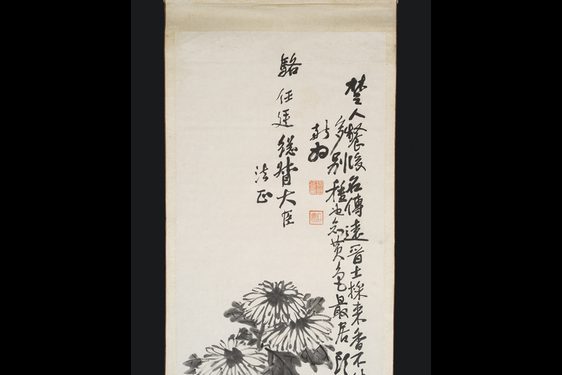
Exploring painting styles of Korean hanging scrolls
Art and design, History and cultures
In our collection we have six Korean hanging scrolls that all date from the beginning of the 20th century. This was a time of great change that marked the end of the long-running Joseon Dynasty (1392 – 1910) and the beginning of the…