The Sendtner orrery: a build of cosmic persistence
The story of this over 100-year-old planetarium or orrery provides a fascinating glimpse into the history of science interpretation, as well as a behind-the-scenes peek into early 20th century museum working.
An orrery is a mechanical model that demonstrates the motion of the planets, moons and sun in the solar system. Planetary models, or planetaria, have existed since the time of the Ancient Greeks. Some had the Earth at the centre, as described by Ptolemy, and some show the Sun at the centre, as described by Copernicus.
The first modern orrery, which also showed the Earth’s rotation, was created in 1704 by the famous clockmakers George Graham and Thomas Thompion. Their design was passed to the London instrument maker John Rowley, who presented a copy to his patron, Charles Boyle, 4th Earl of Orrery, after whom the device became known.
One of five
Our orrery was commissioned in 1912 by Alexander Galt, Keeper of the Technological Department at the Royal Scottish Museum, now the National Museum of Scotland. The maker was Munich manufacturer Michael Sendtner, who made five in total. At the time it was called a planetarium, but as this word has become so associated with star projections we now more often use the term orrery.
Sendtner had previously supplied two models to the Deutsches Museum, Munich in 1906. This pair demonstrate both the 'Ptolemaic' and the 'Copernican' systems. There is one more at the Cranbrook Institute in Michigan, made in 1911, and another at the Franklin Institute in Philadelphia which opened in 1934.

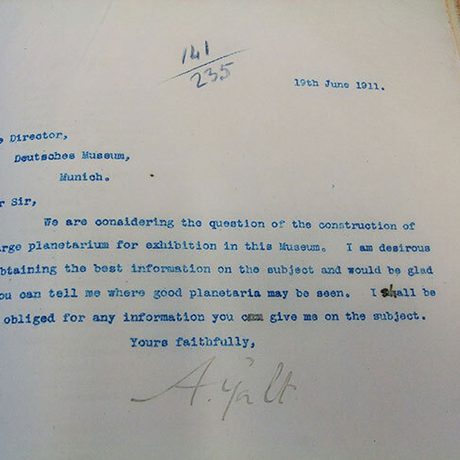
Letter sent from A. Galt to The Director of the Deutsches Museum, 19th June 1911, enquiring as to the whereabouts of good demonstration planetaria.
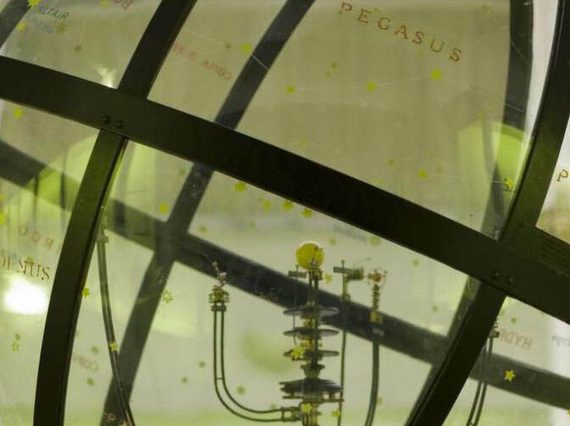
National Museums Scotland’s orrery is Copernican, showing eight planets of the solar system revolving around the sun. It is encased in a glass globe painted with the chief constellations. It was made before Pluto was discovered in 1930. Since Pluto was demoted to the status of ‘dwarf planet’ in 2006, the orrery is up-to-date again.
It would be impossible for the sizes and distances of the planets to be to scale, as the inner planets would be too small to see well if the outer ones fit in the gallery. Instead they are shown to a logarithmic scale. However, the rates at which the planets and their satellites rotate are proportional to the actual rates.
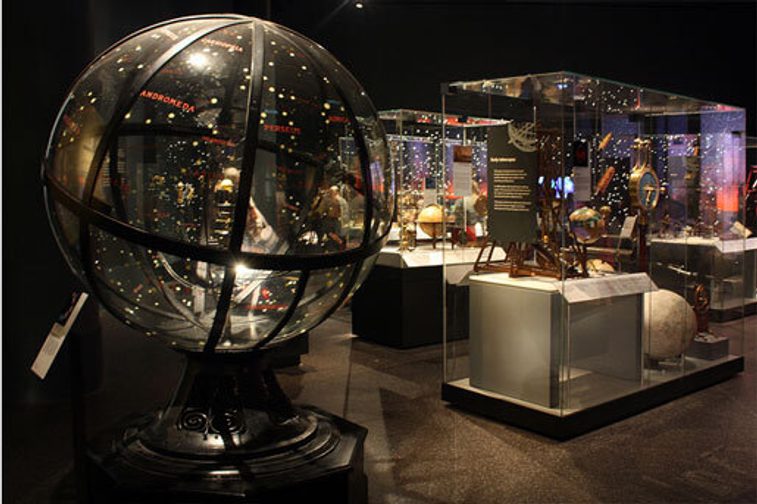
The Sendtner orrery in the Earth in Space gallery. (T.1913.297)
A testing brief
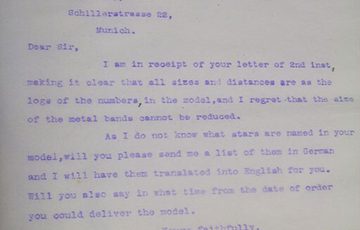
The production of the orrery was far from straightforward. A series of letters from Galt to Sendtner documents the increasingly frustrating process, which appeared to test the keeper’s ability to remain polite in the face of escalating incompetence.
We can only guess at the responses he received from Sendtner as these have not been retained. However, judging by Galt’s tone, they were far from satisfactory.
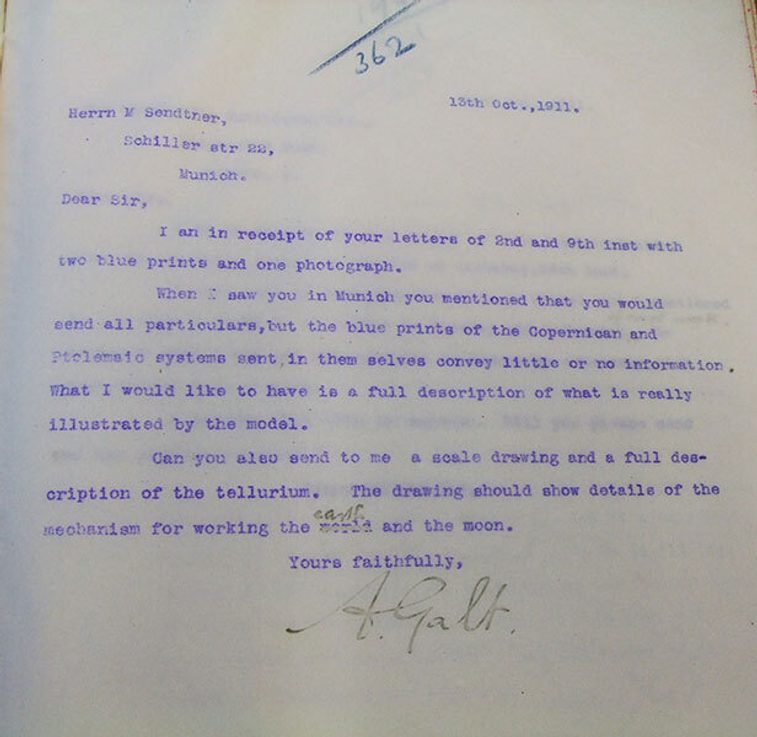
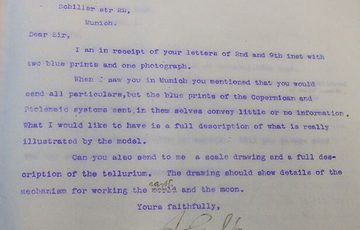
A letter addressed to Sendtner from Galt, dated 13 October 1911, asking for more precise information to be sent, including schematics and details of the moveable parts. The tellurium is the part of the model showing the Earth and Moon.
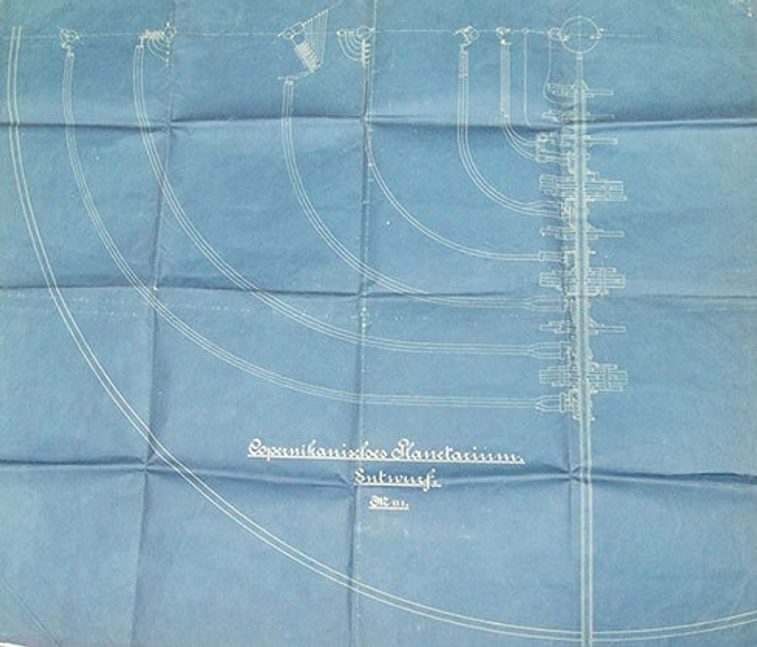
The original blueprint of the orrery design sent to Galt by Sendtner in 1911.
From the start, Galt quibbled over the technical specifications for the orrery, taking a year to finally proceed with his order.

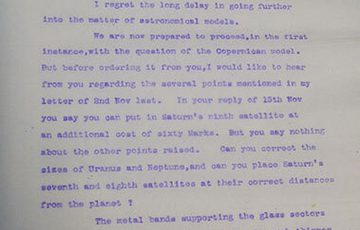
A letter sent from Galt to Sendtner dated 2nd November 1911, questioning the scale of the planets, missing moons and missing information he had asked for previously.
A frustrating build
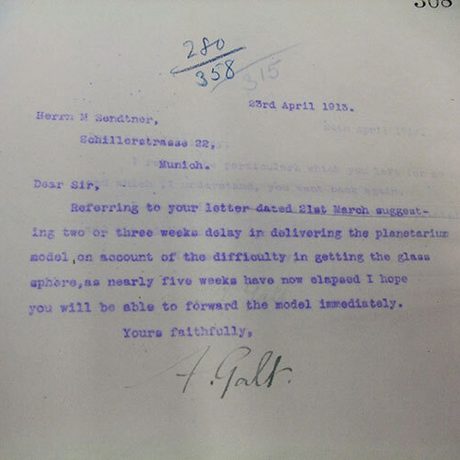
By March 1913, production of the orrery was running late. There were several letters from Galt asking Sendtner to update him on the production and delivery.
“Will you please say when it is to be despatched as three months have already elapsed?”
There had been some delay in the manufacture of the glass. It appears Sendtner was not forthcoming with the reasons until prompted. A month later, it still hadn’t arrived.
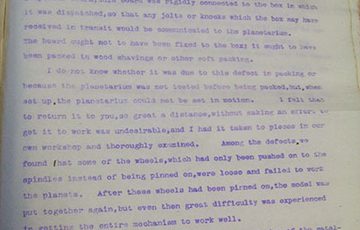
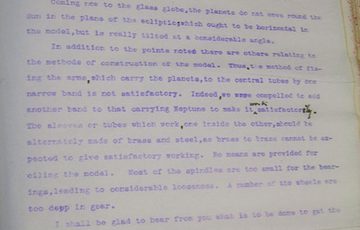
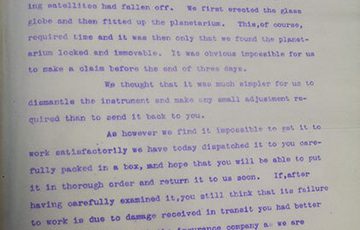
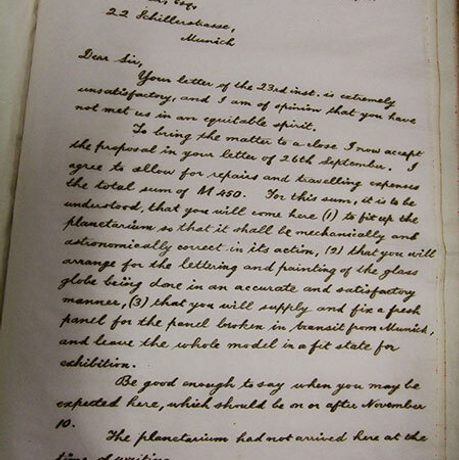
The next letter, dated 2 July 1913, relates a tale of woe. The orrery had arrived at the museum, but possibly due to careless packing, it had been damaged in transit. The museum's engineers had tried to get the model working with very little success, as there were some obvious mechanical errors.
...“could not be set in motion.” ... “The moon appears to revolve round the earth the wrong way” ... “Most of the spindles are too small for the bearings, leading to considerable looseness”.
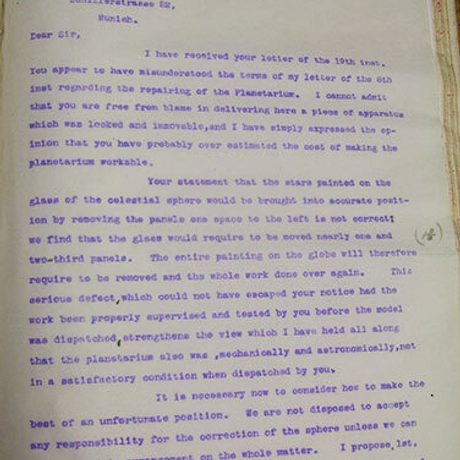
On 11 July, unable to fix the errors in-house, the orrery was returned to Sendtner, with further complaints about the inaccuracies and the painting on the globe.
...“the stars are in the right position relative to each other but that they are painted on the wrong sheets of glass.”
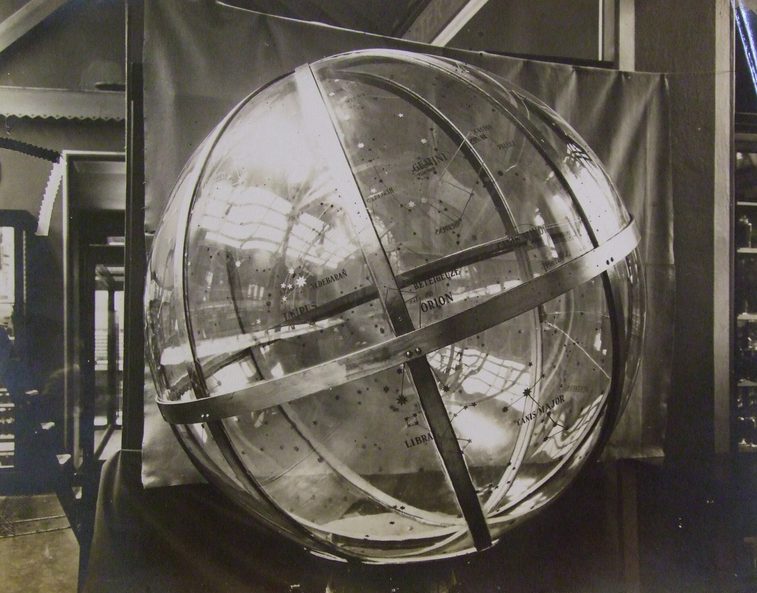
A photograph referenced in Galt’s letter of 8 Aug 1913, showing how the constellations all need to be moved over. There's also a spelling error in Gemini, Pullux for Pollux, whilst the constellation labelled Libra just below Orion is actually Lepus.
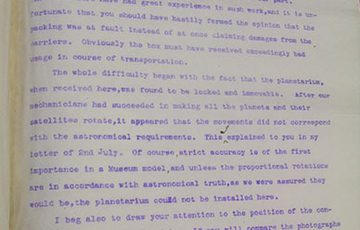
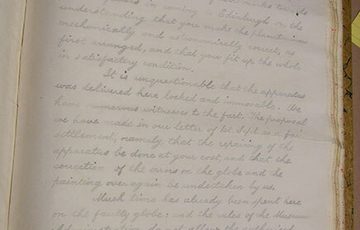
Worse was to come. The orrery was damaged on its return journey to Germany – not, Galt noted tartly, through any fault of his – and Sendtner’s quote to fix it was too high. There was extended quibbling about claiming transportation insurance. In addition, as Galt pointed out sternly, it still didn’t work and there were still inaccuracies.
...“in accordance with astronomical truth” ... “Strict accuracy is of the first importance in a Museum model,”
By the end of November 1913 , the orrery had been returned to Edinburgh, still missing some of the requested corrections. Galt asked plaintively for a remedy.
...“the constellations… still inaccurately placed.” ... “Will you please say what is to be done?”
In December things were no better, with Galt despairingly drawing a diagram to show how the stars should be placed.
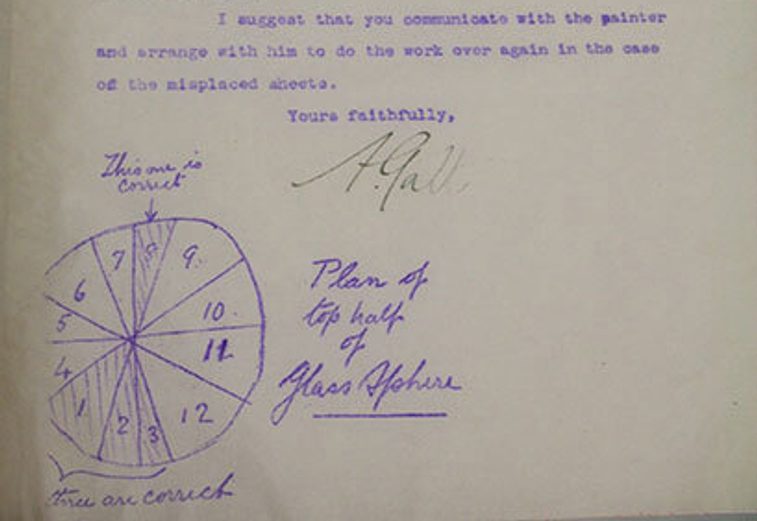
A letter from Galt to Sendtner dated 9th Dec 1913. Galt has to explain via a diagram, that Sendtner has placed some of the stars on the wrong glass panels.
Settled!
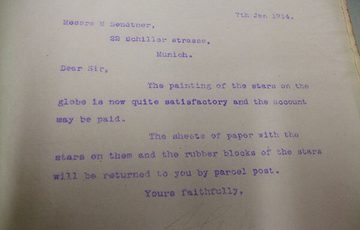
And then, on 7 January 1914, a miracle, the orrery was complete! Sendtner's painter had corrected the mistakes in-situ, and the orrery could be entered into the museum register.
“The painting of the stars is now quite satisfactory and the account may be paid.”
You can view the full collection of Galt's letters, in frustrated detail, at the bottom of this page.
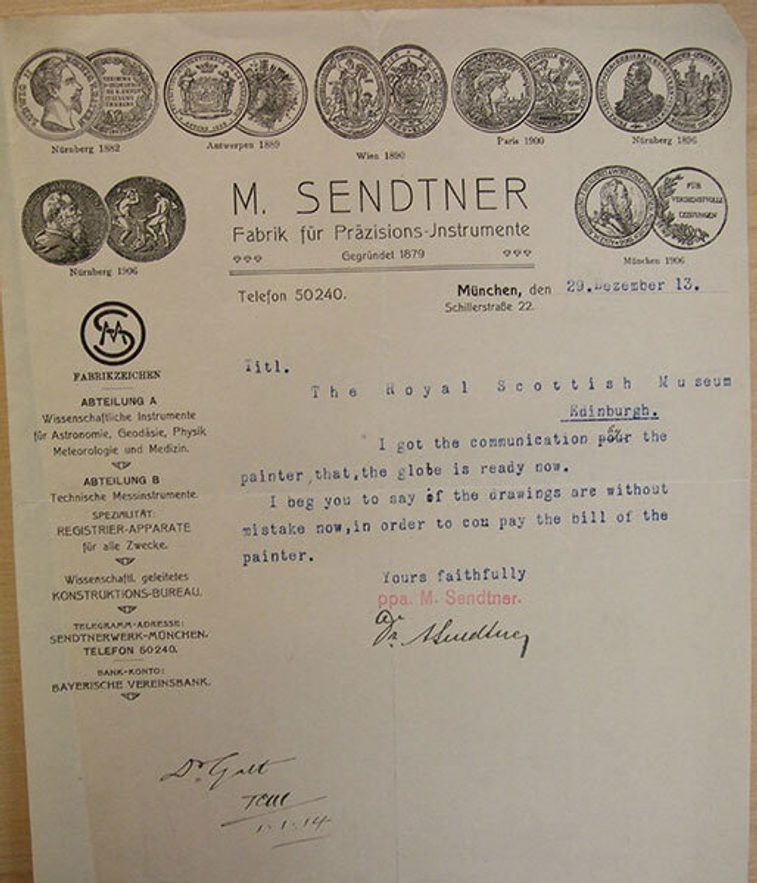
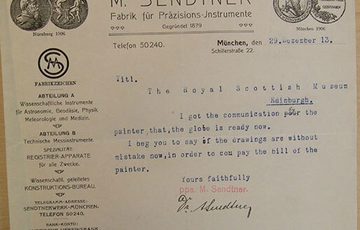
A letter from Sendtner to Galt dated 29th December 1913. Sendtner asks Galt to confirm that everything is satisfactory and chasing payment so that he can pay his painter.
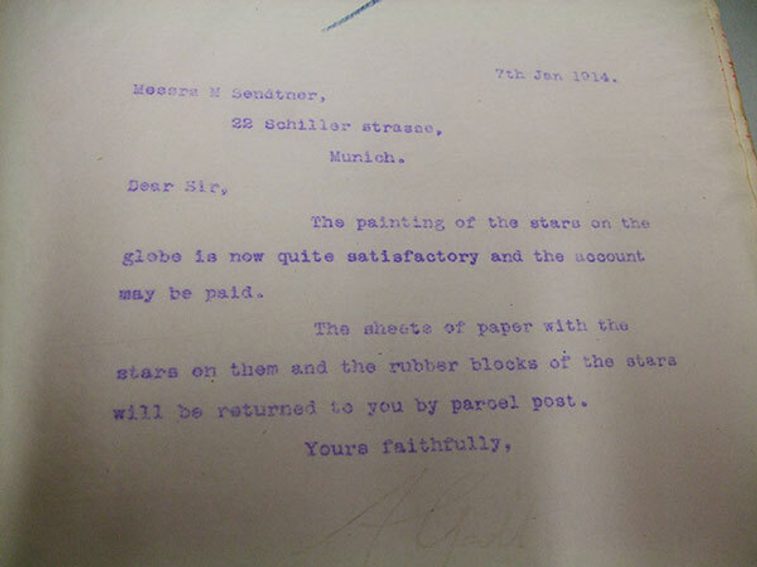
A letter from Galt to Sendtner dated 7th January 1914. Galt states that he is now satisfied with the painting of the stars and confirms that the account can be paid.

The handwritten museum accession register entry for the orrery. It describes the specifications and the omission of some of Jupiter's moons.
Stuck in time and space
Sadly, despite Galt’s best efforts, the orrery remained prone to sticking and experienced considerable wear over decades of use. During the twentieth century, it underwent at least two major overhauls. In 2001, it was completely dismantled, cleaned, and all 500 of its parts were treated. At that stage, the Conservation team decided it was no longer in the orrery’s best interests to replace any further components and that it would be safer to preserve it as a static object.
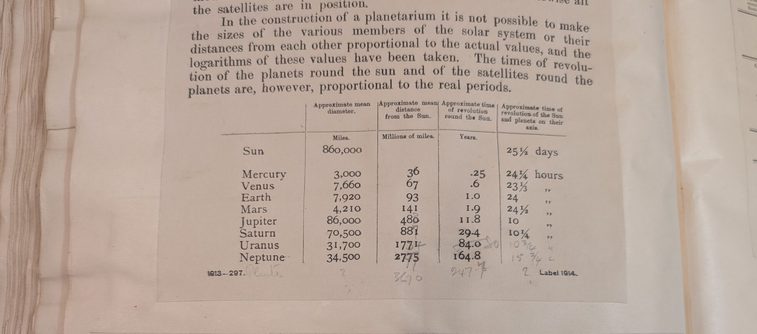
Record copy of the original museum label for the orrery. Pluto has been pencilled in at the bottom of the label.
A hundred years after its creation, it takes pride of place in the Earth in Space gallery at the National Museum of Scotland. The orrery still inspires us to visualise the vastness of space and the movements of the solar system, its perfectly aligned planets remaining testament to the persistence of Dr Alexander Galt!
The full collection of Galt's letters
Here are all of Galt’s letters from 1911 to 1914, displaying ever-increasing mechanical and logistical frustrations, followed by a final response from Sendtner asking for the painter's bill to be settled. They are a fascinating look at early twentieth century museum correspondence just before World War One.







Written by
Dr Tacye Phillipson
Senior Curator of Science
You might also like
A 19th century guide to constellations
Art and design, Natural world, Science and technology
Written by Dr Rebekah HiggittHow well do you know your stars? Learn how to identify constellations like an aspiring astronomer in the 1800s with help from Urania’s Mirror.
Uncovering the history of a thermodynamic model by James Clerk Maxwell
Science and technology, Scotland
Edinburgh born physicist James Clerk Maxwell created this 3D model to represent the behaviour of an imaginary substance showing its solid, liquid, and gas states.
Sheila Scott: The first British pilot to fly around the world
Science and technology
In 1966 Sheila Scott became the first British pilot to fly around the world. In May and June 1966 Sheila Scott flew solo around the world in a Piper PA-24-260B Comanche, registration G-ATOY, named 'Myth Too'. This was the first solo round…