Tractors at the National Museum of Rural Life
News Story
There are a variety of tractors from most decades of the 20th century inside and out at the National Museum of Rural Life. Read on to discover seven tractors in our collection
A little history and background
Mechanised agricultural machinery slowly came into use in the 19th century, although horses were used to work the fields on farms right up until the middle of the 20th century.
The first steam powered farm implements in the early 19th century were portable engines. The first half of the 1860s was a period of great experimentation and by the end of the decade, the standard form of traction engine had been established and was widely adopted for agricultural use. This would change little over the next sixty years.
In 1892, John Froelich invented and built the first petrol powered tractor in the US. The first recorded use of the word 'tractor' was in 1896, derived from the earlier term 'traction motor'. The first commercially successful tractor built in Britain was made by Dan Albone in Bedfordshire in 1902.
It wasn't until after the First World War that demand really took off. During the Second World War, there was an urgent increase in demand for homegrown food and that meant more agricultural machinery for food production.
From the early 20th century, the tractor helped to transform farm life in Scotland. By the late 1950s the horse became a rarity on farms and the tractor became the 'workhorse'.

Photo of Jean Forbes Paterson, Women's Land Army member, seated (far left) on a Fordson tractor with another WLA member, a man and a schoolboy, Perthshire, c. 1946.
1. Glasgow Tractor
This Glasgow tractor is one of the earliest tractors in the collection . It was produced by John Wallace & Sons, Agricultural Engineers and Implement Makers. The Glasgow tractor was manufactured between 1919 and 1924 and at the time was Scotland’s only indigenous tractor.
Between 1920 and 1925, the US tractor market competed for sales in Britain, as Henry Ford introduced the Fordson tractor. The Glasgow tractor was more expensive to buy and maintain than its competitors and John Wallace & Sons found themselves no match for the might of the US manufacturers.
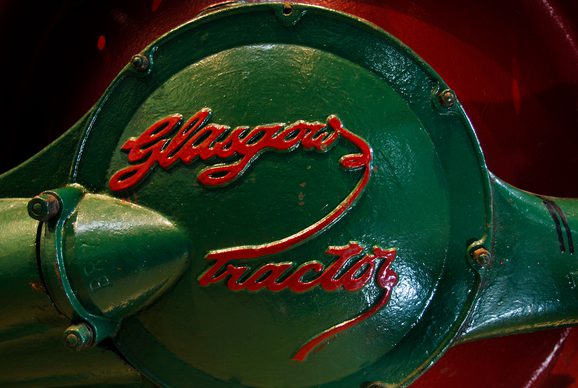
A close up of the Glasgow tractor logo plate on display at the National Museum of Rural Life
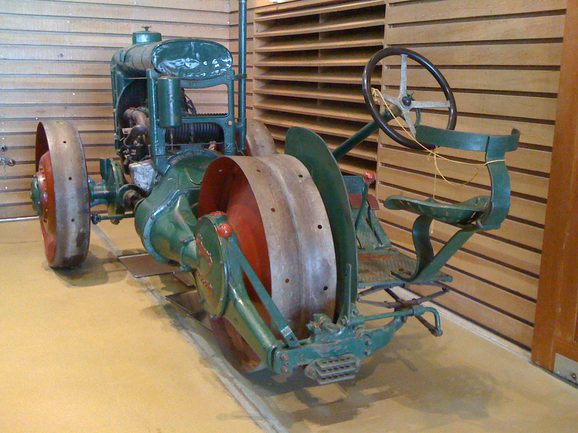
The Glasgow tractor on display inside at the National Museum for Rural Life. Height 1.9m, length 3.4m, width 1.7m Museum reference W.1992.38.
2. Fordson Standard F Series, DSP 920
The Fordson was the first lightweight, mass-produced tractor. Its simple design proved to be commercially successful. For the first time this made it possible for the average farmer to own a tractor.
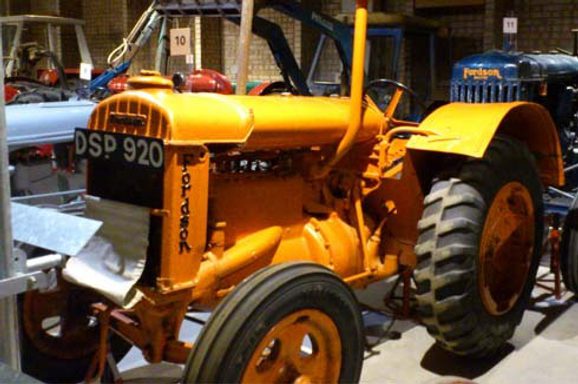
Fordson Standard F Series tractor, DSP 920 on display at the National Museum of Rural Life. Height 1.7m, length 2.9m, width 1.6m, Museum reference W.1999.180.
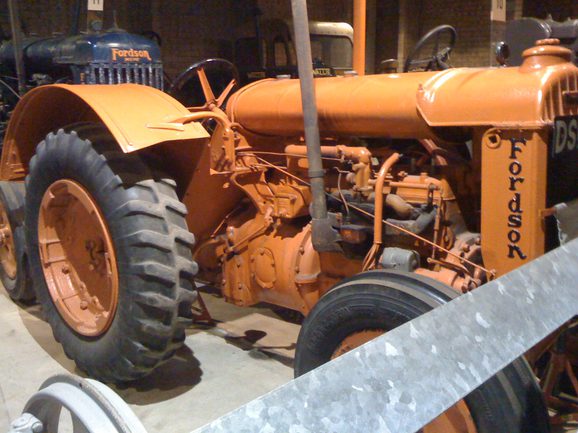
Fordson Standard F Series, DSP 920 on display at the National Museum of Rural Life. Height 1.7m, length 2.9m, width 1.6m. Museum reference W.1999.180.
3. Ferguson Brown
This was the first production tractor with three-point linkage, to attach implements such as a plough. The Ferguson Brown also came with the hydraulic lift system designed by Harry Ferguson. Approximately 1,350 of these machines were produced between 1936 and 1939. After this, Harry Ferguson joined Henry Ford to produce the Ford Ferguson
4. Ford Ferguson
This is an example of the first commercially successful tractor from the 1940s, built with Harry Ferguson’s hydraulic system.

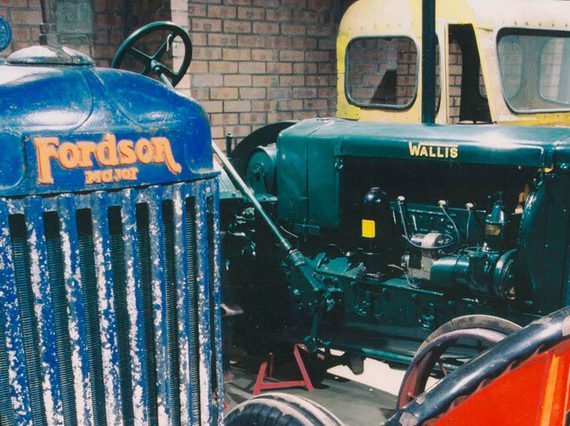
Tractors on display at the National Museum of Rural Life including a Fordson, a Wallis and a Ford Ferguson
5. David Brown Sectioned Cropmaster
This example was manufactured by David Brown as a promotional tool and restored in 2003 by Rolls Royce apprentices. The tractor proved an extremely popular model which, was widely used on small and medium-sized farms.
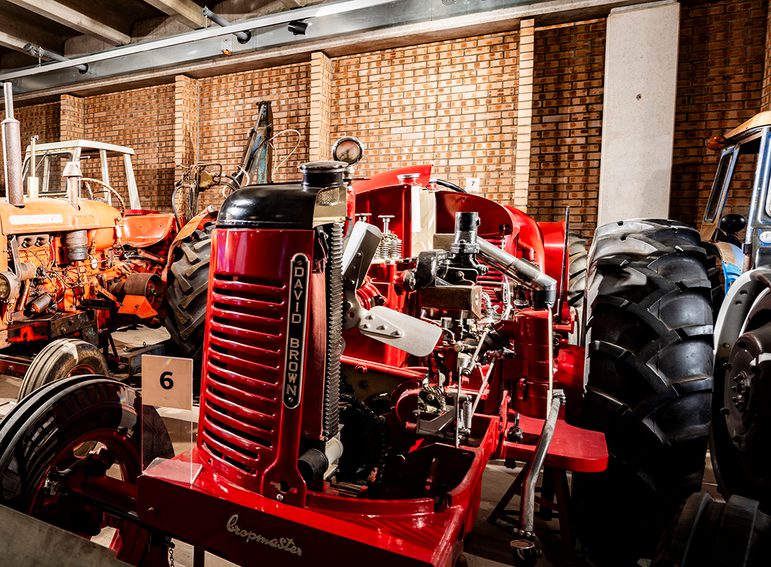
David Brown Sectioned Cropmaster on display at the National Museum of Rural Life. Height 1.4m, length 3.3m, width 1.7m. Museum reference W.1999.184.
6. Field Marshall Tractor Series 1
Field Marshall series 1's were in production from 1945 until 1947. The starting the engine involves lighting a wick containing saltpeter which is inserted into the cylinder at the front of the tractor. The engine is turned over with a starting handle then a shot-gun cartridge is loaded into a breach on the engine's intake system on the side of the tractor. The cartridge is fired by tapping the base of the protruding firing pin with a hammer, kicking the engine into life.
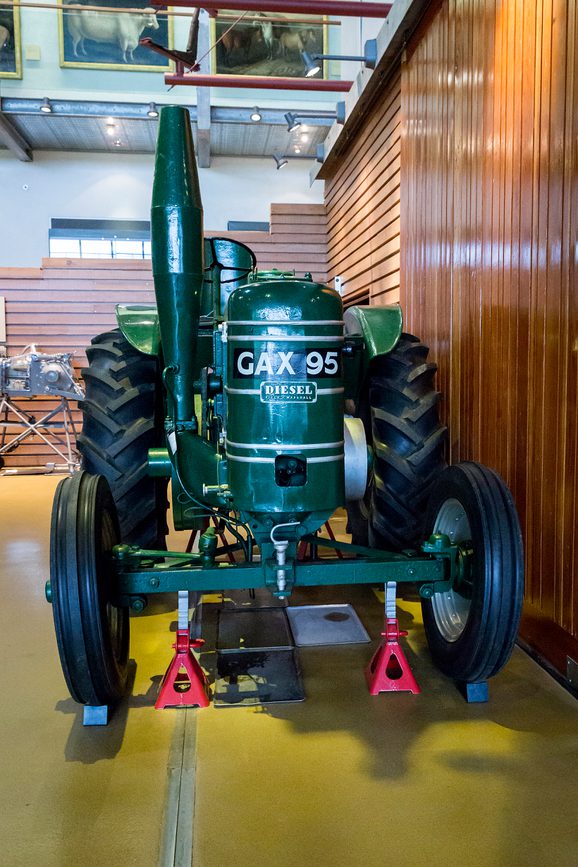
Field Marshall Tractor Series 1 on display at the National Museum of Rural Life
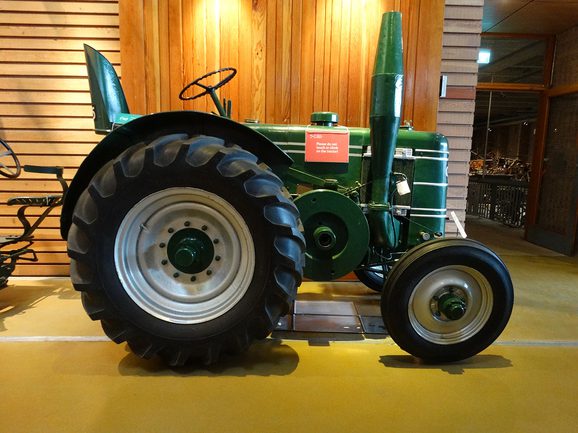
Field Marshall Tractor series 1 on display at the National Museum of Rural Life. Height 2.1m, length 3.m, width 1.8m. Museum reference: W.2013.3.1.
7. TE20 Ferguson SY 8626
Designed by Harry Ferguson and manufactured from 1946 until 1956, this tractor was commonly known as the Little Grey Fergie. It is lightweight but effective, with a petrol/paraffin engine and hydraulic front lift. This tractor is often credited as the machine which replaced the horse on Scottish farms.
You can sit on a TE20 in the Picnic Field opposite the main museum building at National Museum of Rural Life.
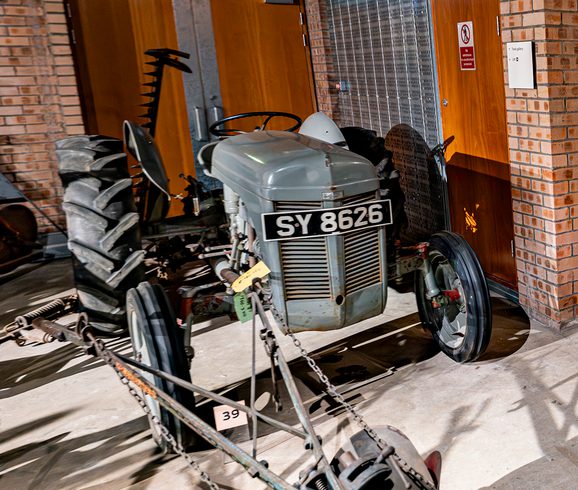
TE20 Ferguson
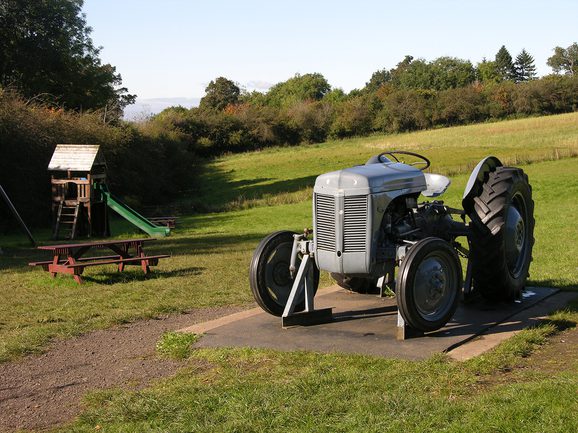
TE20 Ferguson in the Picnic Field at the National Museum of Rural Life
You might also like

'I am yours': 11 Scottish posy rings
History and cultures, Scotland
Written by Dr Georgia VullinghsPosy rings are some of the most evocative objects of love in National Museums Scotland's collections. These finger rings are named for the short inscriptions engraved on the inside of their band.
A tale of 3 sticks and their stories about rural Scotland
Scotland
Written by Oliver TaylorWhat connects three ordinary looking sticks at the National Museum of Rural Life?At first glance, you may disregard one, or even all of them. However, their unassuming nature hides their significance. A poacher's fishing rod
Souvenirs of service: Mementoes from the First and Second World Wars
Scotland
Written by Dr Julie HolderWe all collect souvenirs throughout our lives connected to different people, places and events. These objects were collected as souvenirs of service in both the First and Second World Wars.