Safety guidelines and risk assessment
These notes are provided to help educators and group leaders complete their general risk assessment.
Supervision
We ask that pupils visiting in school groups are accompanied at all times during their visit at a ratio of:
- 1 adult: 5 pupils (under the age of 5)
- 1 adult: 10 pupils (Primary)
- 1 adult: 15 pupils (Secondary).
Where pupils require support on a 1:1 ratio, this adult should be included over and above these ratios.
Before your visit
It is strongly recommended that all educators and group leaders visit the museum and carry out their own risk assessment before bringing a group here.
It is essential that all members of your group understand:
- The aims and objectives of the visit
- How to avoid specific dangers and why they should follow rules
- Why safety precautions are in place and what standard of behaviour is expected
- Who is responsible for the group
- What to do if approached by anyone from outside the group
- What to do if separated from the group.
Hazards and risks
Uneven ground and flooring
Risk:
- Tripping and accidental injury
Controls in place:
- Areas of higher risk have been barriered and/or marked with hazard tape as appropriate
Controls recommended:
- Learners should walk, and not run, anywhere on the site
- Fences and barriers should not be climbed or crossed
- Care should be taken when walking on paths/road and grass and any loose gravel
- Much of the site is outdoors, so there are uneven roads/paths and uneven grass, and care should always be taken.
Aircraft on display
Risk:
- Climbing and falling
- Banging heads on low wings.
Controls in place:
- Safety barriers in place
Controls recommended:
- Adult supervision where there is direct access e.g., Comet and Jetstream
- Briefing students before they enter spaces to be careful.
Vehicles
Risk:
- Being hit by a vehicle
Controls in place:
- 10mph speed limit on site
Controls recommended:
- Visitors should take the same precautions crossing any road on site as they would in a public place
- If walking on roads in “convoy” an adult marshal should lead and another follow up the rear to ensure children do not wander
- Visitors should walk at edge of road to keep out of direct traffic routes. Use marked path in front of main car parking area along grass.
- Group leaders should be aware that the site is used by buses.
Deep water in Emergency Water Supply Tank
Risk:
- Falling and drowning
Controls in place:
- The area is fenced and the gate locked at all times
- Warning signage is in place
- Lifebelt is also in place.
Use of stairs
Controls in place:
- Handrails
- Marked nosings.
Controls recommended:
- Care should be taken at all times when ascending and descending stairs
- Children should always hold onto the handrail.
Use of interactives
Controls in place:
- All interactives are designed to be safe if used in an appropriate manner
- Visitors are excluded from moving parts etc for safety purposes.
Controls recommended:
- When using interactives children should be supervised to ensure they are used in an appropriate fashion and what they were designed for
- Do not allow throwing of loose objects
- Do not throw paper planes at another person and stay behind the launcher when in use
- Appropriate numbers of children should use an interactive at any given time (most are 1 to 1).
Use of Assault Course
Risk:
- Falling from equipment
Controls in place:
- Wide fall areas filled with cushioning bark are employed to break falls if they occur
Controls recommended:
- Ensure that children are always supervised
- Ensure equipment is used appropriately, especially the zip wire.
Slips, trips, and falls
Controls in place:
- Floors to be kept clear
- No unsecured trailing wires.
Controls recommended:
- Young people’s coats and bags should be stored
Toxic substances
Controls in place:
- Supplies only sourced from educational suppliers
- Any hazardous substances are only used with appropriately aged learners
- Handling objects are regularly and thoroughly checked.
Choking on small objects
Controls in place:
- Any small objects only used with appropriately aged learners
- Handling objects are regularly and thoroughly checked.
Sharp objects
Controls in place:
- Scissors only used with appropriately aged learners
- Handling objects regularly and thoroughly checked.
Flying models such as paper aeroplanes
Risk:
- Getting hit with paper aeroplane
Controls in place:
- Flying models only made from soft and light materials such as paper and foam
- Models flown into an area clear of people.
Controls recommended:
- Young people should not be allowed to fly their models anywhere but in the designated flying areas
Passing on of viral or bacterial infection
Controls in place:
- Hand sanitiser always available
- Toilets with soap and water always available to wash, especially before eating.
Controls recommended:
- Group leaders to determine if child is fit enough to come to the Museum prior to departure
First aid
First aiders are always on site and we also have a fully automatic defibrillator.
Any questions?
If you have any questions about our risk assessment, please get in touch.
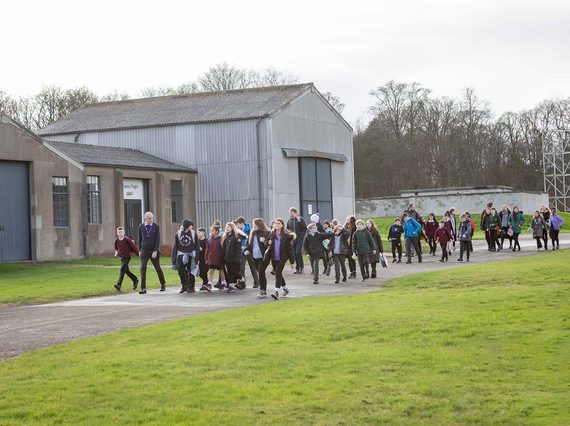
Schools visits at National Museum of Flight