Safety guidelines and risk assessment
Please read this information before your visit and share with group leaders and adult helpers.
Supervision
Children under the age of 16 must be supervised at all times during their visit and remain the responsibility of the teacher/group leader/adult helper.
We suggest a ratio of:
- 1 adult: 5 pupils (Nursery)
- 1 adult: 10 pupils (Primary)
- 1 adult: 15 pupils (Secondary).
Where pupils require support on a 1:1 ratio, this adult should be included over and above these ratios.
Group size
We recommend splitting your class into small groups whilst exploring our site.
Before your visit
It is essential that all members of your group understand:
- The aims and objectives of the visit
- How to avoid specific dangers and why they should follow rules
- Why safety precautions are in place and what standard of behaviour is expected
- Who is responsible for the group
- What to do if approached by anyone from outside the group
- What to do if separated from the group.
During your visit
Fire alarm
The Museum has clear evacuation procedures. In the event of a fire alarm, a member of staff will direct you outside/to the nearest assembly point.
If the fire alarm goes off in the museum, school groups must meet at the fire muster point at the playpark beside the museum.
If the fire alarm goes off at the farm, school groups must meet at the fire muster point at the bus shelter.
School leaders should have a list of all pupils with them to check the full group is at the muster point.
You are responsible for keeping your group together.
First aid
First aiders are always on site. They can be summoned via radio by any member of museum staff. We also have a designated first aid room.
We have a fully automatic defibrillator on site.
We are within a short distance of major hospitals.
Getting lost
It is helpful to agree a meeting point for your group in case your group is split up. Museum staff will assist with lost children.
Hazards and risks
Coach parking
Coaches and buses should not use the turning circle in front of the museum building. This is not designed for the size and weight of coaches.
Instead, there is a designated drop-off point for school groups at the top of the visitor car park.
After dropping, coaches can be parked in the coach park opposite the entrance from the roundabout.
On collection of pupils, coaches should again move to the dropoff point at the top of the car park.
Walk from car park to the museum
Children can walk from the car park to the museum via the designated footpath.
This walk to the museum involves crossing a public road. Children should be supervised at all times during the walk to the museum.
Outdoor environments and weather
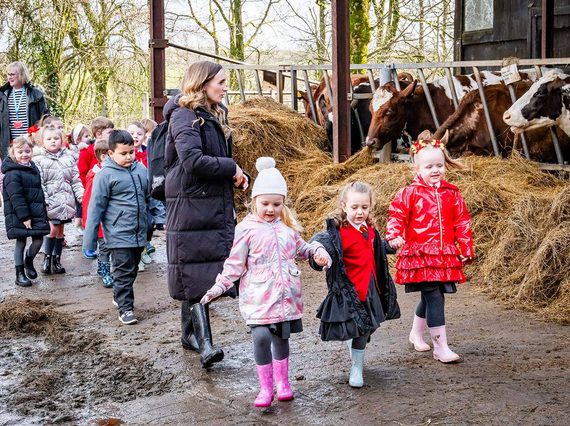
Schools should be prepared for their visit to be partly outdoors and be prepared for any weather. Suitable outdoor clothing and shoes should be worn by the group.
Uneven ground and flooring
The National Museum of Rural Life is a working museum and farm. This means that flooring and terrain can be uneven in places.
Please ensure that learners:
- Walk and do not run anywhere on the site
- Do not climb or cross fences and barriers
- Do not climb over gates
- Close gates behind them.
If a gate has a warning notice, eg ‘no entry at this time’, you should wait behind the gate until a member of the team advises that it is safe. They will open the gate for you.
For individuals with mobility concerns the Farm Explorer trailer can provide transportation to the farm and back to the museum.
Public roads by the museum
The road by the museum is a public road and vehicles may be travelling at speed.
The following controls are in place:
- Road markings and signage are in place at courtyard gates and along the footpath. They advise when a public road is ahead.
- Heavy vehicle signage is present on the footpath
- Tractors signage is present at the farm steading.
During your visit, we recommend:
- Visitors take the same precautions crossing any road on site as they would in a public place
- Learners be careful when crossing both roads on the way to the farm
- Look left and right when crossing
- Staff supervise learners as they cross the road.
Farm Explorer tractor trailer ride
Groups can take the Farm Explorer tractor trailer between the museum and the farm.
The maximum group size per journey is 18.
A safety briefing is delivered by museum staff before the tractor trailer sets off. Visitors are supervised when getting on and off the tractor trailer.
We ask that:
- All members of the group listen carefully to the safety briefing and follow instructions
- Visitors remain seated at all times on the journey
- Visitors don’t rest their heads against windows in the tractor trailer
- No one eats or drinks onboard the Farm Explorer.
Spread of disease from touching animals
Diseases can be spread by touching farm animals.
We recommend that visitors:
- Do not touch or feed animals
- Do not eat or drink on the farm
- Wash their hands before leaving the farm.
Use of interactive displays
All interactives are designed to be safe if used in an appropriate manner. Visitors are excluded from moving parts for safety purposes.
We recommend that:
- Children are supervised when using interactives to ensure they are used in the way they were designed for
- Children do not throw loose objects
- Appropriate numbers of children use an interactive at any given time.
Butter Making and Ice Cream Making workshops
Food allergies
Museum staff are trained in food hygiene.
Schools should alert the museum in advance about pupils with allergies. These pupils can be given alternative foodstuffs.
Any questions?
If you have any questions about our risk assessment, please get in touch.
Schools visits at National Museums of Rural Life