Insect response to environmental perturbation during the end Triassic mass extinction
Dr Richard S. Kelly successfully defended his thesis in 2019 after 4 years as a PhD student at the University of Bristol and co-supervised by National Museums Scotland.
Last updated: 3 February 2022
About the research
The end Triassic mass extinction (eTme) was a time of extreme biotic turnover related to high levels of perturbation to the Earth system caused by massive volcanic eruptions of the Central Atlantic Magmatic Province. All major groups of marine and terrestrial plants and animals were affected with estimates of more than 50% loss of genera. Previous studies of insect occurrence however have found little evidence of a major insect extinction. The main aim of this project was to document insect survival across the end Triassic mass extinction to better understand its effects on insects.
Relevantly aged entomofaunas exist from several regions globally. The UK has arguably the most useful collection for understanding the eTme with several thousand specimens distributed through relatively well understood stratigraphy around the Triassic-Jurassic boundary. For the purpose of this study and for the benefit of future researchers, this material was stratigraphically and taxonomically revised to current standards before being analysed for changes across the eTme.
- Project title
Insect response to environmental perturbation during the end Triassic mass extinction
- Student
Dr Richard S. Kelly
- Project active
2015 - 2019
- Funder
- University Supervisors
Prof Mike Benton - School of Earth Sciences
- National Museums Scotland Supervisor
- Research theme
Sustainability
Project contact
Dr Andrew Ross
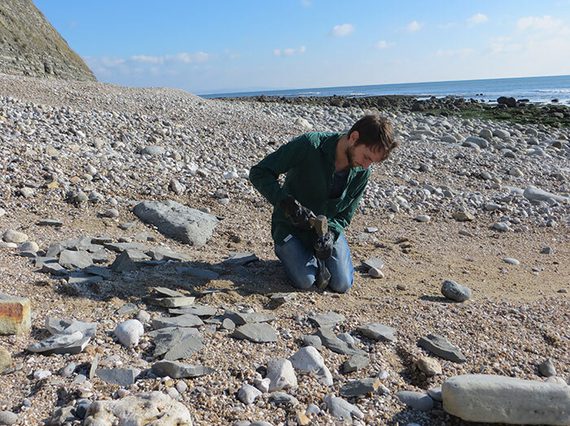
Lead image: Richard Kelly undertaking fieldwork.
Natural Sciences news and stories

Scotland in the time of Giants
Natural world, Scotland
Written by Dr Sarah StewartFollowing the extinction of dinosaurs and other animals such as marine reptiles 66 million years ago, smaller surviving animals evolved, and some became giants.
The Roaring Game: Scotland's curling stone island
Natural world
Written by Dr Bob GoodayDid you know that all curling stones are quarried on a small, uninhabited island in the Firth of Clyde called Ailsa Craig?
6 world-class type specimens in our stores
Natural world
Written by Professor Andrew Kitchener, Dr Rachel Walcott & Dr Andrew RossType specimens are among the most important objects in natural science collections. They are the specimens on which the scientific names of species of animals, plants or minerals are based. Animals and plants are named using the Linnaean…