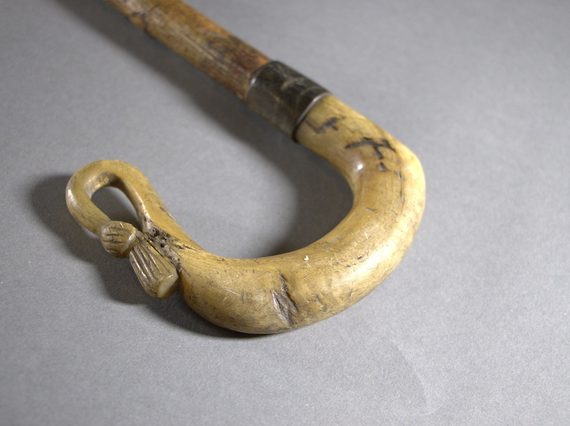
A tale of 3 sticks and their stories about rural Scotland
What connects three ordinary looking sticks at the National Museum of Rural Life?
At first glance, you may disregard one, or even all of them. However, their unassuming nature hides their significance.
A poacher's fishing rod
Deep in Galloway during the mid-nineteenth century, an ordinary gentleman walked along the riverbank. In one hand he carried a bamboo walking stick with a short handle. There is nothing extraordinary about this scene, which is exactly the impression the gentleman wanted to portray. In reality, he had recently been up to no good. Hidden inside the walking stick was a secret fishing rod.
Ever since restrictions on access were put on rivers, people have gone out of their way to disregard them. This may be because of a necessity to catch fish to supplement a poor diet, to sell fish caught for some much needed money to support a family, or even for sport. In all cases, a level of ingenuity has kept pace with the efforts of those tasked with keeping watch over Scotland’s rivers. One device that was at the forefront of poaching technology in the nineteenth century was this poacher’s fishing rod from Galloway.
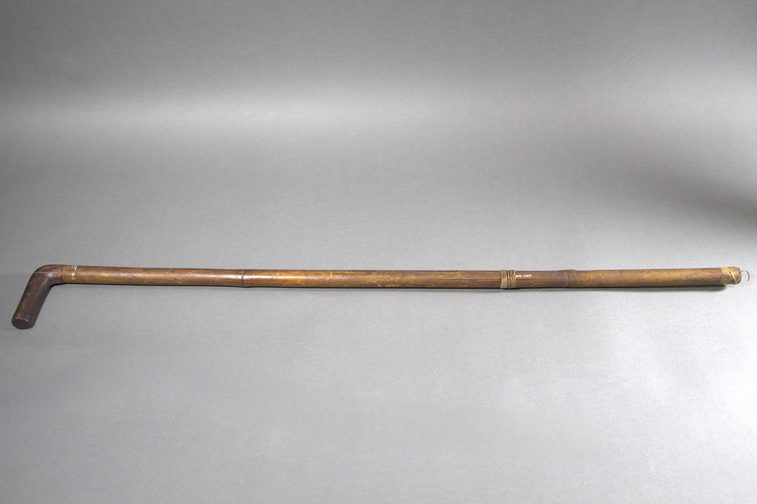
Poacher's fishing rod. Museum reference W.PT 40.
At a modest 87 cm, as a walking stick it would lend itself to an afternoon stroll along a riverbank. But, at a moment’s notice, it could become an impressive 264 cm fishing rod. The rod is telescopic and is formed of four pieces of bamboo. Towards the handle there is a small hole where a line could be inserted and fed through to a hole at the bottom of the stick. A piece of cork would have hidden the inner workings of the rod when it was pretending to be a walking stick, and once the cork is removed the walking stick transforms.
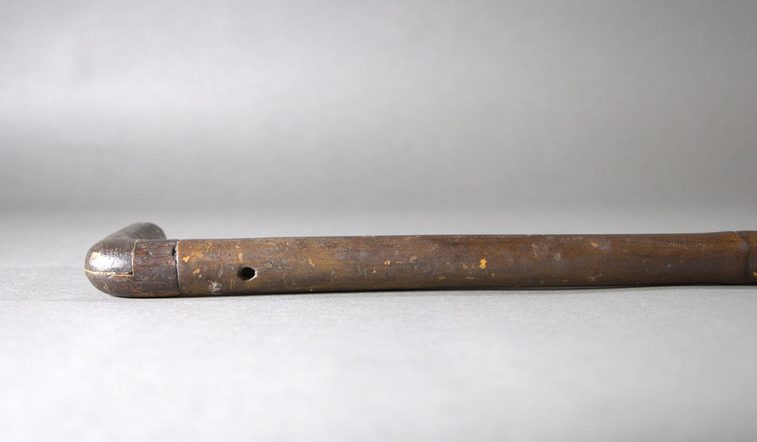
The hole for the fishing line. Museum reference W.PT.40.
Unlike other fishing rods of the period, this example wasn’t designed to be flaunted in front of other admiring sports people. It was intended to be left poking out from a bush along the riverbank, its line waiting expectantly over a promising pool. The poacher would have kept an eye on it from a safe distance, and at the first sign of trouble it could be effortlessly returned to a plain walking stick.
Poaching was a part of the Scottish economy as well as a pastime, and tales of poachers besting those charged with managing and caring for rivers were widely recanted. Perhaps the most famous story is ‘John McNab’, by John Buchan. Published in 1925, it’s the story of three wealthy friends’ bid to reacquire a zest for life by trespassing in the Highlands of Scotland to catch a prize salmon (or stag), or risk a forfeit. Buchan was inspired by the true story of Captain James Brander, who took a stag from his friend Lord Abinger’s land.
There was also the story widely published in 1858 of a man who disguised himself to look like a gentleman, to poach on an estate that belonged to an absent laird. The man had a successful morning of shooting before coming across a gamekeeper. He calmly explained to the gamekeeper that he had been looking for him all day,and would he be so kind as to show him the road? The gamekeeper thought nothing of it and even carried the poacher’s bags.
The idea of a walking stick leading a double life as a fishing rod isn’t unique. In 1881, two men in Peebles were sentenced to three days imprisonment and were found to have on them, ‘a walking stick or a cleek (a cleek is a large hook used to poach fish) and which, when necessary, could be folded up and put in the pocket’.
During the nineteenth century there was a craze for walking sticks that weren’t as they seemed. In 1881, the Fifeshire Advertiser published an article entitled ‘stick gossip’ detailing the lengths ‘stick fanciers’ went to disguise their stick’s true purpose. The article reported on one walking pole that could be transformed into a telescope, a microscope, a reading-glass, and if used in sunnier weather, even a cigar lighter.
A shepherd's crook
Unlike the poaching stick, this traditional shepherd’s crook isn’t masquerading as something else. However, it was designed to be an efficient and elegant multi-purpose tool.
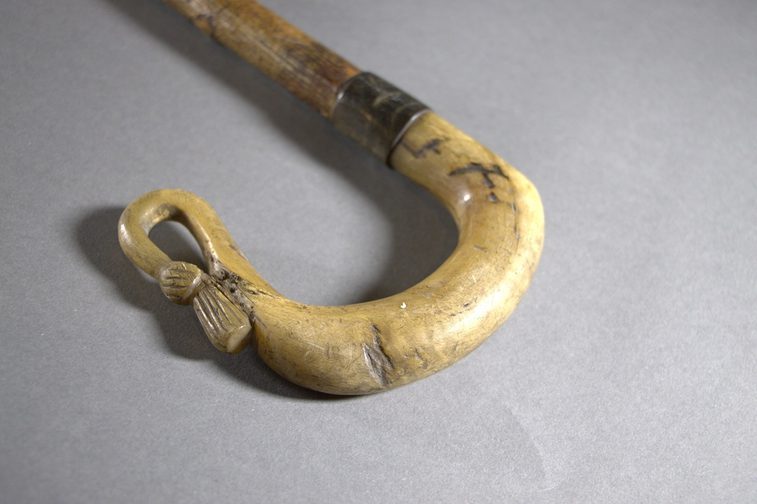
The carved handle of a Shepherd's crook. Museum reference W.PL 13.
This crook was made by, and once belonged to, Argyll shepherd John Ferguson between 1836 and 1846. Traditionally, crooks were made by the shepherds to while away the time on long dark evenings watching over sheep.
Crook making is a recognised heritage craft. Crooks are notoriously tricky to make, requiring a healthy dose of patience and dexterity. This crook has been carved with the emblematic flower of Scotland, a thistle, which reinforces this idea that there was pride in making them well. A crook, such as this one, could take up to two years to make, as the horn and the shank can take that long to dry, and then be worked into their desired shape. The shank of the crook can only be made between October and January, as otherwise, the bark of the stick shrivels up and makes the shank unusable. The horn is worked into the right shape with careful application of heat, pressure and delicate carving. The crook would be varnished with a 'secret' concoction devised by the maker. Importantly, a crook must be wide enough to catch a sheep around the neck or leg without hurting the animal.
Crooks have long been prized, so much so that they are often given as awards at agricultural shows, and there are competitions for the best crook. These crooks are largely ornamental, but day-to-day shepherds likely used a more practical stick to assist them on tussocky terrain.
A cattle rod
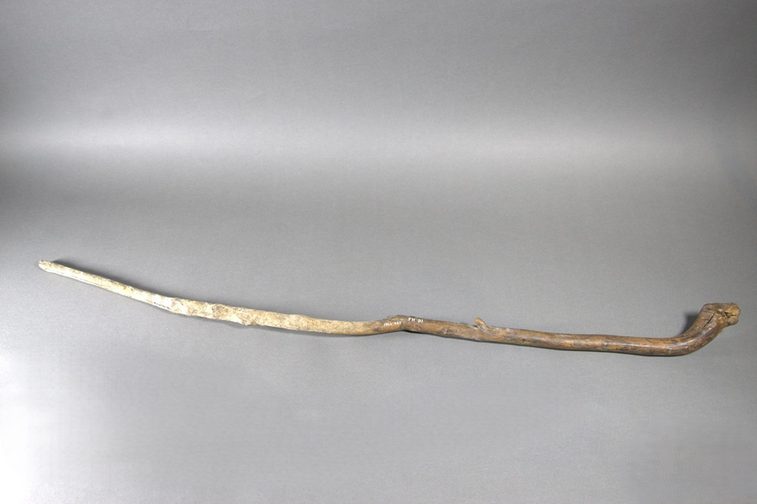
A cattle rod. Museum reference W.PH 31.
Our final stick is a perfect example of a tool chosen for its practicality over its style.
This stick isn’t disguised like the fishing rod, and it hasn’t been manipulated into shape like the shepherd’s crook. It was chosen and cherished because it served a purpose. What sets it apart from any ordinary stick is its well-worn handle, which is evidence of its importance to the user's daily work. This stick was used by a cattle farmer, or perhaps a cattle drover, to guide cattle from the Scottish Highlands to markets in the south.
Until the modern period the cattle trade was so crucial to the Scottish economy that it was a key part of the negotiations of the Act of Union of 1707. By the nineteenth century, the trade surged as Britain industrialised. In 1800 England received most of Scotland’s cattle, estimated to have been as many as 100,000 animals.
Before the advent of the railway, these cattle were 'drove' across the country. There could be anywhere between one hundred and several thousands of animals in a drove that would stretch several miles. Unsurprisingly, moving large numbers of beasts by foot altered the landscape. In some areas, such as the southern uplands, ‘streams’ (parallel tracks) were created when cattle were driven across the landscape in lines twenty to thirty metres across. These tracks etched the landscape for decades after the trade had ended. These cattle travelled great distances along established drove roads. Many of these drove roads had long-been well-used routes for people and goods. Examples are the Larig Ghru in the Cairmgorms, the Monega Pass and the Bealach Na Bà on the Applecross peninsula. The drove roads criss-crossed the landscape and largely terminated at a ‘tryst’ or cattle market where the cattle would be sold.
The largest tryst in Scotland was in Falkirk. At their height, Falkirk Trysts hosted as many as 150,000 cattle, sheep and horses. The trysts were supported by a large, tented village that boasted banks, taverns and shops. They were filled with diversions to occupy spectators and drovers, like piping competitions.
The drovers were renowned for their toughness, expertise in animal husbandry, and as entertainers. There are several songs and poems composed by famous drovers that describe their way of life, the landscapes and people they encountered along the way. One of these is ‘Facail an Òrain’ (The Drover’s Song) by Murdo Ruadh nam Bò (Murdo MacKenzie) from Loch Broom in 1831.
The Highlands, from which drovers such as Murdo Ruadh nam Bò hailed, was suited to cattle husbandry and communities there depended on it. The favoured breed were black Highland cattle. They were capable of walking great distances, and could cope with rougher Highland grazing, thanks to their smaller stature. However, a range of interrelated changes in Scotland’s rural economy led to the decline and then ultimately the end of cattle droving. Towards the end of the nineteenth century, droving was largely a thing of the past. In their place the steamship took beasts to markets and eventually the railway transported buyers direct to the graziers on their hillsides in the Highlands, cutting out traditional drovers altogether.
Written by

You might also like
The Autumn harvest in 8 rural snapshots
History and cultures
Seasons of the year have always shaped how communities and people live. Farming and rural life was driven by the changing of the seasons. While the technology employed to do the work has changed, the tasks done in each season have largely…
9 summer customs in rural Scotland
History and cultures
Explore stories of spring in rural Scotland through tools, machinery and photographs from the rural history collections.
Over 400 years on the farm: The history of the National Museum of Rural Life
Scotland
The Reid family owned and ran the Wester Kittochside Farm for more than 400 years. Now part of the National Museum of Rural Life, we trace the history of the farm right up to the present day.