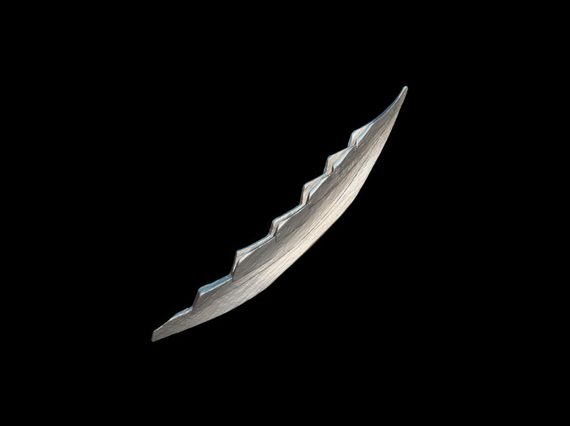
A Viking Age boatyard on Eigg
News Story
Two oak boat stems dating to 880-1050 AD from the isle of Eigg show the arrival of Scandinavian seafaring technology to Scotland.
These rare survivals reveal how the Viking Age forever changed Scotland's seaways.
Vikings and the sea
We tend to picture vikings (spelled with a lower-case v, unless we are talking about the Viking Age) as raiders on fearsome ships with dragon-headed prows. Unlike horned helmets, this is no myth. Real-world ships like Oseberg and Gokstad from Norway show us just how imposing and beautiful these vessels could be.
Scandinavian longships and boats were clinker-built, with overlapping planks of cleaved wood. Their curved stems and shallow draughts gave Viking Age vessels their distinctive look, while also allowing them to be highly adaptable. They could navigate far up rivers and even be dragged over land when needed. Big or small, the combination of square sails with traditional Scandinavian boat-building techniques eventually made vikings the most agile seafarers of the early medieval period.
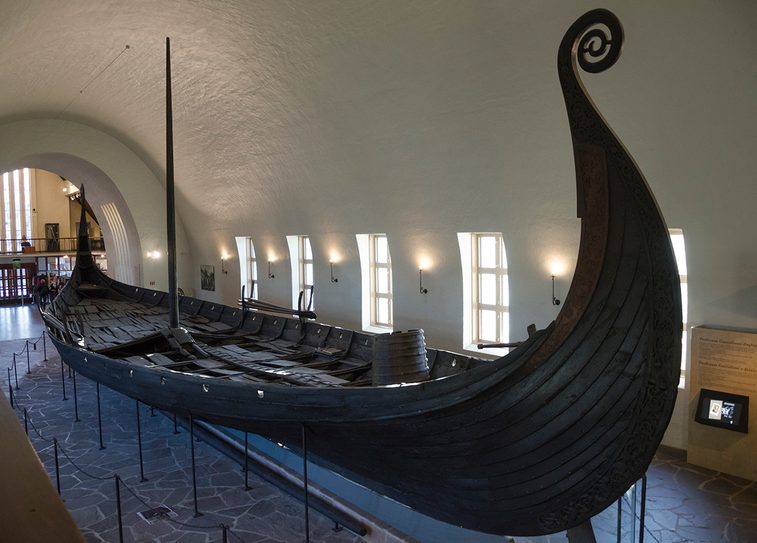
The Oseberg ship on display at the Viking Ship Museum, Oslo (Image source: CC BY-SA 4.0)

Viking boats in Scotland
While large warships would have once plied these waters, the only fragments of Viking Age vessels from Scotland are from relatively small boats rather than longships. Wood does not survive well in the ground. So, typically, all that is left are rows of iron rivets, leaving a ghostly outline in the shape and size of the original vessel. The largest of these found so far is the boat from Kiloran Bay, Colonsay, which may have measured 9-11m. The spectacular finds from this burial, including a sacrificed horse, are on display in the Early People gallery in the National Museum of Scotland. Several lavish boat graves are also known from Orkney, including Scar, Sanday and Westness, Rousay.
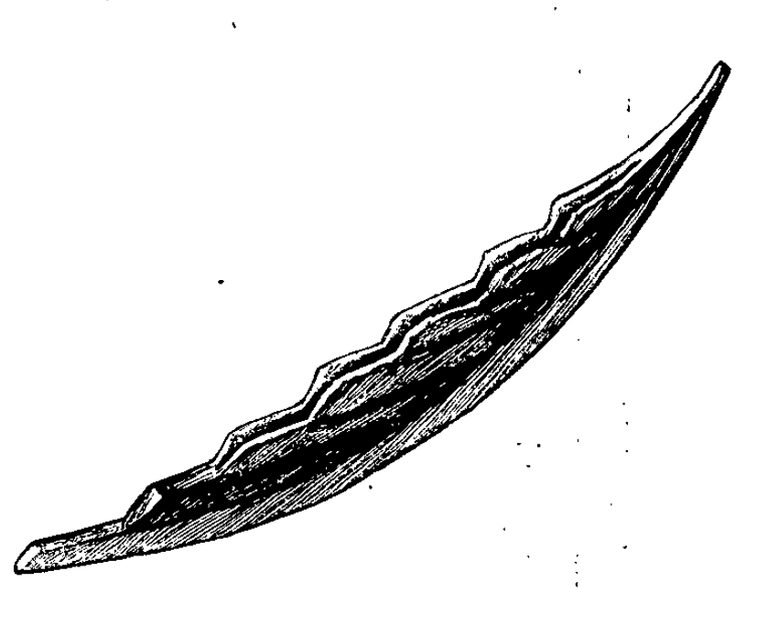
Original engraving of Eigg boat stem X.IN 4 (MacPherson 1878, fig. 16)
The discovery of the Eigg boat stems
In 1878, workers draining a ‘moss’ or peat bog at Laig Bay on the north end of Eigg, came upon some intact, carved wooden objects. The two curving oak posts were reportedly found “lying some 30 feet apart” with another piece of wood between them which was not preserved. The two boat stems were then displayed for the Society of Antiquaries of Scotland. An account of their discovery was published by Norman MacPherson in their journal. The two wooden posts from Eigg are registered as X.IN 4 and X.IN 5 and are both now on display in the Early People gallery, National Museum of Scotland.
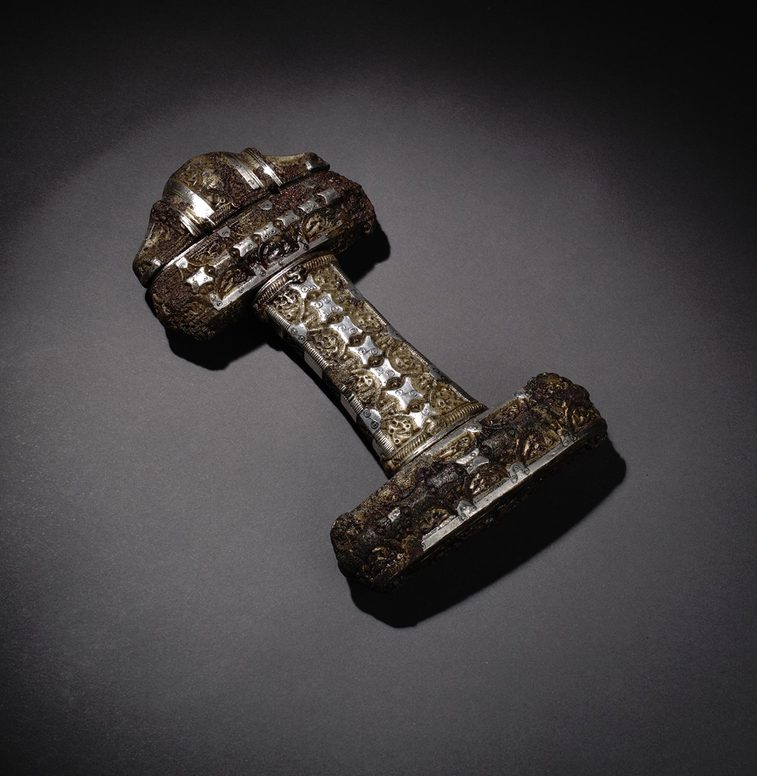
Sword hilt from a grave in Kildonnan, Eigg, X.IL 157.
MacPherson describes three other mounds excavated in the nineteenth century on Eigg. These excavations produced the unmistakeable material culture we associate with Viking-Age grave goods. These included the Eigg sword hilt, the finest of its kind from anywhere in Britain, along with other weapons, brooches and accessories. Those graves were found in the fields and coastline near to Kildonnan Church on the opposite end of the island from the boat stems. Together, they suggest that by the ninth century, Eigg was one of the islands of the Hebrides that had fallen to the control of a new maritime power. In other words: the vikings had arrived.
The two curved boat stems were of matching sizes, each with an original length of around 2m. One of them (X.IN 4) is nearly finished in form, with six well-defined steps and a central channel, while the other, (X.IN 5), is a roughout that has only been partly worked. Each of the steps would have accommodated the curving planks, or strakes, that made up the hull of the boat. There are no rivet holes or evidence the finished post had been used yet. Along with the fact the other post is unfinished, we can confidently suggest these were being made here, and it is highly likely that they were a matching pair, intended as the stem and stern of a boat.
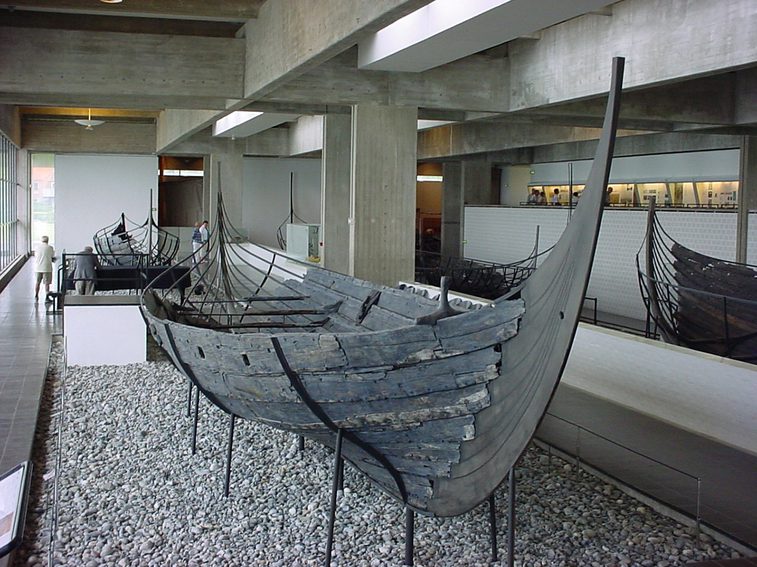
Skuldelev 3, Viking Ship Museum, Roskilde, an example of the kind of boat represented by the Eigg boat stems. (Image: Wikimedia Commons, CC-BY-SA-3.0)

The best studied group of Viking-age vessels are the Skuldelev ships, a group of 5 excavated from Roskilde Fjord, Denmark in 1962. The group had been scuttled in the eleventh century to form a defensive barrier. The only complete boat stem from this group belonged to Skuldelev 3. At 3.4m long and with seven steps, it belonged to a larger vessel than that of Eigg, but the design principles are nearly identical. Closer in size to Eigg was Skuldelev 6, described as a fishing boat reconstructed as 11.2m in length. The study of its timbers suggests that it was built after 1027 in western Norway. That means the Eigg boat would have been comparable in size to that used in the Kiloran Bay boat burial from Colonsay.

Diagram of Skuldelev 6, which would have been of a similar size to the Eigg boat. Image source: Vikingeskibsmuseet.
The roughout boat stem from Eigg was radiocarbon dated in 1998, and is likely to date to AD 880-1050 at a 95.4% probability (Beta-114594, 1060 ± 50). New CT-scans of the boat stems will help determine exactly what part of the oak trunk the dated sample belonged to, and where the tree may have grown.
Why were these boat stems found in a peat bog? Several boat stems have been found in wetland contexts across Scandinavia, which could suggest a ritual deposit. But on Eigg, it is very likely that the peat bog was once an inland loch near the ocean, long since drained. Because oak wood hardens and warps as it dries, it is best to store it in water while it is being worked, and that would explain finds like these. Another similar boatyard has been discovered at Rubh’ an Dùnain on the Isle of Skye, just 28km by sea from Laig Bay. An oak boat timber retrieved from the water was radiocarbon dated to the twelfth or thirteenth century.
When MacPherson described the discovery of the Eigg boat stems, he reported they were found "some 30 feet apart" or about 9m, which is in the projected range of the Eigg boat, with a piece of wood between them that he suggested could have been the keel.
All of this suggests that this was likely a Viking-age boatyard on Laig Bay, Eigg, making seaworthy vessels of the latest Scandinavian type in the tenth or eleventh centuries.
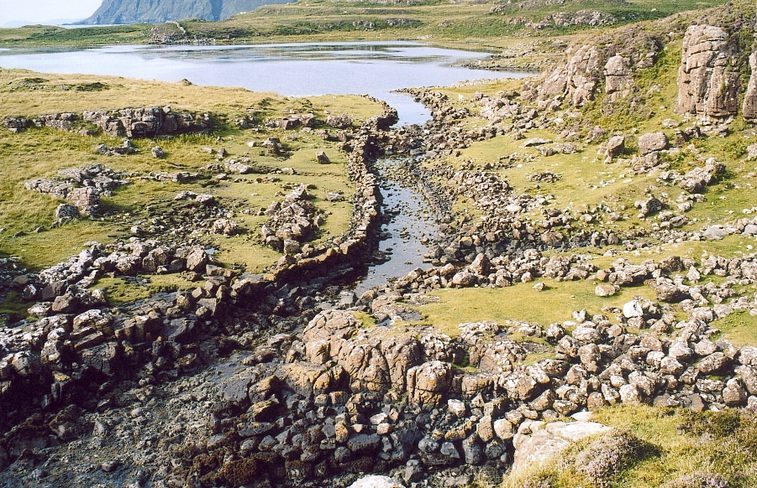
The ‘viking canal’ at Rubh’ an Dùnain, Skye (source: Wikimedia Commons)

Find out more
Crumlin-Pedersen, O. (2002) 'The Skuldelev Ships I'. Roskilde: Viking Ship Museum (Ships & Boats of the North, 4).
MacPherson, N. (1878) ‘Notes on antiquities from the island of Eigg’, Proceedings of the Society of Antiquaries of Scotland, 12: 577–597.
Written by