
'I am yours': 11 Scottish posy rings
News Story
Posy rings are some of the most evocative objects of love in National Museums Scotland's collections. These finger rings are named for the short inscriptions engraved on the inside of their band.
1. ‘I AM ZORVIS’ / I am yours
Found in Stirlingshire, this ring declares boldly ‘+I+AM-ZOVRIS+’, meaning I am yours. The old spelling of ‘yours’ alongside the style helps to date this ring to the 16th or 17th century. The outer section of the band is decorated with green and white enamel.
During the 15th to 18th centuries in Scotland, rings like this were given as tokens of love. While usually associated with courtship and marriage, they might also have been gifts between friends and family.

Gold and enamel posy ring from Arnprior, 16th-17th century. Museum reference X.2021.43.
2. A gesture of commitment
This posy ring was found in Edinburgh. It's inscribed in Scots - ‘QUHAIR THIS I GIVE I WISS TO LIVE’ - and speaks for the giver. One translation of the ring is 'where this I give I wish to live'. The giving of the ring is a gesture of life-long love and commitment.
You can imagine the promises and hopes that might have been exchanged when a ring like this was given and received. Worn by the person, the engraved words on the inside of the band touching their skin would have been a constant reminder of their relationship, the love, and promises of the person who gave it.

Gold posy ring from Edinburgh, 16th – 18th century. Museum reference H.NJ 11.
3. ‘En bon an’ / To a good year
This ring also found in Stirlingshire has French words on the outside band. It demonstrates the use of French as the language of the court and romance in Renaissance Scotland. The inscription ‘en bon an’ means to a good year. So, it might have been a new year’s gift.
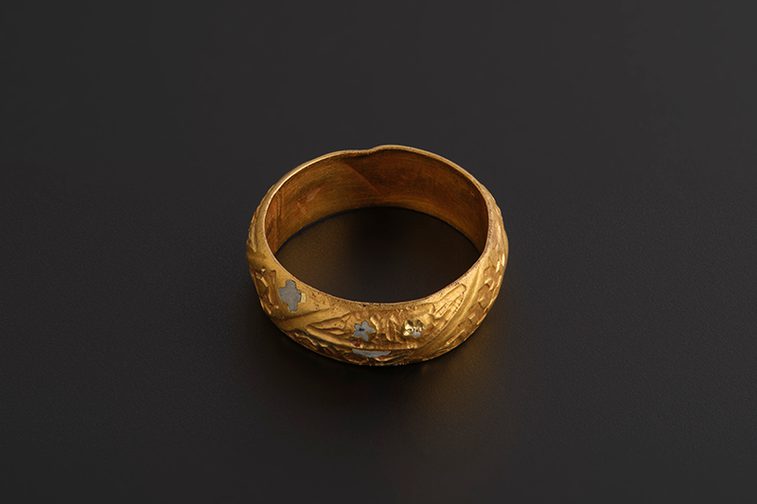
Gold and enamel ring with French inscription from Cowie, 15th – 16th century. Museum reference X.2024.255.
4. The end of sorrows
This ring was possibly given after a death. The inscription ‘lett murning cease and love increase’ hopes for the end of sorrows and a loving future.

Gold posy ring with plain outer band Shieldhill, Falkirk, 17th – 18th century. Museum reference X.2017.5.
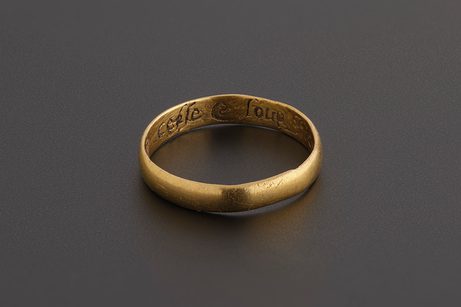
Gold posy ring with plain outer band Shieldhill, Falkirk, 17th – 18th century. Museum reference X.2017.5.
5. A symbol of constancy
This posy ring from Angus carries a single word: ‘constancie’. Was it a promise or request for a faithful relationship?

Gold posy ring with plain outer band from Ethie, 17th – 18th century. Museum reference X.2024.25.
6. Precious love
‘My love like this’. The words on this 17th century gold ring from West Lothian maybe refer to the material properties of the band itself, suggesting the love will be golden, precious, and eternal.
Most of the posy rings in our collection are made of gold. They were materially and emotionally precious. But the number that have been found through metal detecting and reported to Treasure Trove, as well as the spread across Scotland, suggests they were fairly common. The sort of jewellery that would have been available to people from well-off Burgh and landowning families.

Gold posy ring with plain outer band from Carriden, 17th century. Museum reference K.2010.45.

Gold posy ring with plain outer band from Carriden, 17th century. Museum reference K.2010.45.
7. No riches to content
In contrast to the above, the inside band of this ring reads ‘No Richese to content’. This suggests that no wealth could compare with or satisfy compared to their love.

Gold posy ring with plain band, 18th century. Museum reference H.NK 155.

Gold posy ring with plain band, 18th century. Museum reference H.NK 155.
8. Romantic iconography
The bands can be plain or patterned and coloured with enamel. Some colour is visible to the eye, but our conservators have been finding more miniscule flecks of enamel when looking under the microscope.
The enamelled band of this ring from Dumbartonshire incorporates lover’s knots and pansies. From the French ‘la pensée’, they symbolised thoughts for a loved one. At the same time, these little flowers native in Scotland were a cure for heartbreak. The inscription inside the band acknowledges the risk of heartache that came with being separated from a loved one: 'gife parted ♥ ♥ in paine'. This means that if parted, two hearts would be in pain.

Gold ring with enamelled exterior from Cardross, 16th-17th century, X.2025.29

Gold ring with enamelled exterior from Cardross, 16th-17th century. Museum reference X.2025.29.
9. Inspired by poetry
A gold ring with white enamelled clasped hands for the bezel incorporates another French posy. ‘Prenes En Gre’ translates to accept with gratitude. The words come from a French poem by Christine de Pisan, and refer to the acceptance of a gift as well as the person giving it.

Gold ring or fede ring with clasped hands at the bezel from Rosewell, 16th - 17th century. Museum reference X.2013.34.
10. An exchange of hearts
Rings incorporating clasped hands are sometimes known as fede rings. In this example, the two hands hold a heart. The inscription makes a play on words to refer to the exchange of hearts between two loves. ‘+HART+FOR+♥+’. In Renaissance Scotland, ‘hart’ was also used for a trinket or jewel in the shape of a heart, referring to the ring itself.
Both this ring and the ring above date to around the later 16th to early 17th century and were found near to each other. This suggests that maybe there was a particular maker working in this style or fashion for it in the area.

Gold ring with clasped hands at the bezel from Rosewell, 16th – 17th century. Museum reference X.2018.36.
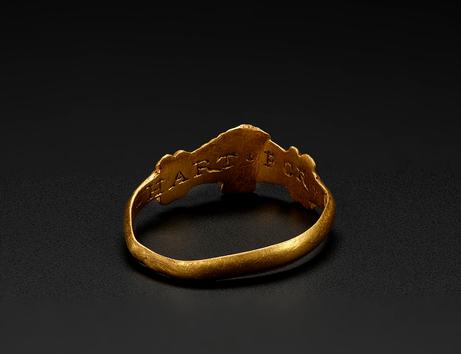
Gold ring with clasped hands at the bezel from Rosewell, 16th – 17th century. Museum reference X.2018.36.
11. Religious devotion
The fede rings demonstrate that the posy rings are part of a longer and broader culture of meaningful jewellery. This included rings that carried religious inscriptions and were part of the practice of faith. Not all special rings were gold either!
Not strictly a posy ring, the silver band of this ring incorporates clasped hands together with the letters ‘IHESVS’, for Jesus. Variations on IHESVS or IHESVS NAZARENVS is a common inscription on Medieval rings and brooches.
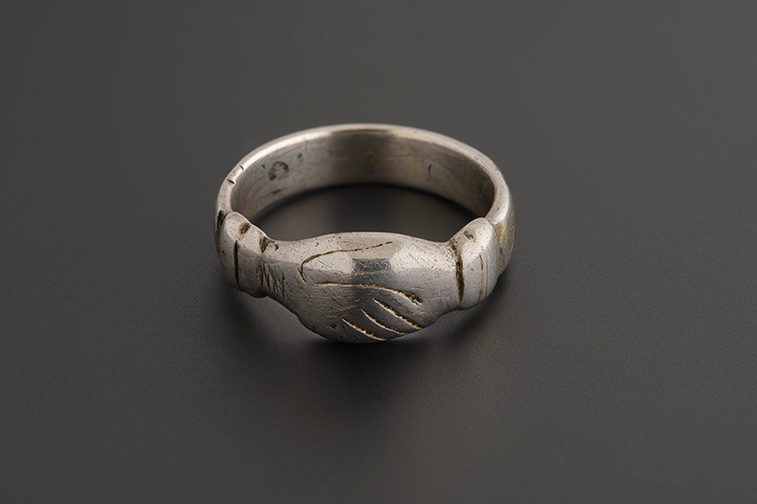
Silver ring with clasped hands at the bezel and letter IHESVS in squares around the band,15th – 16th century. Museum reference H.NJ 16.
Despite their tiny size, these posy rings are full of meaning. We’re doing more research to find out about their makers, the origins of the texts inside them, and the lives of the people who might have given and worn them.
Written by

Dr Georgia Vullinghs
Curator, Renaissance and Early Modern History