
Monkey and infant on a pine tree: a naturalistic turning point in Japanese art
Find out more about Mori Sosen's Japanese scroll painting.
Natural observation
Mori Sosen (1747-1821) was a highly regarded painter of the Japanese Edo period who worked and lived in Kyoto, Japan.
Born into an artistic lineage, Sosen belonged to the Mori school of painting, which was shaped by late-18th-century naturalistic movements that sought to bring greater realism and vitality to traditional Japanese art. In particular, he was influenced by nature-observation painters like Maruyama Ōkyo (1733-95).
A New Year's painting
Most likely from Sosen's mature period, this painting was made between 1790 and 1810, at the height of his technical skill and expressive confidence.
It shows two monkeys balancing on a branch of a pine tree. While the mother stares into the distance in a watchful mode, the infant, attentive to his mother, hangs playfully from a branch. The silhouette of the rising sun can be seen over the branches, alluding to the New Year. The elements of the scene are set against a pale ink wash background.
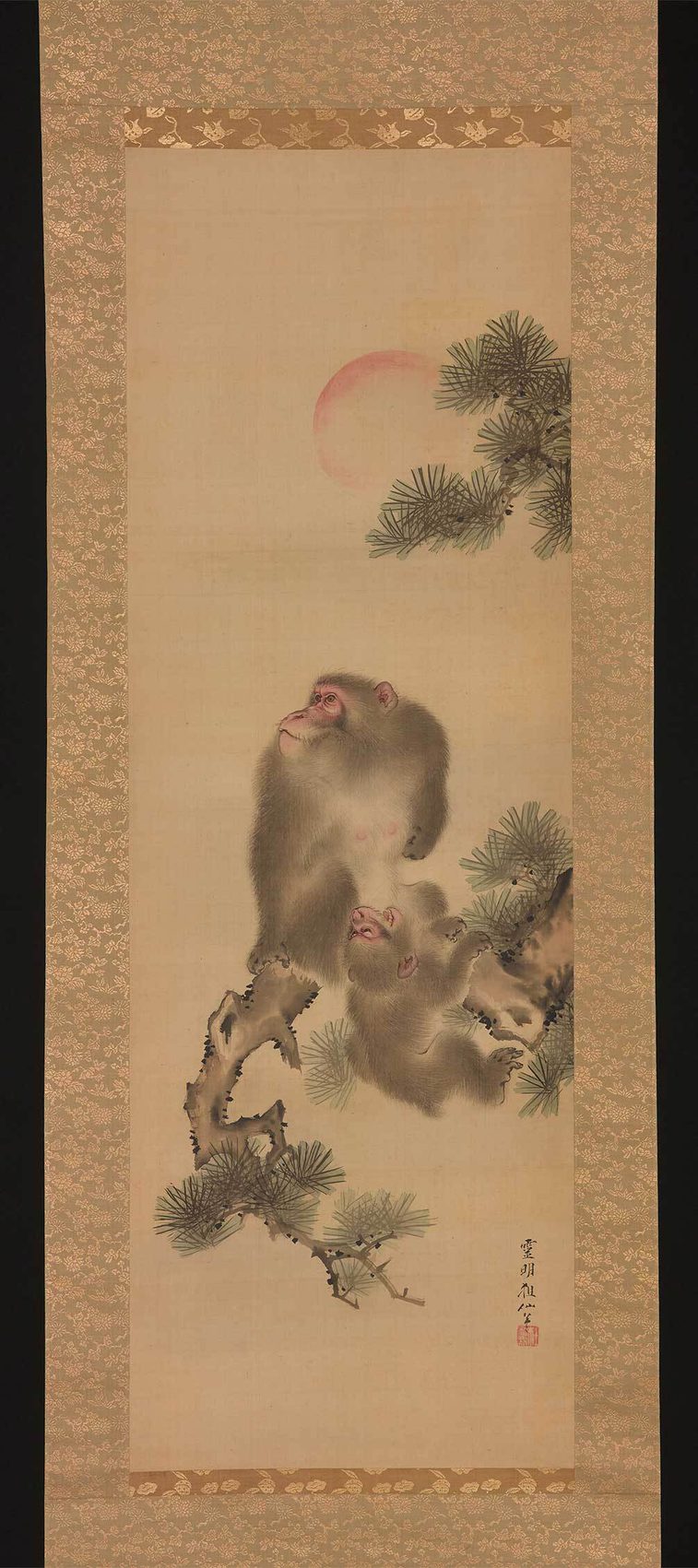
Hanging scroll painting of monkey and infant on a pine tree, with rising sun, signed and sealed: Japan, Osaka, by Mori Sosen, ca. 1790. (V.2016.141)
Emotive and sensitive style
The interaction between the two animals is subtle yet emotive and imparts tenderness to the whole scene. Sosen gained fame for his signature depictions of simians, but he also painted landscapes, birds and flowers, and other animals. It is believed that he observed monkeys in their natural habitat, hence his ability to subtly capture the animals' characteristic attitudes and movements.
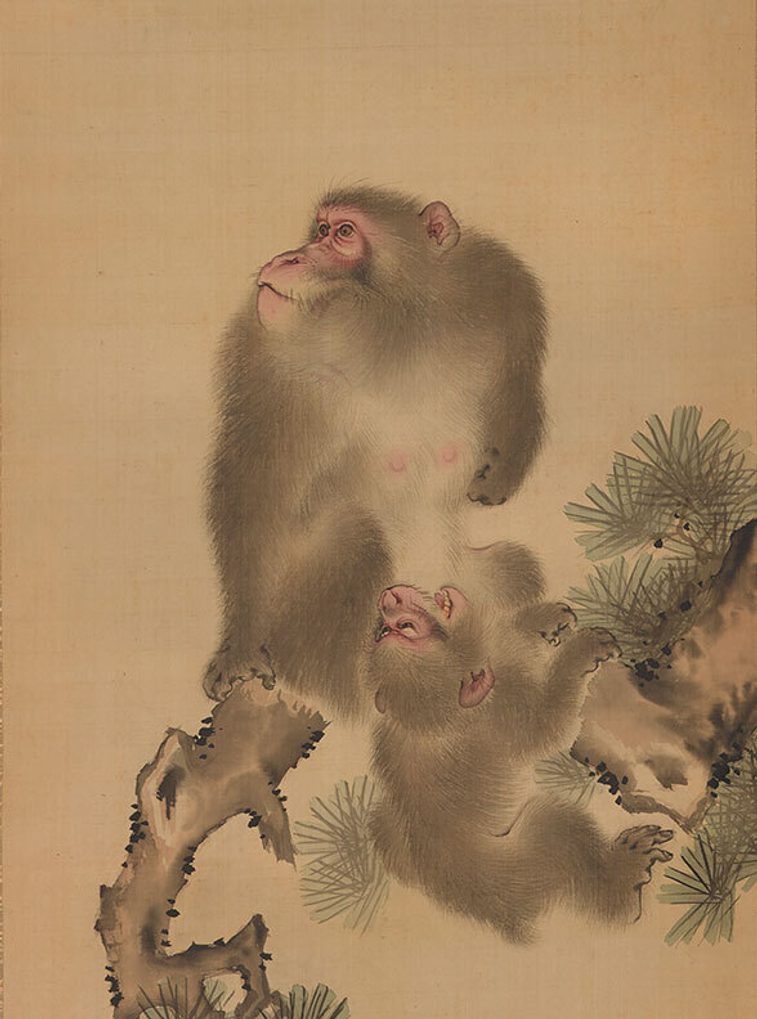
Details of the two monkeys on the tree. (V.2016.141)
The realistic and accurate depiction of the animals' soft fur shows Sosen's outstanding technical skill. We can tell that these are Japanese macaques thanks to his fine and accomplished brushwork.
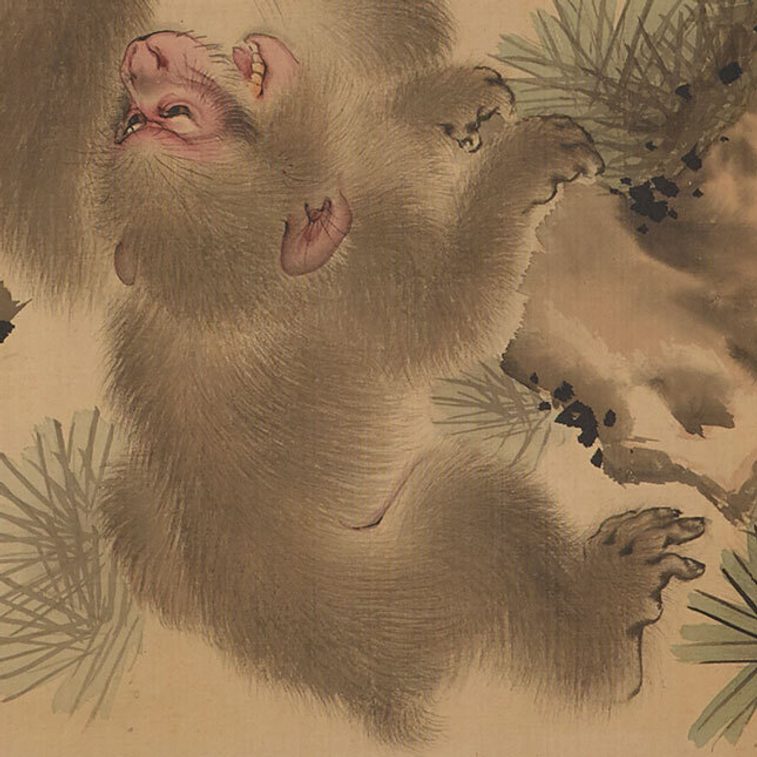
Detail of infant monkey hanging on the branch. (V.2016.141)
The scroll
The painting is mounted in typical East Asian method, as a hanging scroll, with a beautifully ornate border of brown and gold brocade bearing a pattern of pomegranate fruits among foliage.
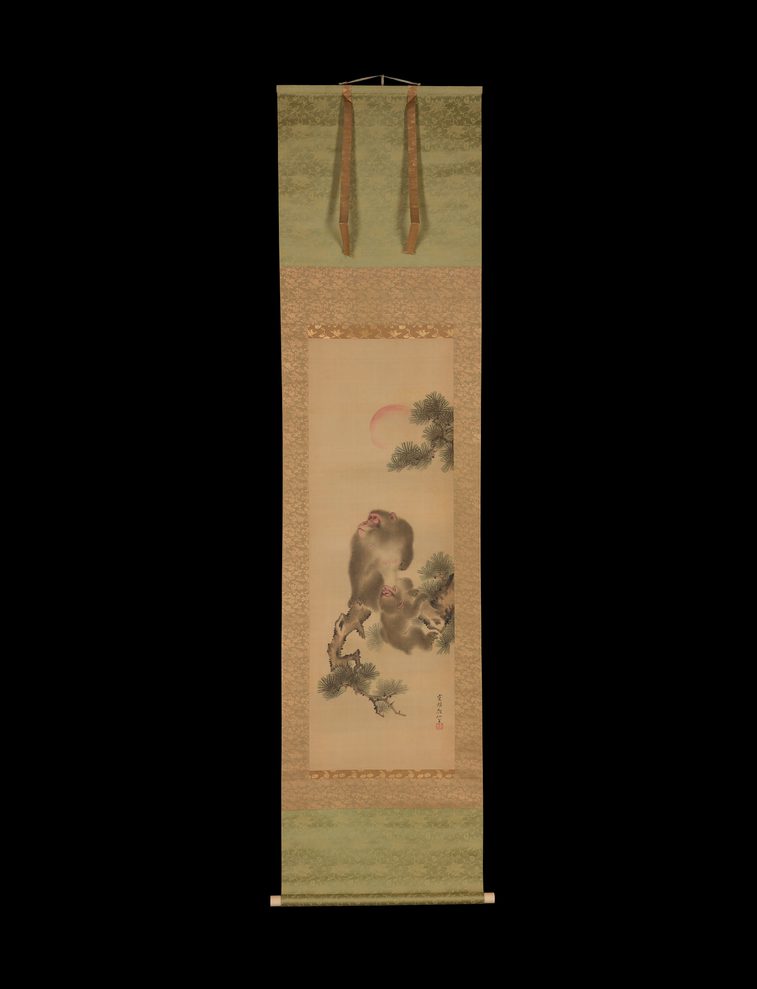
Hanging scroll painting of monkey and infant on a pine tree, including the hanging straps and bottom weight. (V.2016.141)
The signature
The painting is signed ‘Reimyo Sosen hitsu’ [From the brush of Reimyo Sosen] and is sealed ‘Sosen’.
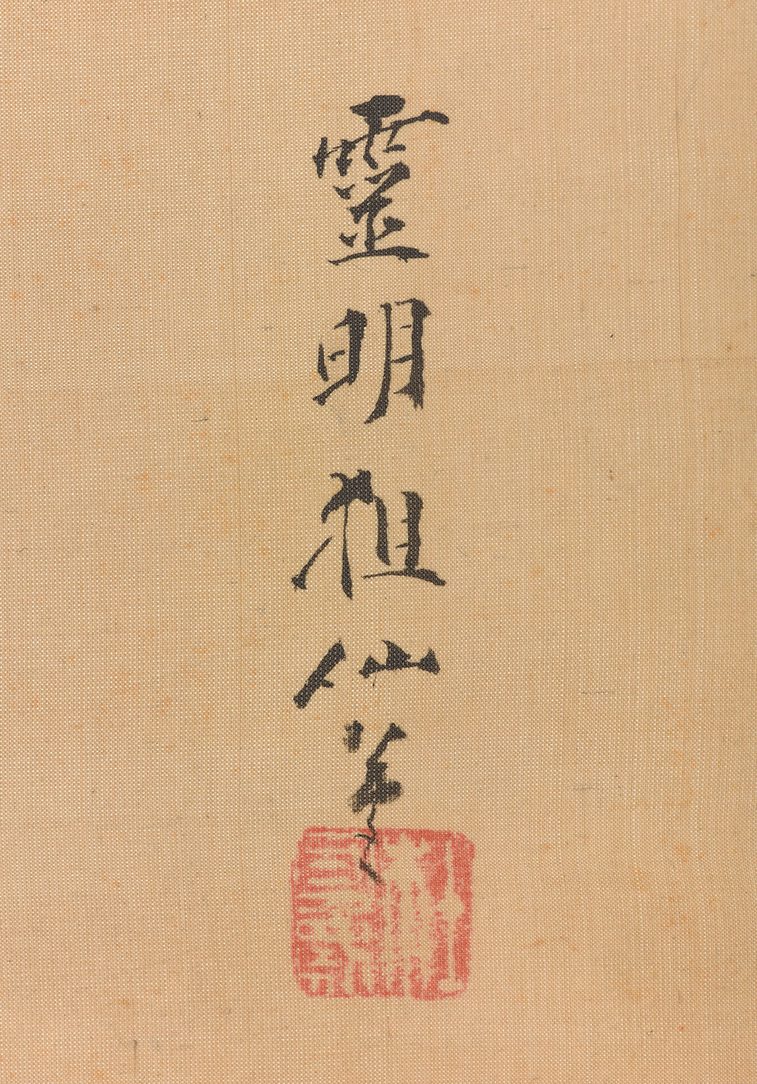
Close-up of signature by the artist. (V.2016.141)
Seasonal imagery
In Japanese visual culture, seasonal references are used to show appreciation for the natural world and its cycles. It is also a way to express awareness of the inevitability of change.
Seasonal themes can be observed in all Sosen’s paintings of monkeys. He depicted the animals in different environments to evoke different times of the year.
Hanging scrolls would have been changed regularly according to the season or for special occasions.
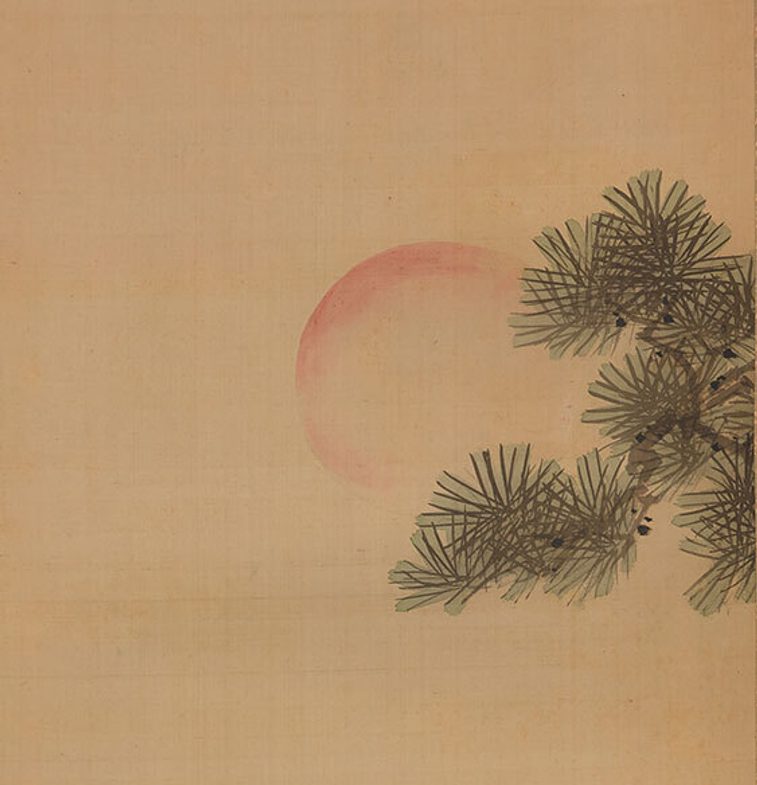
Detail of the rising New Year sun. (V.2016.141)
Other Japanese naturalistic paintings
National Museums Scotland holds several other paintings of the Maruyama-Shijō school of naturalistic painting, most of which depict landscapes. This scroll, however, represents the first animal example in the collection.
Written by
Dr Rosina Buckland
Former Senior Curator (East and Central Asia)
You might also like
Fan favourites: 5 decorative souvenir fans
Art and design, Fashion and textiles
Written by Dr Emily Taylor & Carys WilkinsHand-held folding fans are a lightweight portable accessory. Although their practical function is to keep you cool, the decoration and materials used to make fans communicate much, much more.Fans make ideal souvenirs, intended to be…
Owen Jones' The Grammar of Ornament
Art and design
The Grammar of Ornament is Owen Jones’ design masterpiece. This lavish folio, first published in 1856, highlights stunning patterns, motifs, and ornaments in 100 illustrated plates. Each intricate illustration explores the design…
Developing new mannequins for our fashion displays
Fashion and textiles
Written by Georgina RipleyOur displays are evolving to reflect different bodies and to tell new stories. Find out more about our process and where we plan to go from here.