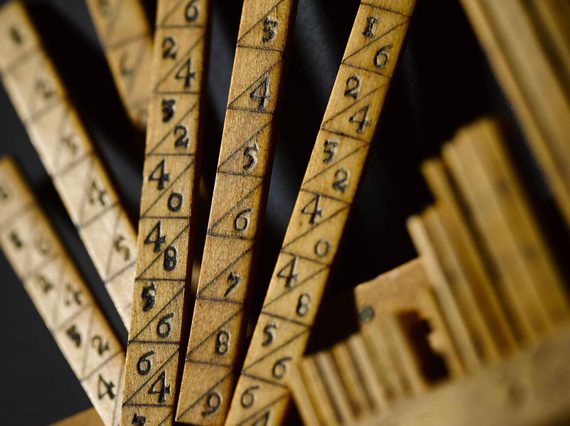
Napier's bones: The logarithmic genius who revolutionised calculations
Find out how this brilliant Scottish mathematician and occultist invented a method of calculation that accelerated scientific discovery.
In 1614, Edinburgh-born Renaissance scholar John Napier (1550-1617) invented logarithms. A means of simplifying complex calculations, they remain one of the most important advances in the study and practical application of mathematics. Napier’s ‘bones’ or ‘rods’ are just one of the methods this brilliant mathematician invented to speed up arithmetic.
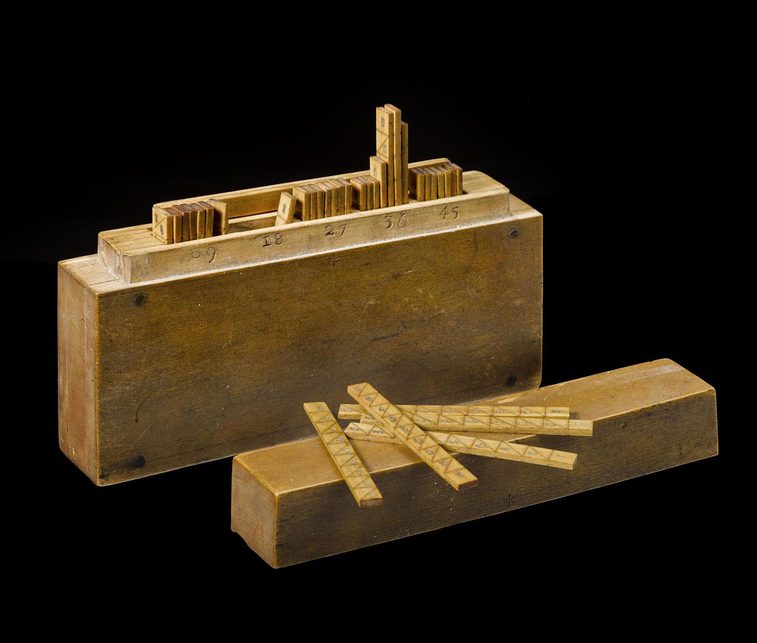
Set of Napier's bones. Museum reference T.2008.169.
"…there is nothing … so troublesome to mathematical practice ...than the multiplications, divisions, square and cubical extractions of great numbers, which besides the tedious expense of time are for the most part subject to many slippery errors, I began therefore to consider … by what certain and ready art I might remove those hindrances."
John Napier
'Marvellous Merchiston'
John Napier was born in 1550 at Merchiston Castle near Edinburgh, now part of Edinburgh Napier University. He lived in a world that saw the dawn of Renaissance scientific achievement and discovery, yet still clung to some aspects of medieval magic.
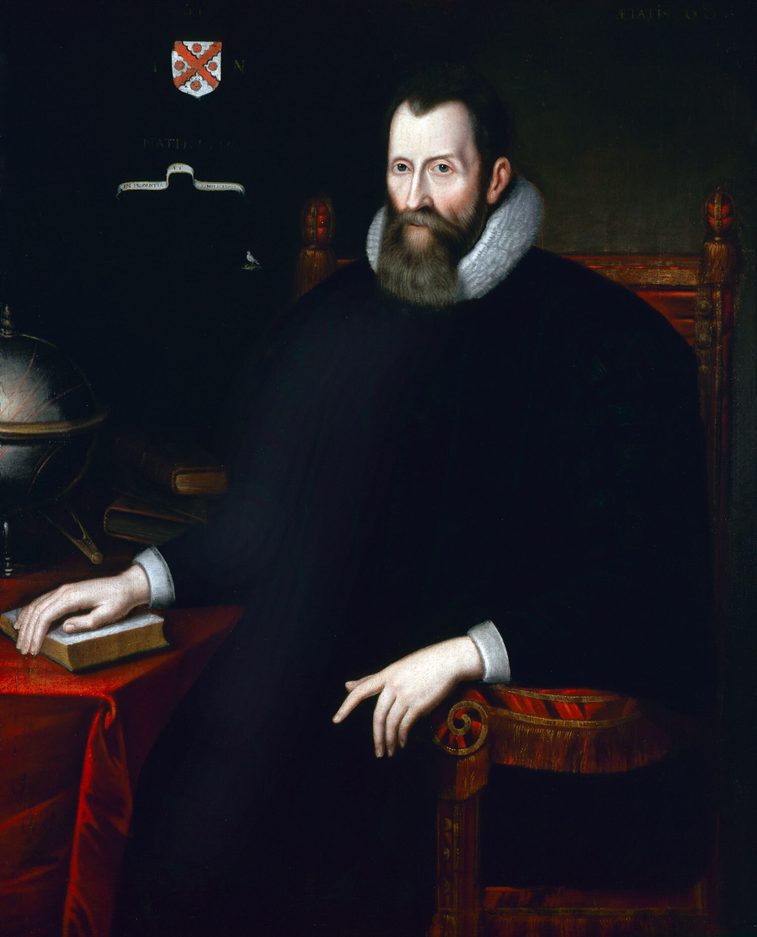
Portrait of John Napier (1550-1617) © University of Edinburgh.
Napier was a brilliant scholar. His interests and expertise ranged from philosophy, religion and politics, to astronomy, military invention and agricultural improvement, but it is for his mathematical work which he is primarily remembered.
He also studied the occult and gained a reputation as a wizard. Many people thought that his pet black cockerel was a familiar – a supernatural being which assisted witches and wizards in their magical practice. However, he may simply have kept the cockerel as a pet.

Scots Dumpy rooster, similar to the 'familiar' kept by Napier.
Like many successful inventors, his work came from a deep understanding of a problem, and a tenacious determination to solve it. He worked in particular on simplifying arithmetical calculations, which were time-consuming, tedious and hampering, particularly to those doing calculations involving trigonometry. In his own words, translated from Latin:
"The difficulty and prolixity of calculation, … a toil which is apt to deter most people from the study of mathematics, I have all my life with what powers and little genius I possess laboured to eradicate."
The instant impact of faster and simpler calculations
Napier spent over 20 years developing various methods of simplifying calculations. In 1614 his work introducing logarithms, 'Mirifici logarithmorum canonis descriptio', was finally published. The impact of his invention was enormous. More rapid calculation was now available to mariners for navigation, to land and military surveyors for their plans and particularly to astronomers.
Napier was not working in academic isolation, he was part of a European network of scholars, despite the slow and difficult travel and communication of the time. Leading astronomers, including the Dane, Tycho Brahe (1546-1601), and German, Johannes Kepler (1571-1630), were aware of Napier’s work from 1594, and Kepler published his own work on logarithms in 1624.
What are logarithms?
The word logarithm was devised by Napier from the Greek words 'logos' meaning ratio and 'arithmos' meaning number.
Napier invented logarithms by exploiting the properties of number series, the strings of numbers which feature in ‘find the next number’ challenges. Some advance by adding: 1,2,3,4,5... or 2,4,6,8… and some by multiplying: 2,4,8,16… or 3,9,27,81…
Napier worked out a relationship between two such patterns, and filled in the gaps between the numbers, a particularly laborious task. Among other properties, logarithms provide an efficient means of calculation, a kind of shorthand, particularly transforming multiplication into addition and division into subtraction.
The logarithms we most commonly use today are called base 10 logarithms. This is different to the form which Napier published in 1614.
Henry Briggs (1561-1630) of Gresham College, London, improved Napier's version and published the first base 10 logarithms in 1617. Briggs is sometimes credited with having devised modern common logarithms but it is clear that the idea was Napier’s from the forewords to both Briggs' and Napier’s books. The considerable labour of calculating the revised logarithms was done by Briggs and his team.
'Speaking rods'
Napier worked on other calculating methods. He was the first to introduce the use of the decimal point and to propose using binary numbers in calculations.
Particularly associated with his name are Napier’s bones. These could be assembled in different ways to multiply or divide large numbers by reading across the columns of figures. Napier published his work on the bones (rods) and other techniques in 1617, just before he died, in a book called 'Rabdologiae' or ‘speaking rods’.
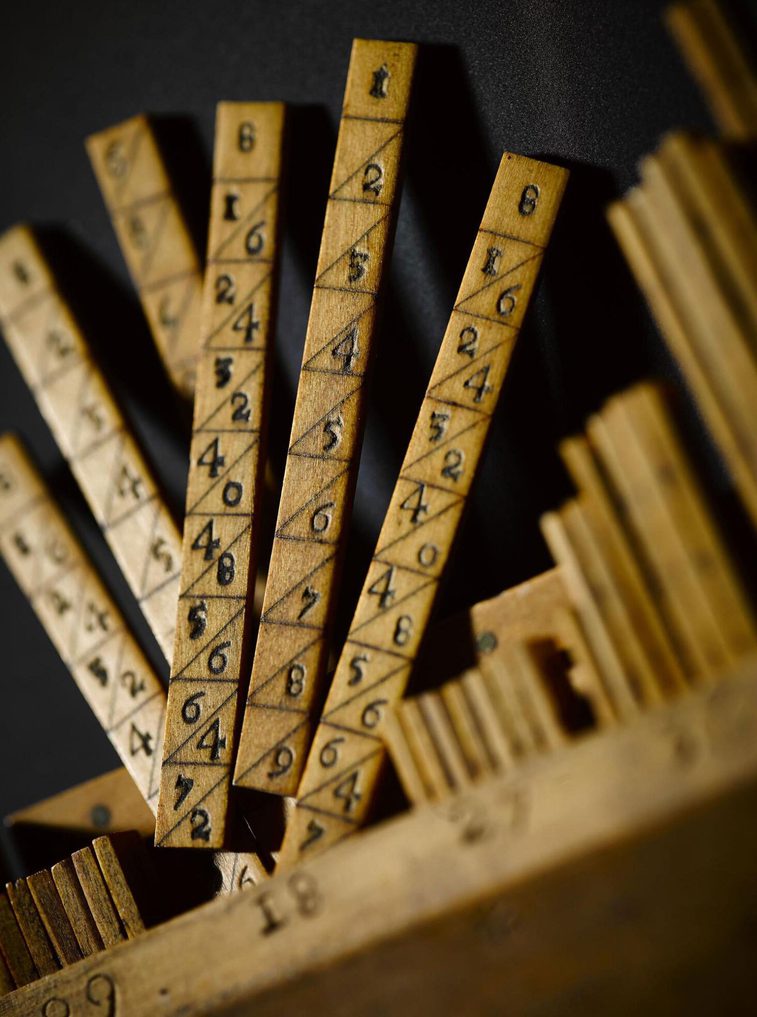
Wooden set of Napier's bones, made between 1650 and 1750. Museum reference T.2008.169.
Isaac Newton (1643-1727) recommended their use for repetitive computations and devices similar to Napier’s rods were still being made in the late 19th century.
Image gallery
There are several examples of Napier's bones at The National Museum of Scotland.

Set of 17th century Napier’s bones, also on display at the National Museum of Scotland. Museum reference H.NL 38.

Set of Napier's bones in ivory, in a small leather case, c. 1650. Museum reference H.NL 43.
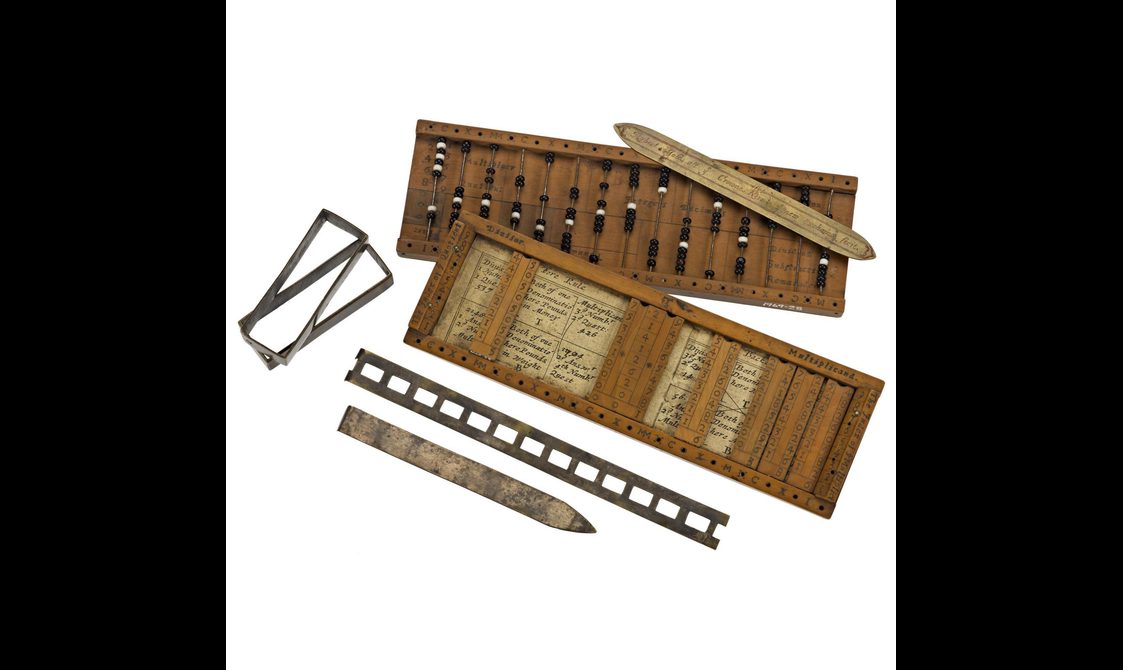
Arithmetical compendium, combining strip form Napier's Bones and bead-type abacus, in boxwood case, by Robert Jole of London, c. 1670. Museum reference T.1969.28.
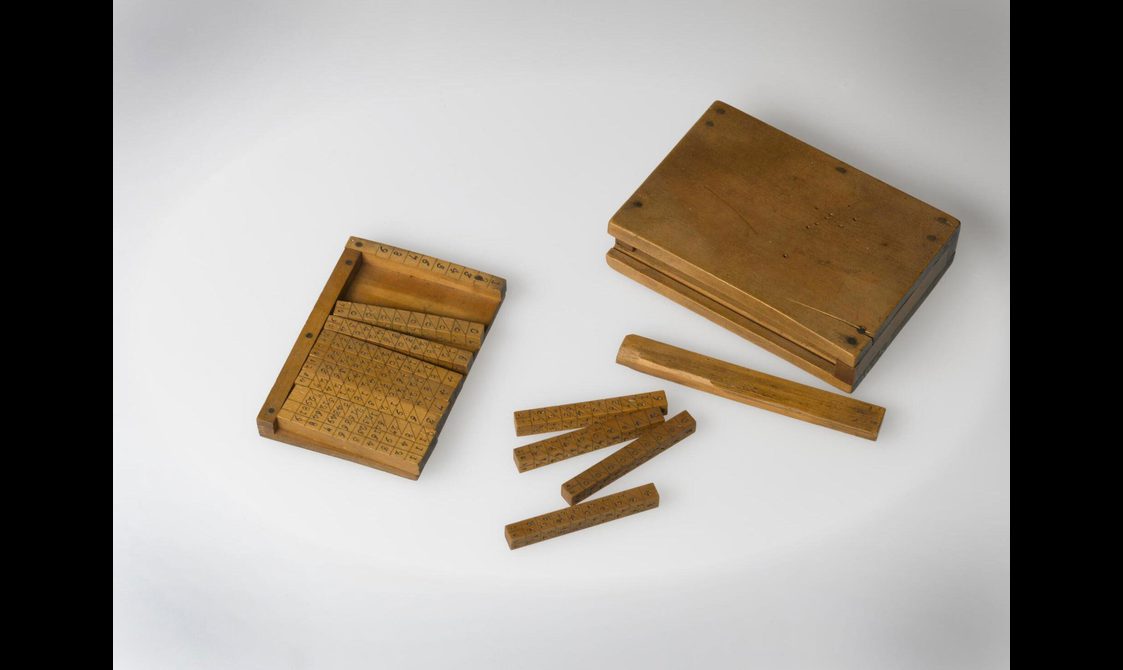
Set of 18th century Napier's bones in boxwood. Museum reference T.1866.57.

A set of Napier’s bones. Museum reference T.1881.19.1.
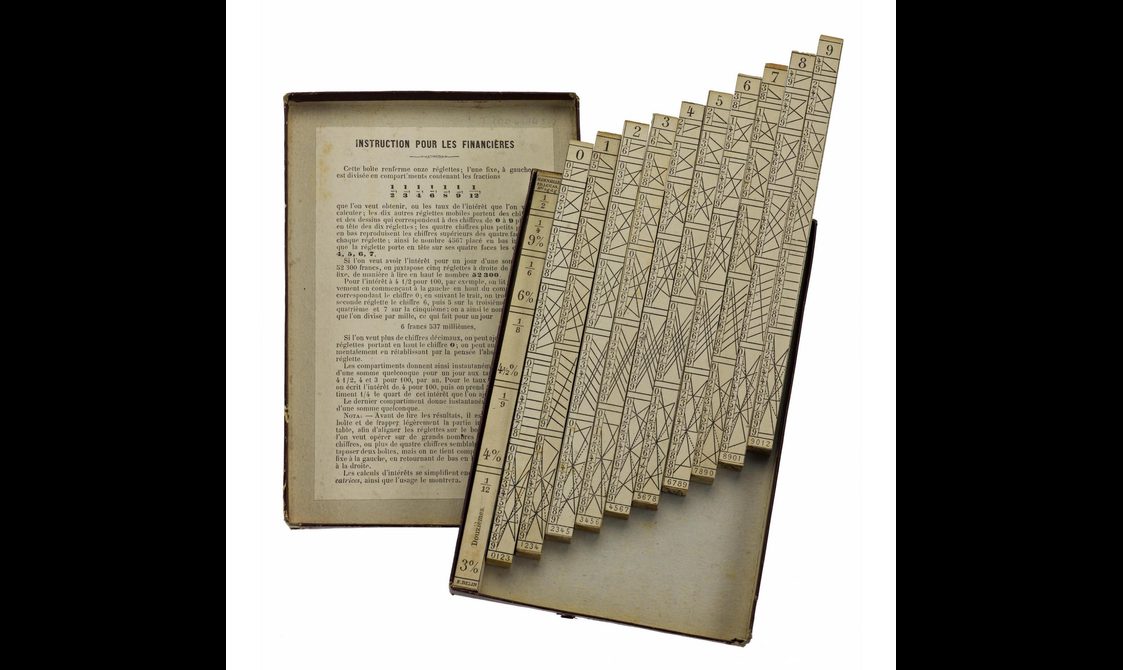
Les Reglettes Financieres: ten wooden rods numbered '0' to '9', in cardboard box with one fixed wooden index rod, made by Eugene Belin et Fils of Paris, c. 1885. Museum reference T.2004.143.2.
The impact of Logarithms
Soon after the publication of Napier’s Logarithmorum, other mathematicians developed logarithmic calculating devices. These let people use logarithms without the number tables.
In 1620, Edmund Gunter (1581-1626) introduced rules with logarithmic scales which could be used with dividers for calculation. By 1630 the first slide rules had been constructed by arranging two of Gunter’s scales so that they could move side by side.
About the same time William Oughtred (1575-1660) devised the circles of proportion, a circular slide rule. One of these instruments made by Robert Davenport is the earliest known signed scientific instrument made in Scotland in about 1650.
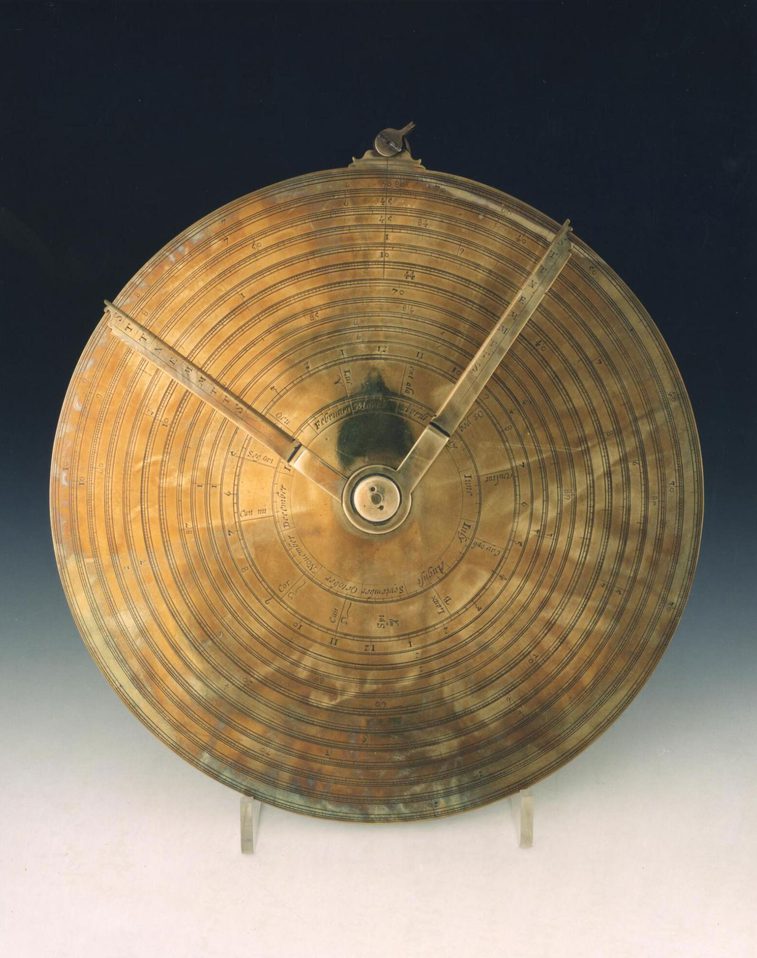
Instrument with 'circles of proportion' designed by William Oughtred and made by Elias Allen, English, 1648. Museum reference T.2004.723.

Instrument with 'circles of proportion' by Robert Davenport, Scottish, c1650. Museum reference T.1972.252.
Napier, Charles Babbage and the difference engine
The computer pioneer Charles Babbage (1791-1871) was directly inspired by John Napier’s logarithms and other number tables. A disadvantage of number tables was that they took years to calculate and check. There were often errors in the printed versions which resulted in errors in calculations.
Babbage’s ‘difference engine’ was intended to solve these problems, by calculating the numbers and producing printing plates automatically. He also experimented with different coloured papers and inks to make the tables as clear to read as possible.
Edward, Jane and Flora Sang
Despite Babbage’s efforts, until the 20th century calculating tables of logarithms had to be done by hand. It was a hugely time-consuming task to ensure there were as few errors as possible. Most tables were copied from previous editions with corrections, and new slips.
One of the biggest and best tables of logarithms was calculated in the late 19th century by the Edinburgh mathematician, engineer and scientific instrument maker Edward Sang (1805 – 1890) and two of his daughters, Jane Sang (1834 – 1878) and Flora Sang (1838 – 1925). These 47 handwritten volumes were never published. The high cost of printing such a large work and few people who would actually use it made it difficult to get a financial return for the huge amount of work.
Slide rules
Slide rules and logarithm tables were a very visible legacy of Napier’s work until the late 20th century. They were particularly appropriate for many technical and engineering calculations. Slide rules were faster, but only gave the first two or three digits of the answer. The logarithm tables were slower but gave more precise results.
Slide rules remained in common use until the 1970s.
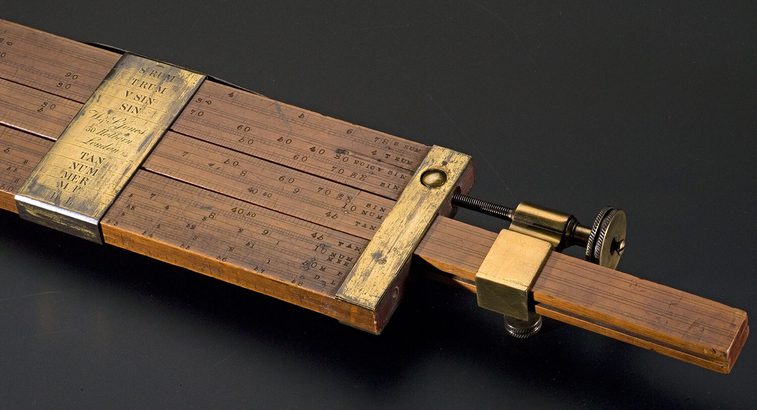
Slide rule by W. and S. Jones of London, made about 1820. Museum reference T.1978.94.
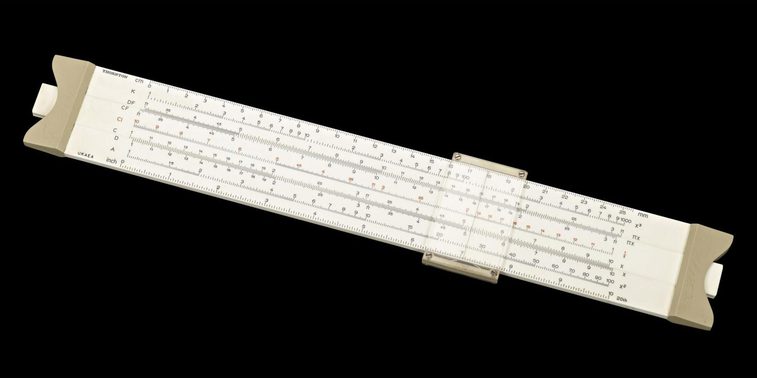
Engineer’s slide rule by Thornton, English, late 1960s. This rule was used at Dounreay nuclear power station. Museum reference T.2011.222.
Modern calculations
Many other types of calculating machines have been invented for different jobs. Mechanical calculators were particularly good where every digit is important, for adding up sums of money, for example.
All modern calculators have a ‘log’ button and some computer chips are designed particularly for logarithmic calculations.
Logarithmic scales are also used for measurement, from decibels for sound to the Richter scale for earthquakes.
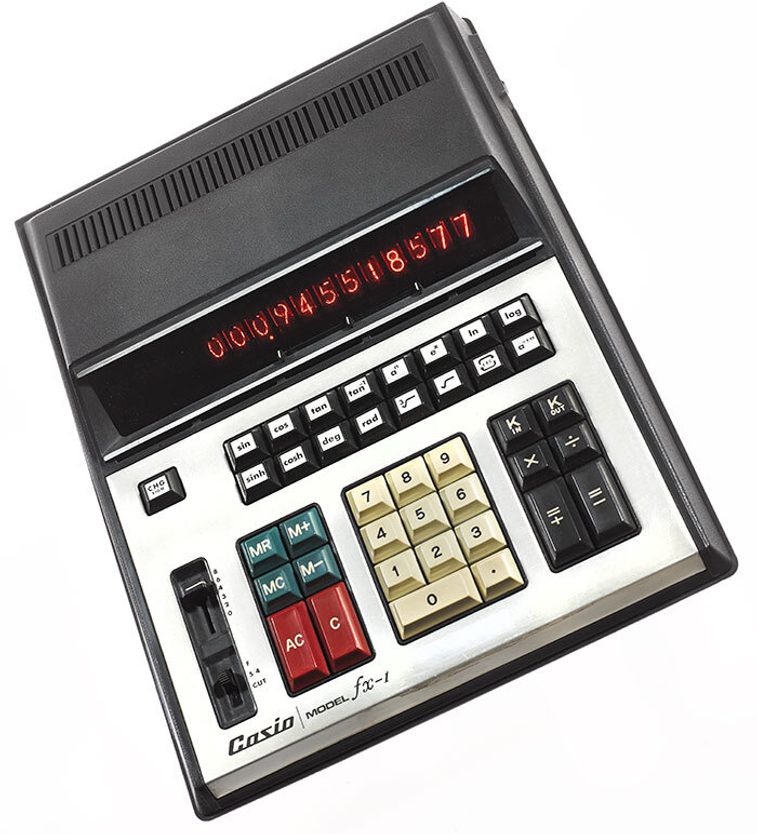
1970s Casio FX-1 calculator. The log button is in the top right hand corner. Museum reference T.1986.458.
Napier's legacy
Today, electronics have replaced nearly all other calculating devices. However, modern calculations and computing still use Napier’s invention.
Written by

You might also like
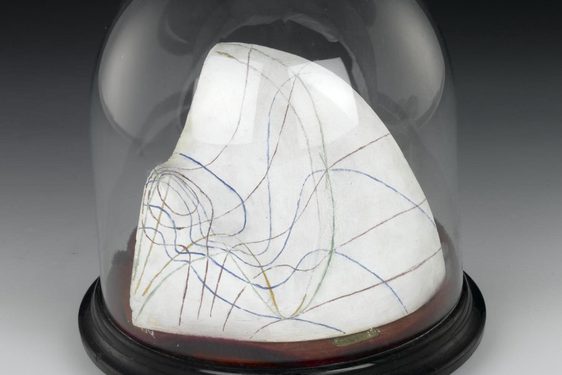
Uncovering the history of a thermodynamic model by James Clerk Maxwell
Science and technology, Scotland
Edinburgh born physicist James Clerk Maxwell created this 3D model to represent the behaviour of an imaginary substance showing its solid, liquid, and gas states.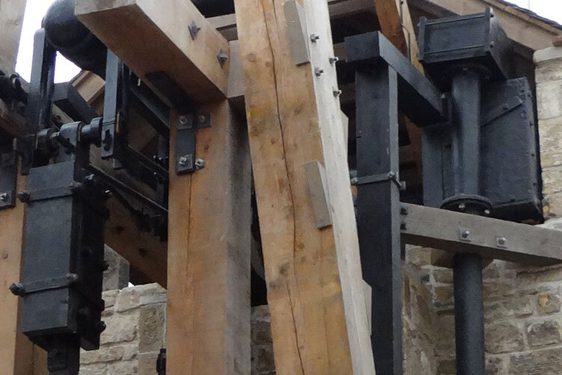
The Newcomen engine and its role in Britain’s industrial revolution
Science and technology
Towering 9.5m high and weighing 20 tonnes, the Newcomen engine in our collection is a part of the story of the industrial revolution in Britain.Thomas Newcomen developed this type of engine in 1712 in response to the problem of water in…
Did Alexander Graham Bell invent the telephone?
Science and technology, Scotland
The box telephone was the first model of telephone to go on sale. But can its creator, Alexander Graham Bell, truly lay claim to the title ‘inventor of the telephone’?