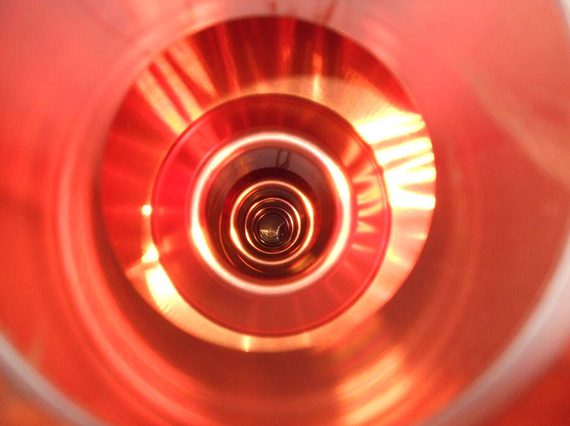
The CERN accelerating cavity: Powering the particle push
News Story
Between 1989 to 1995, this copper accelerating cavity played an important part in scientific history. It was used in the Large Electron-Positron collider, the precursor of the Large Hadron Collider.
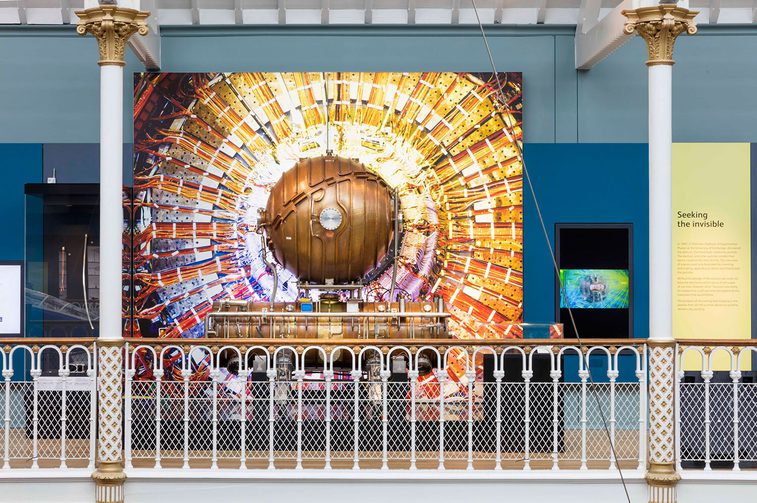
The copper cavity on display at the National Museum of Scotland. Museum reference T.2014.34.
CERN and the LEP
In 1989, Sir Tim Berners-Lee invented the World Wide Web as a way to share information between scientists and researchers around the world. That same year, the Large Electron–Positron Collider (LEP) was completed. Both breakthroughs took place at CERN, the European Organization for Nuclear Research.
CERN is a world-leading research centre where scientists study the building blocks of the universe by colliding them at high speeds. They also develop cutting-edge technology and work with scientists from all over the world to learn more about physics, engineering, and computing.
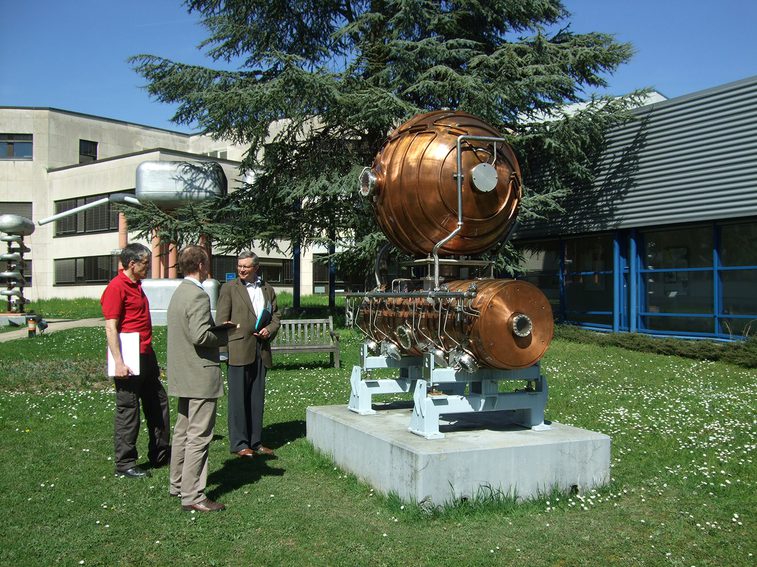
Accelerating cavity on display in the gardens at CERN.
The LEP was the largest and most powerful electron-positron accelerator ever built, housed in a 27 km-long circular tunnel 100 meters underground at CERN’s research centre in Geneva, Switzerland.
Particles are accelerated to near the speed of light and collided in vast underground chambers. These collisions let scientists study how particles interact and gain insights into the fundamental laws of nature.
The cavities
Cavities like this one were positioned around the LEP to form a massive ring, allowing physicists to accelerate electrons and positrons (anti-matter electrons) in opposite directions within the same tube. The ring shape of the LEP allowed the same particles to circle millions of times, being given a boost each time to maintain or increase their speed.
Each cavity was made of very pure copper. They weighed nearly 2 tonnes and were about 2.5 metres tall, 1 metre wide, and 2 metres long.
The inside of these cavities was shaped with great precision so electromagnetic waves inside them resonated at 352 MHz. The shape of the cavities and high electrical conductivity of the copper reduced the amount of energy input needed to maintain these electromagnetic waves. As electrons and positrons moved through each cavity in opposite directions they were accelerated by the electromagnetic field, increasing and then maintaining their speed.
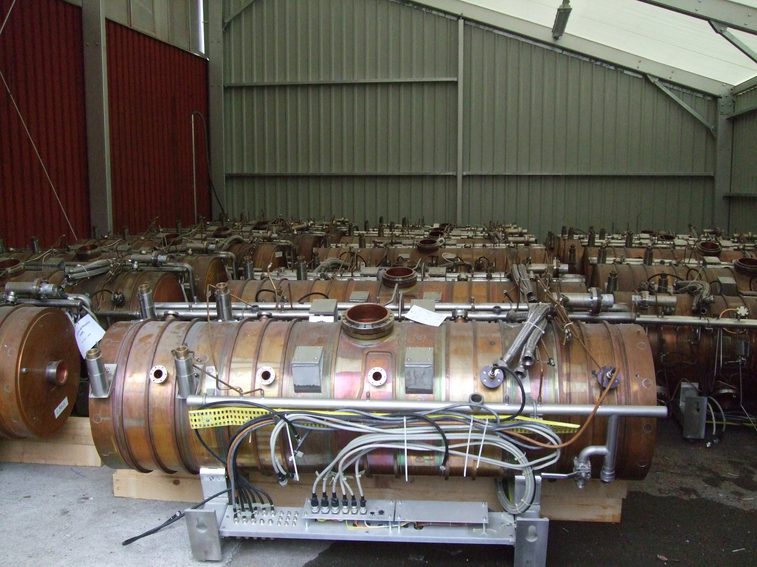
Cavities in the store room at CERN.
At four places around the ring, beams of electrons and positrons were sent towards each other to crash together and disappear. Huge detectors recorded what happened, helping scientists understand what occurs when matter meets antimatter at very high speed.
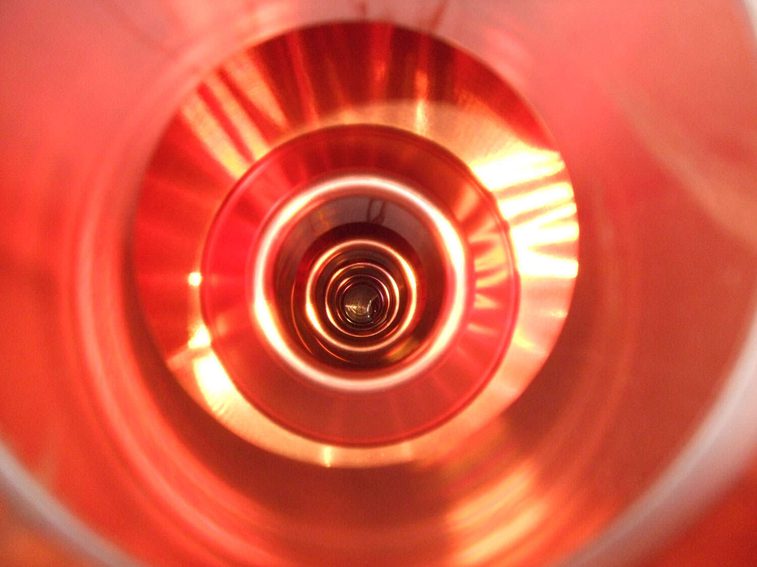
The inside of the copper radio frequency accelerating cavity. Museum reference T.2014.34.
This cavity was used between 1989 and 1995, and was then replaced. The research conducted using the LEP advanced our understanding of the fundamental building blocks of matter and supported a key scientific theory called the Standard Model.
Over 11 years, experiments with the LEP showed that there are exactly three types of neutrinos, very light subatomic particles, which means there are probably only three groups of matter particles in the universe.
The LEP also gave the first hints about a mysterious particle called the Higgs Boson. It didn’t prove it existed for sure — that was done later by the Large Hadron Collider at CERN. Between 2011 and 2013, the Large Hadron Collider confirmed the Higgs boson was real by working at higher energy levels than the LEP.
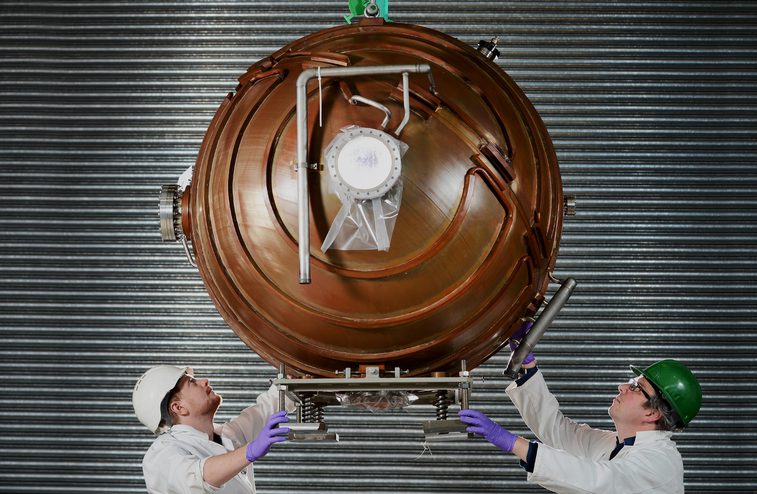
Accelerating cavity from CERN's Large Electron Positron collider (LEP), operational from 1989 to 2000. Donation by CERN.
The LEP was closed down on 2 November 2000 to make way for the construction of the Large Hadron Collider in the same tunnel. Copper cavities from the LEP are still used today for research and training in laboratories around the world.
This copper cavity was generously donated to National Museums Scotland by CERN in 2014.
Written by
You might also like

Escape and Evade: How to avoid capture in the Second World War
Science and technology
In 1939, a secret department of Military Intelligence (MI9) was formed. It employed the inventor Christopher Clayton Hutton and former magician Jasper Maskelyne. Their remit was to devise ingenious ways to smuggle maps, compasses, money…
Edinburgh physicist James Clerk Maxwell’s explorations in colour
Science and technology, Scotland
James Clerk Maxwell is particularly acknowledged among scientists for combining the theories of electricity and magnetism into electromagnetism, described by Maxwell’s equations. However, his research was very wide ranging, including an…
Inventors of photography: Exploring Victorian photographic techniques
Science and technology
Discover how Victorian inventors and entrepreneurs succeeded in capturing the very first images.