The Roaring Game: Scotland's curling stone island
News Story
Curling is a sport native to Scotland, that can be traced back to medieval times. Today, the game involves two teams taking turns to slide heavy, polished granite rocks (called stones) across ice toward a circular target. But where do the stones used in the game come from?
Curling involves sliding stones that weigh around 18 kilograms across the ice towards a target, with the aim of getting your team’s stones closer to the centre than your opponents’. The sport is thought to have originated in Scotland around 500 years ago and as a nation we’re still pretty good at it. Great Britain women's team won the gold medal and men's team won the silver medal in Beijing Winter Olympics in 2022.
But it’s not just the athletes themselves that travel from Scotland to the Winter Olympics. All of the curling stones used throughout the competition are quarried on a small, uninhabited island in the Firth of Clyde called Ailsa Craig. The rock on Ailsa Craig, 16 kilometres west of Girvan, is a kind of granite. It has been recognised as an excellent material for making curling stones since the nineteenth century.

Ailsa craig.
So what makes granite from Ailsa Craig so special? Why go to all the bother of quarrying stones on a little island hundreds of miles from where the Games are being held? Isn’t granite one of the most common rocks on Earth?
The Ailsa Craig granite formed from the cooling and solidifying of magma around 60 million years ago. About the same time, a huge volcano was active on the nearby island of Arran. To the west, Lava flows in Antrim were forming the rocks that would one day become the Giant’s Causeway. But the chemistry of the Ailsa Craig magma was unusual: it was very low in aluminium compared to most granites. This led to the presence of some uncommon minerals in the rock, with strange names like arfvedsonite (named after the Swedish chemist Johan August Arfwedson, who also discovered the element lithium); aegirine (after Ægir, Norse god of the sea); and aenigmatite ('aenigma' means 'riddle' in Greek).

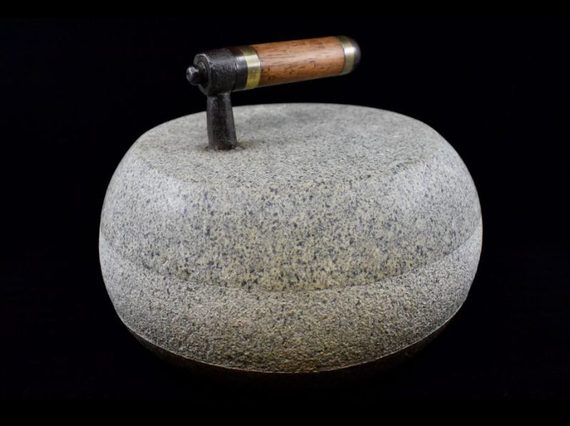
A curling stone from our collection, made from Ailsa Craig Common Green.
For some reason (we are still not sure why) these minerals, along with more common granite minerals such as feldspar and quartz, make the rock very tough and resistant to chipping and cracking. Perfect for curling stones that slide around and knock into each other on the ice.
There are three ‘types’ of granite found on the island. These have been given the names 'Common Green', 'Red Hone', and 'Blue Hone' by quarry workers and curling stone manufacturers. But geologically they are all actually very similar. Common Green is the most abundant and has the distinctive black spots that you can see on many curling stones. Blue Hone has smaller crystals than Common Green and is a greyish blue colour, while Red Hone is thought to be Blue Hone that has been stained by iron minerals (basically rust).
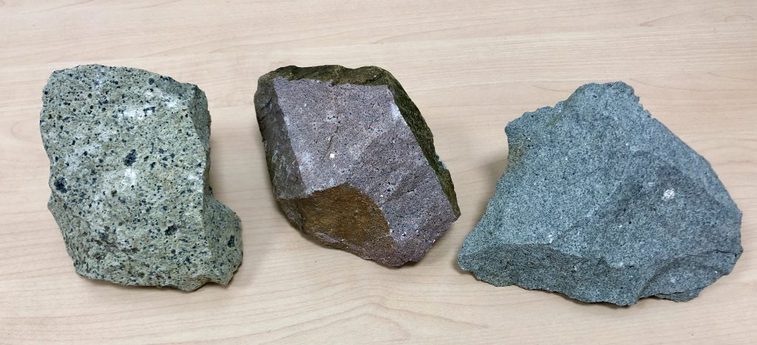
The three types of granite from Ailsa Craig: Common Green Red Hone and Blue Hone.
The Red Hone has all been quarried away now, but Common Green and Blue Hone are still widely in demand. Through lots of use, and even scientific experiments, it has been found that Common Green is particularly good for making the body of the curling stone. This includes the ‘striking band’ where stones collide with each other. Blue Hone makes an excellent surface for sliding across the ice, or the ‘running band’. Because of this, many top-level curling stones comprise a body of Common Green with a plug of Blue Hone set into the base – the peak of curling stone technology!
The Common Green granite in particular is unique and very distinctive. The black spots on a greenish-grey curling stone could be recognised anywhere. This property of the rock has been important to a totally different branch of geological science. Boulders of this easily recognisable granite have been found along the west coast of Wales and the north and east coasts of the island of Ireland. These rocks couldn’t have come from anywhere other than Ailsa Craig and must have been transported by glaciers during the ice ages. This helps glaciologists map past ice movements across the British Isles.

Microscope image of one of the black spots in Common Green. The green mineral is arfvedsonite.
At National Museums Scotland, we have plenty of geological specimens from Ailsa Craig in the collections. They include a curling stone and a huge slab with a big hole in it from which an entire curling stone was cut out! Our Ailsa Craig collection goes back a long way, with some of our mineral specimens having been collected by nineteenth-century Scottish Mineralogist Matthew Forster Heddle.
Heddle was instrumental in the early curation of the Museum’s Scottish Mineral Collection. He also happened to be interested in curling, publishing a paper on the scientific properties of curling stones from all over Scotland in 1890. Over 130 years later, we are still applying modern research techniques to this wonderful rock from this fascinating little island.
Written by

You might also like

What's in a firework? Minerals that bang
Natural world
Written by Emily BrownSo, you light a firework, you stand back and WHOOSH, off it shoots into the air. A few seconds wait and then BOOM, the firework explodes in a shower of coloured sparkles raining down from the sky. To get this sequence of events, you need…
The enigmatic origin of a beautiful igneous rock
Natural world
Standing nearly two metres tall with a busy patterned surface, the orbicular granodiorite is as striking as it is rare. There are thousands of areas of igneous rocks across the earth, but we only know of less than 200 occurrences of this…
The mineral pentlandite and its Scottish connections
Natural world
The mineral Pentlandite could be named after several things with a Scottish connection, but which one? Or is it something else entirely?Pentlandite is an iron nickel sulphide with the chemical formula (Fe,Ni)₉S₈. It is found in nature as…