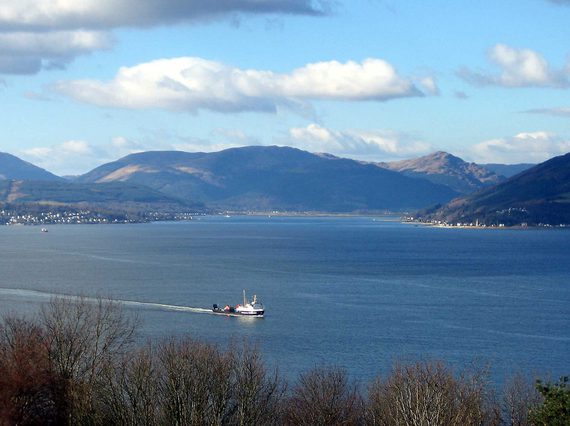
'The world opened up to us’: Collecting American-Scottish Cold War experiences in Dunoon, Scotland
News Story
The Cold War in Scotland forged new bonds between Scottish and American communities. As testimonies of veterans and Dunoon locals tell us, the conflict brought different cultures together and had a lasting impact on the town and its residents.
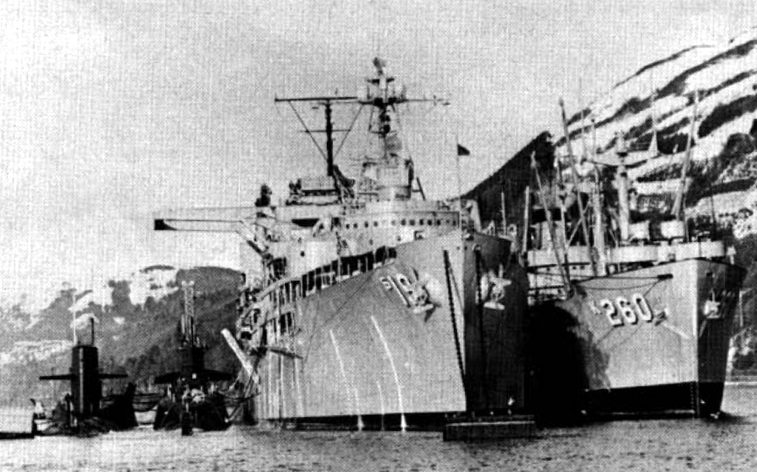
The U.S. Navy submarine tender USS Proteus (AS-19) tending two submarines at Holy Loch, Scotland (UK), circa 1962. To the right is cargo ship USS Betelgeuse (AK-260) which was especially modified to transport the UGM-27 Polaris missiles.
Late October 1962, United States navy sailor Gerald Pursley was in the engine room of the USS Proteus. The submarine tender was floating on the Holy Loch in Argyll, keeping the engines warm as Cold War tensions with the Soviet Union mounted. His new Scottish girlfriend Linda Jones called him about rumours she had heard circulating in Dunoon, a nearby town. There was talk, Linda said, that the ship was about to leave.
Gerald was adamant in his reply: ‘I’m on the ship and we’re not going anywhere’. Less than an hour later, Gerald and his crew mates were scrambled with firing orders into the Atlantic Ocean. Such was the urgency, one eyewitness recalled seeing crew running along the side of the ship, cutting all shore fastenings and communication cables with an axe. This was the beginning of the Cuban Missile Crisis.
American President John F Kennedy and Soviet Premier Nikita Khrushchev were able to defuse the conflict. The USS Proteus returned peacefully to the Holy Loch. However, the incident emphasised Scotland’s place as a Cold War battleground. The picturesque town of Dunoon and the Holy Loch and Cowal Peninsula were marked as prime targets.
A strategic location
Situated between the two superpowers of the USA and the Soviet Union, Scotland would become the US military’s most important forward operating base during the Cold War. In 1959, President Dwight Eisenhower asked British Prime Minister Harold Macmillan for a Scottish base. This would allow access to the Atlantic Ocean and the Greenland Iceland UK Gap. The Holy Loch in the Cowal Peninsula was an ideal position. It had been previously used by the British during the Second World War and was within close distance to Prestwick airfield. In return, the British government were keen to gain access to American developments in nuclear weapons technology.
The Cold War had arrived on 3 March 1961 as USS Proteus sailed up the Holy Loch. This began a three decades-long stay for American nuclear submarines. Thousands of American service personnel and their families came to support the naval submarine base. A large notice at the gangway of the American depot ship read: ‘You are about to represent your country in Scotland. Do so with pride, dignity and honour’.
Local people were initially resistant to the development of the US Naval Base. Protests and peace vigils from anti-nuclear movements demonstrated the public’s opposition to the base. As one local recalled:
‘...the British government has imposed this fate on the town. We were...target number one on Russia’s list if things tipped over into conflict'.
Andrene Messersmith, Dunoon local resident, quoted in The American Years: Dunoon and the US Navy, 2nd edn (Edinburgh: Argyll Publishing, 2023), p. 16.
This was also a national issue. After the announcement of the base in November 1960, 30 Labour MPs representing Scottish constituencies tabled a motion of opposition in Westminster.
As time went on, local councils and many local people increasingly welcomed and cooperated with the base. Many developed lifelong friendships with their new American neighbours.

Anti-nuclear activists protesting at Ardnadam pier on the Holy Loch.
A new community
Dunoon was brought on to the international stage and ceased to be a small community. As one local put it, ‘the world opened up to us’.
Many American personnel stationed at the base brought their families and children with them. As they attended schools, clubs and churches, Dunoon's new residents quickly became part of the local community. In turn, the Americans introduced their own customs and culture to the town. This included sporting activities such as baseball and basketball, and hobbies such as quilting, line-dancing and barbequing. Shops started to stock American branded cereals, tater tots and Kool-Aid. Large American cars filled the streets – and a new cinema and bowling alley were built. The local taxi trade boomed due to sailors wishing to travel to Glasgow night clubs during their shore leave. At the same time, locals, teachers and the police were also exposed to the racial segregation and discrimination of 1960s America. This highlighted contrasts between American and Scottish social and political attitudes.
Margaret Hubbard grew up in Innellan near Dunoon. She was 14-years old when the Americans arrived. She remembers meeting her new classmates who taught her how to play baseball, while the American children learned Scottish country dancing.
Margaret also vividly remembers the Cuban Missile Crisis and the fear and uncertainty of this time. She recalls, 'I remember going to school that morning...I was a well-behaved little girl who always did my homework, but I hadn't done it the night before because what was the point? I could be dead the next day’.
Unlike other parts of Scotland, Margaret and her classmates knew the scrambling of the US ships and submarines from the Holy Loch were a huge concern. It could have been the beginning of a nuclear war.
Scottish and American communities in Dunoon grew closer together as the years went on. Many American personnel found love in Scotland. Some went on to have families, often choosing to stay or return to make Scotland home after their naval service. After the USS Proteus returned safely from its Cuban Missile Crisis mission back to the Holy Loch, Gerald Pursley made his way to Dunoon to find his Scottish sweetheart Linda Jones. Gerald recalled:
‘I hadn’t seen her in over a week and things were getting a bit serious...we had a reunion in the main area of town...that’s where I’d found what I really needed...and actually proposed to her three days later and we’ve now been married 64 years'.
Gerald Pursley
After leaving the navy and returning to America in 1965, Gerald and Linda decided to come back to Scotland with their children. They have lived in Dunoon ever since.
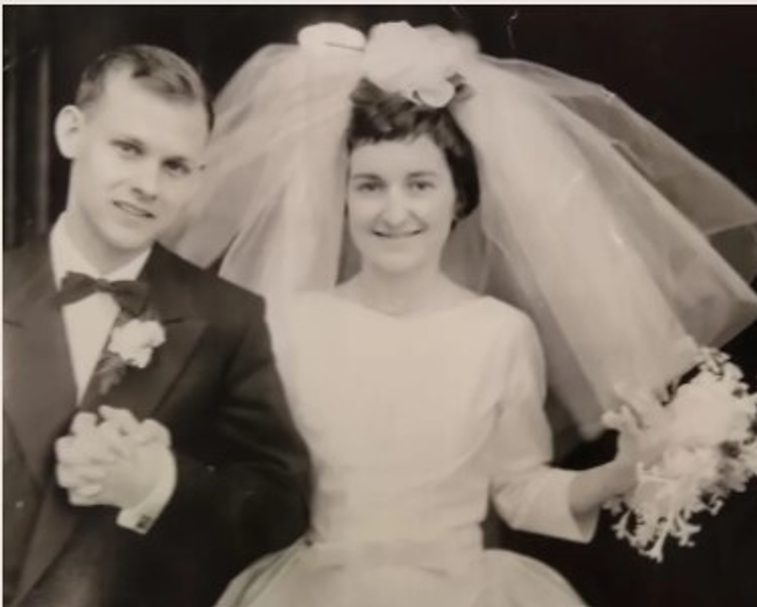
Gerald and Linda Pursley (née Jones) on their wedding day, 1963
Collecting stories, collecting objects
The US Naval Base closed in 1992. Since then, the Holy Loch American Veterans Association and the American Years Revisited project have commemorated the significant impact the Americans had on this area of Scotland. The American Years Revisited project has gathered extensive oral testimonies from veterans and Dunoon locals who held memories of the Americans living in the area.
At National Museums Scotland, some of these stories featured in the 'Cold War Scotland' exhibition (Jul 2024 - Jan 2026). We also recorded additional oral testimonies from three US navy veterans and from Innellan local Margaret Hubbard, board member of the American Years Revisited project. Building on this, Modern and Contemporary History curator Mhairi Maxwell recognised that the Museum did not hold any objects relating to this significant chapter in Scotland’s modern history. By reconnecting with the American Years Revisited members, we have begun to share knowledge and reflect on the legacies of the Cold War in Scotland.
Together, we are now working to collect objects representing their experiences. This includes three objects which have been generously offered for donation.
1. A commemorative cap
Retired Chief Petty Officer Charlie Witherow was one of the veterans who shared his story with us. Charlie has offered to donate a Holy Loch American Veterans Association (HLAVA) cap to the National Collection.
Charlie arrived in Scotland in 1973, and has remained in Dunoon ever since. In 2002, Charlie helped to establish the HLAVA. Their aim is to support and cultivate a community of local veterans, while honouring the memory of HLAVA personnel. This hat is available to members of the Association. It highlights the legacy of the US navy in the Holy Loch and the importance of commemorating their service to their country.

Holy Loch American Veterans baseball cap made in 2019 and designed by American veteran Charlie Witherow who was stationed on the USS Canopus 1973-75.
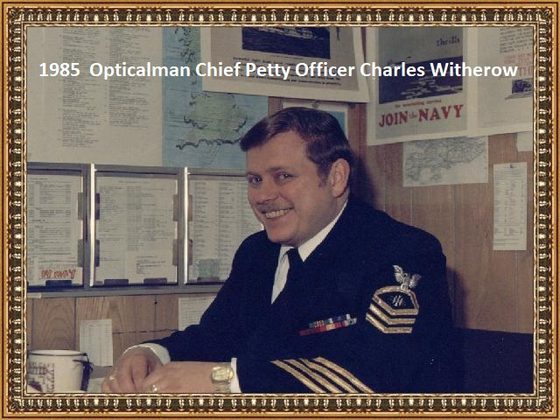
Chief Petty Officer Charlie Witherow in 1985
2. A well-worn watch
Terry Sinsheimer is another US navy veteran, and member of HLAVA. Terry has offered to donate his battered glow-in-the-dark watch bought on board the USS Hunley AS-31 to the Museum.
Terry enlisted in the US navy in 1982 and spent two years in the Holy Loch in boat operations. Terry recalled ‘I fell in love with Scotland immediately’ and later he even met his future wife in Dunoon. He has also recounted how ‘the best part of the job was being 19 with all your friends and having a great adventure’.
His Seiko divers watch was an ‘unofficial’ part of his uniform. Worn daily while on duty, it ensured he kept to schedule and importantly, when to stop for mealtimes. The waterproof watch went through four strap changes. This wear and tear is testament to the graft of life underwater. The watch face serves as a reminder of his time on the submarines and the people he worked with.

A well-worn and used Seiko Divers model watch worn by American veteran Terry Sinsheimer who was stationed on the USS Mahan 1982 -84.
3. A Christmas message
Margaret Hubbard shares a balanced perspective of growing up in the Cowal Peninsula during this period of change. Her testimony recounts the negative aspects of her home becoming a new frontline in an international conflict. Margaret also highlights the positive elements of the experience. She was introduced to new music like Jazz, hobbies such as baseball and developing lifelong friendships.
Margaret has donated a US navy issued Christmas card to National Museums Scotland. She received this card from her American neighbour in the 1980s, who was a crew member of the USS Hunley. The card lists the names of all personnel working on this vessel.
The nuclear defence paradox was impossible to overlook in this seasonal greeting. The front depicts a herald spreading the message of ‘Peace on Earth’ over a landscape not unlike the Holy Loch or a sleepy Dunoon. On the reverse of the card is the USS Hunley crest which depicts a ship loading a submarine with nuclear missiles. The design includes the ship’s motto ‘We serve to preserve peace’. When this card was sent, the vessel would have been visible from the comfort of locals’ living rooms.

Margaret Hubbard's Christmas card given to her by a USS Hunley American sailor sometime in the 1980s, featuring a herald spreading the message ‘Peace on Earth' over a sleepy village, not unlike Dunoon.
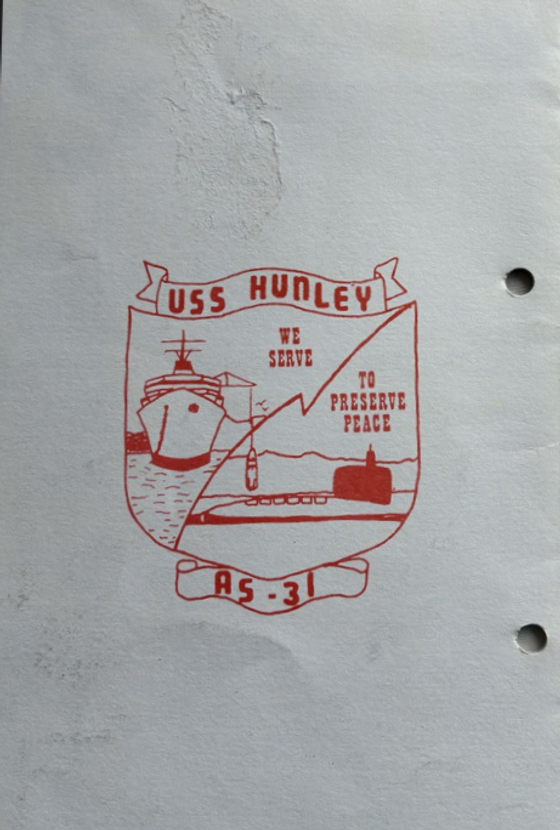
The reverse side of Margaret Hubbard's Christmas card showing the USS Hunley ship's crest.
These objects help to tell the story of the Cold War in Scotland. Along with the testimonies of veterans and locals, they also emphasise the lasting relationship between Scotland and America since this period. Despite the initial controversy when the US navy arrived, later generations of Dunoon locals find it difficult to remember a time when their American neighbours were not present.
The above has been written based on interviews with members of the American Years Revisited. Interviews were conducted over 2025 and 2026 by Dr Sarah Harper, Assistant Curator, Technology and Dr Mhairi Maxwell, Curator of Modern and Contemporary History at National Museums Scotland. They were done with the support of members of the American Years Revisited project and Andreya Kelly, Manager of Castle House Museum in Dunoon. Dates are as accurate as can be remembered.
Find out more
We have worked closely with members of the American Years Revisited group and the Castle House Museum on this community contemporary collecting project. The Castle House Museum in Dunoon is currently developing a display and booklet highlighting the impact of the US Naval Base. The museum will be the starting point for a new downloadable tour. The tour will guide visitors around key American locations in town, narrated by those knew them best.