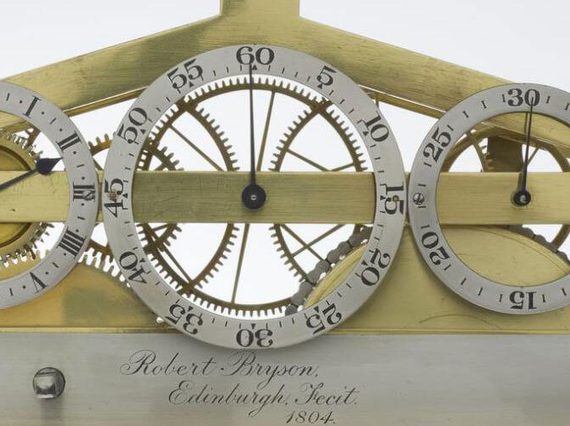
Congreve rolling ball clock: Zigzagging through time
News Story
Discover a fascinating yet temperamental clock that keeps time in an unconventional way, and learn how our former Conservator of Technology, Darren Cox, worked tirelessly to improve its accuracy.
This mechanical clock was built in 1804. At this period, most clocks kept time through the regular swinging of a pendulum, while watches used rotating balance wheels. However, instead of a pendulum, this clock uses a rolling ball and tilting plate to provide the timekeeping mechanism.
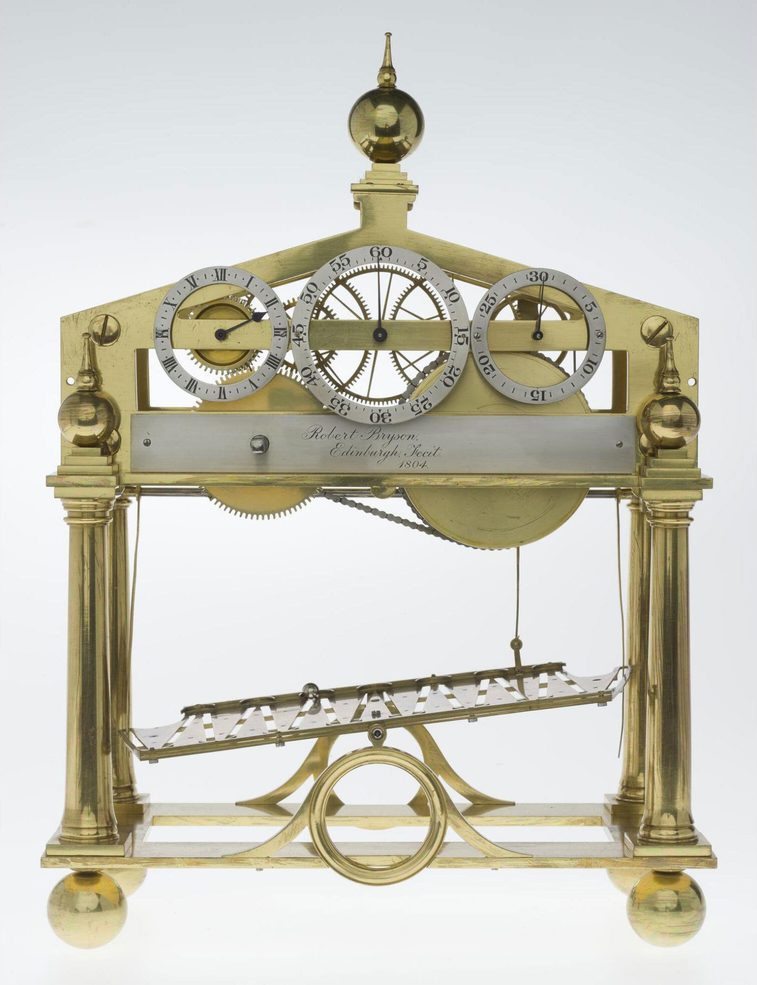
Brass Congreve rolling ball clock, patented 1808, but signed Robert Bryson, Edinburgh, 1804. Museum reference T.1972.127.
Sir William Congreve and the provenance of the clock
Sir William Congreve (1772-1828) was a military artillery officer, politician, and prolific inventor. He was most famous for designing the Congreve Rocket, used during the Napoleonic wars and the American War of Independence. Among other things, Sir William Congreve invented a special paper for printing bank notes that couldn’t be forged, and developed an interest in perpetual motion machines.
In order to regulate precision timekeeping, traditionally pendulums were used for clocks and balance wheels in watches.
Congreve claimed the credit for inventing this rolling ball clock and took out a patent for the design in 1808. Interestingly, our clock was made by the renowned Edinburgh clock maker Robert Bryson four years earlier, in 1804. It is thought that Congreve was slow in getting his patent.
Zigzag, tilt, repeat
A brass ball zigzags across a track, which is laid out on a horizontal tilting plate. When it reaches the end of the track, the ball hits a lever and a spring raises the end of the plate. This sends the ball rolling back the other way and also advances the hands of the clock by 15 seconds, 5,760 times a day.
Watch the clock in motion.
Theory versus practice
The idea sounds great in theory, but unfortunately, falls short in practice. The mechanism relies on the ball to take exactly the same amount of time to roll down the track—but it doesn't. Even a small trace of dust can disrupt the ball's rolling motion and slow it down. Temperature changes also affect the metal, causing it to expand or contract, altering the length of the track and size of the ball, further disrupting the timing.
As a result, it functions more as a kinetic sculpture than an accurate timekeeping device.
A most complicated and troublesome machine…
Buckingham Palace staff, 1837, describing a rolling ball clock they were tasked with keeping to time.
Wrestling with the law of physics
Former Conservator of Technology Darren Cox wrestled with our Congreve clock to persuade it to keep reliable time. He reset it to the correct time every working day for two months.
One full wind of the clock was supposed to last two weeks, but as Darren soon realised, the spring had aged and weakened, so the energy released by the rolling mechanism did not last as long as it should.
On top of that, despite Darren's attempts otherwise, the tilting table continuously attracted dust and debris, which affected the motion of the metal ball, which he had to polish at least once a fortnight. A custom case reduced the dust but could not entirely eliminate it.
Darren explained further frustrations about the condition of the clock and the adjustments he had to make to this very sensitive device:
"However, the biggest task in getting this clock to work was adjusting all the levers and the table that had been bent and twisted previously. It takes very little to stop the ball from rolling and if it doesn’t roll fast enough it will not be able to unlock the train of wheels and lift the table."
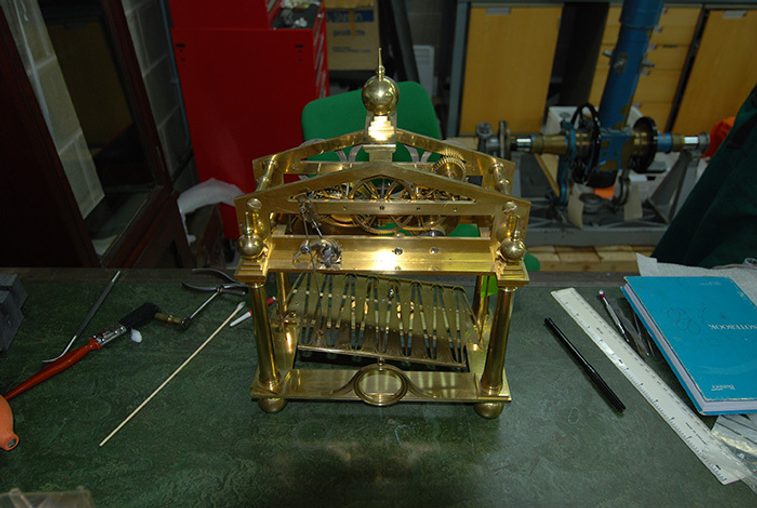
The Congreve clock in the museum's Conservation workshop. Museum reference T.1972.127.
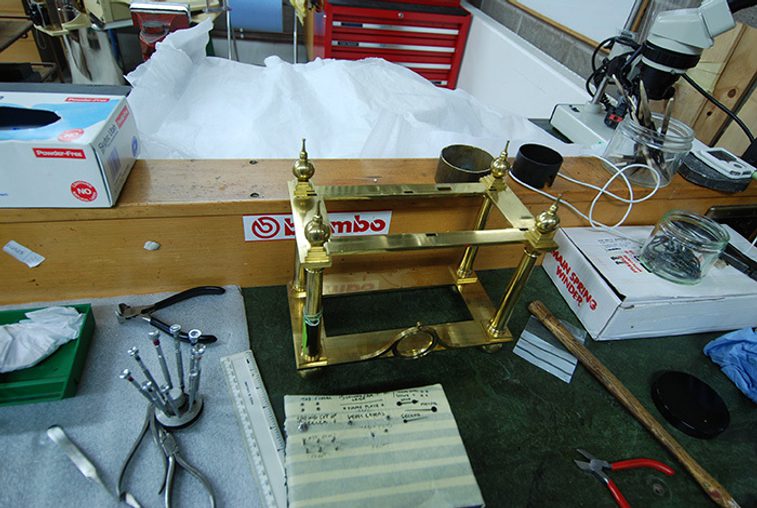
The Congreve clock frame in the museum's Conservation workshop.Museum reference T.1972.127.

The Congreve clock in the museum's Conservation workshop. Inspecting the upper section. Museum reference T.1972.127.
Adjusting for time
Darren explained more about the environmental challenges and how demanding the time adjustments were:
"The only other rolling ball clock I know well kept time to about 15 minutes a day in a very stable environment. Our engineering workshop is far from stable and this clock is very susceptible to temperature and humidity. This and the fact that I have not been on hand regularly to attend to the clock’s every need is reflected in the time keeping I recorded. I noted yesterday that the clock was five minutes slow; this morning it was two hours slow!
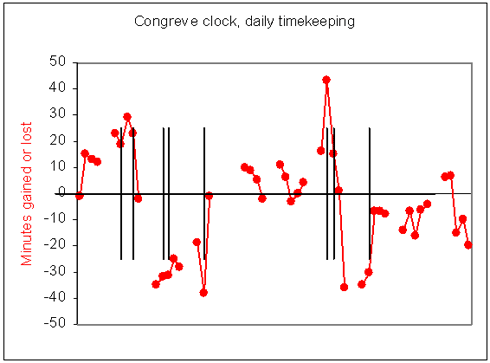
This chart shows how much time the clock lost or gained on a daily basis – up to 45 minutes a day! The vertical black lines indicate adjustments to the clock's time keeping in an attempt to correct it.
Persistence and patience
However, he has not given up hope of frictionless, dust-free conditions:
"I think if the conditions are good enough we should be able to get accuracy for this clock, give or take about 15 minutes a day, but unless the case it’s kept in is perfect at keeping the dust out, the time keeping will be a lot wilder."
The Congreve clock is displayed in the Earth in Space gallery in the National Museum of Scotland.
You might also like

Napier's bones: The logarithmic genius who revolutionised calculations
Science and technology
Written by Dr Tacye PhillipsonFind out how this brilliant Scottish mathematician and occultist invented a method of calculation that accelerated scientific discovery.In 1614, Edinburgh-born Renaissance scholar John Napier (1550-1617) invented logarithms. A means of…
The Dunlop tyre: Air apparent
Science and technology
This revolutionary pneumatic tyre was donated to the museum by its maker, John Boyd Dunlop, in 1910. But who really invented the pneumatic tyre? And who really benefitted?
The story of syringes
Science and technology
Syringes are important medical tools and have existed for thousands of years. The humble hypodermic injection is also known in Scotland as the jaborjag. Its history is more complex and is characterised by experimentation and innovation.