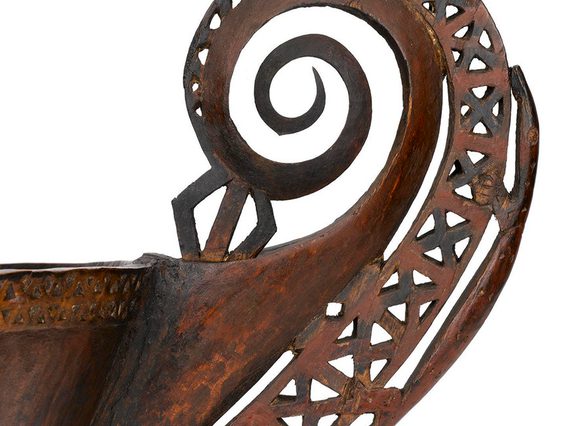
Fit for a Feast: intricate carved bowls from Lou Island
This large wooden bowl is from Lou Island, part of the Admiralty Islands, an archipelago of 40 islands off the northern coast of Papua New Guinea.
Used for large feasts it is the most distinctive type of carved bowl from the area due to its decorative carved handles.
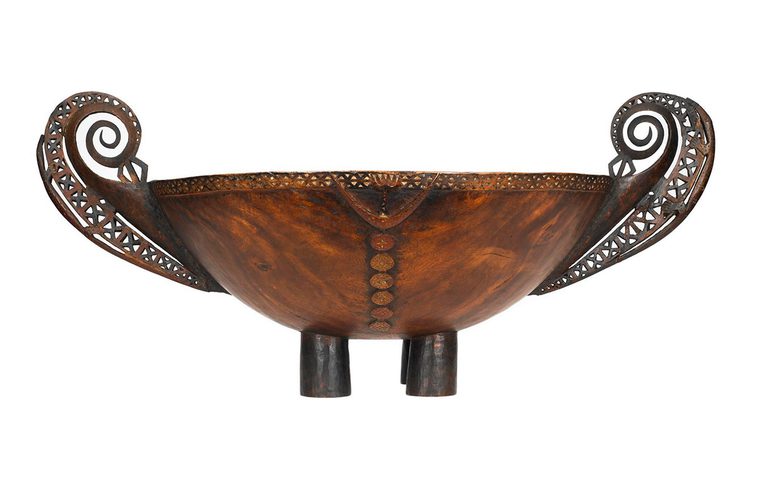
Wooden feast bowl on four cylindrical feet with attached handles, carved from wood with decorative carving around rim and elaborate fretwork on handles, the handles are attached using parinarium putty. Oceania, Papua New Guinea, Admiralty Islands, mid 19th century. Museum reference: A.1956.864
Celebrating design
During the 19th century, when the majority of these bowls were made, Lou Island was the centre of production. From there they were traded throughout the region. Smaller wooden bowls and baskets were used to hold everyday food in the Admiralty Islands. However the size, weight and design of this larger bowl means that it was more highly prized. Bowls like this one were used for feasts within special events. They were used for festivals, initiation ceremonies, funerals and bride price ceremonies. The bowls could contain large amounts of food such as taro or sago broth.
Inspired by Nature
Made from the towering Calophyllum tree, the main body of the bowl is made from a single piece of wood and hollowed out using fire. The handles are carved separately and attached to the bowl using a gum made from crushed parinarium nuts. The intricate designs were likely carved using an obsidian knife. The dark colouring and shine on the bowl comes from the production process. This is achieved by using heat and smoke, as well as the application of a patina such as coconut oil.
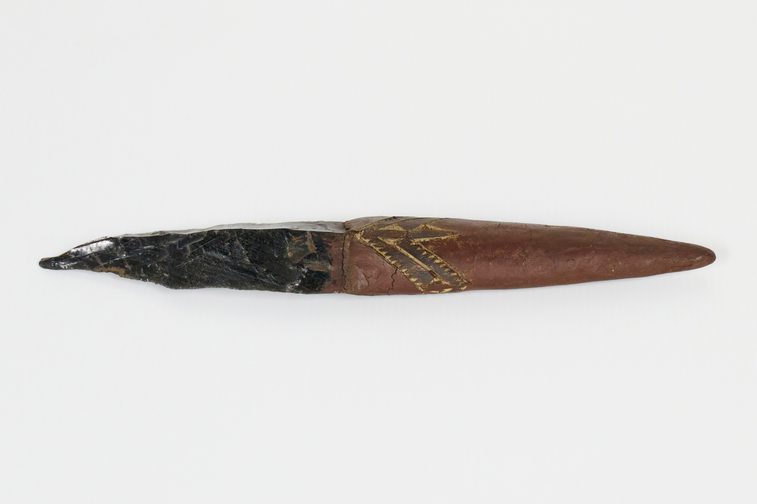
Knife with an obsidian blade and wooden handle covered with red painted gum, ornamented with incised bird designs. Oceania, Papua New Guinea, Admiralty Islands. Museum reference: A.1922.477
The inspiration for the spiral design seen carved into the handle is a subject of debate. It is thought to have been inspired by forms in the natural world such as pig tusks, cuscus tails or the shell of the sea snail. The spiral design can also be found on Admiralty Islands canoe prows and they are thought to have been based on the designs seen on these bowls.
How did the bowl come to be in Edinburgh?
The bowl was transferred to the Royal Scottish Museum (now National Museums Scotland) in 1956 from the National Museum of Antiquities of Scotland. It had been donated to them in 1901 by John Young Buchanan, a Scot who studied chemistry at Glasgow University. Buchanan had joined the Challenger Expedition (1872-1876) as part of the scientific team under the scientific leadership of Charles Wyville Thomson of the University of Edinburgh. The expedition was suggested by the Royal Society with the aim of exploring the ocean floor across the world to find undiscovered organisms. They hoped that their research could help explain the origins of life on earth. The expedition was unprecedented in scale and revolutionised western scientific understanding of the world’s oceans. Many of the scientific specimens collected are still used for environmental research today.

Scientists onboard the Challenger. John Young Buchanan is seated on a chair fifth from the left. Photograph by John Haynes.
Science and art
The crew of the HMS Challenger were instructed to investigate:
- The physical conditions of the deep sea throughout all the great ocean basins.
- The chemical constitution of the water at various depths from the surface to the bottom.
- The physical and chemical characters of the deposits.
- The distribution of organic life throughout the areas explored.
In order to do this it was proposed that ‘a staff of scientific men qualified to take charge of the several branches of investigation’ be appointed. These men were then to make ‘a collection of the objects of research’. Instructions were provided on how and what to collect. The focus was on the collection and study of organic life in the depths of the ocean. However, like many expeditions during the colonial period, members of the crew also acquired cultural belongings from the people they met around the world.

Captain Charles Wyville Thomson with Indigenous Peoples on the Admiralty Islands. Photograph by John Haynes. Museum reference: 1885.127.349
Many of these collections were donated to museums in the UK by members of the expedition including National Museums Scotland and the British Museum. We don’t know the exact circumstances in which these objects were acquired; they may have been gifted, traded, exchanged or stolen.
Buchanan donated 43 objects to the National Museum of Antiquities of Scotland. This included cultural items from Australia, Fiji and West Papua. The majority of collections came from the Admiralty Islands. We know from the Expedition reports that these would have been acquired sometime between March and October 1875. Buchanan donated two other Admiralty Islands bowls to the National Museum of Antiquities of Scotland. This included another large feast bowl this one with handles featuring stylised figures and a smaller double bowl used for food.
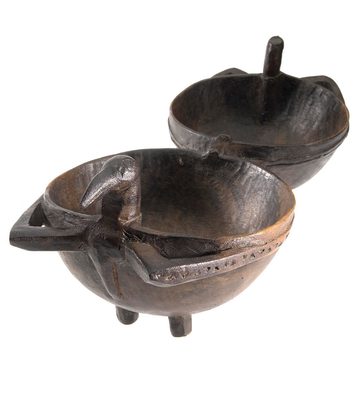
Double food bowl carved from a solid piece of dark brown wood, each half connected by two short bars, in form of a hemisphere on four feet, with a long beaked bird head at each end and two projecting openwork wings: Melanesian, Admiralty Islands. Museum reference: A.1956.866
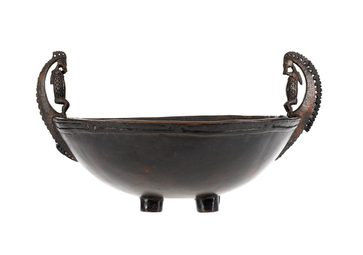
Bowl on four cylindrical feet with attached handles, carved from wood with decorative carving around rim and handles in the form of stylized figures, the handles are attached using parinarium putty, used as a container for food at marriage ceremonies and feasts: Oceania, Melanesia, Papua New Guinea, Admiralty Islands, mid 19th century. Museum reference: A.1956.865
The modern tradition of feast bowls
In 2026 Shiva Lynn Burgos from the Mariwai Project went to Lou Island. While there, she showed elders images of the carved bowls cared for by National Museums Scotland as well as other historic examples. Included in the group was carver Leslie Pokana. Leslie is a skilled craftsperson who makes large bowls with intricate handles as well as bowls shaped like birds.
Image gallery
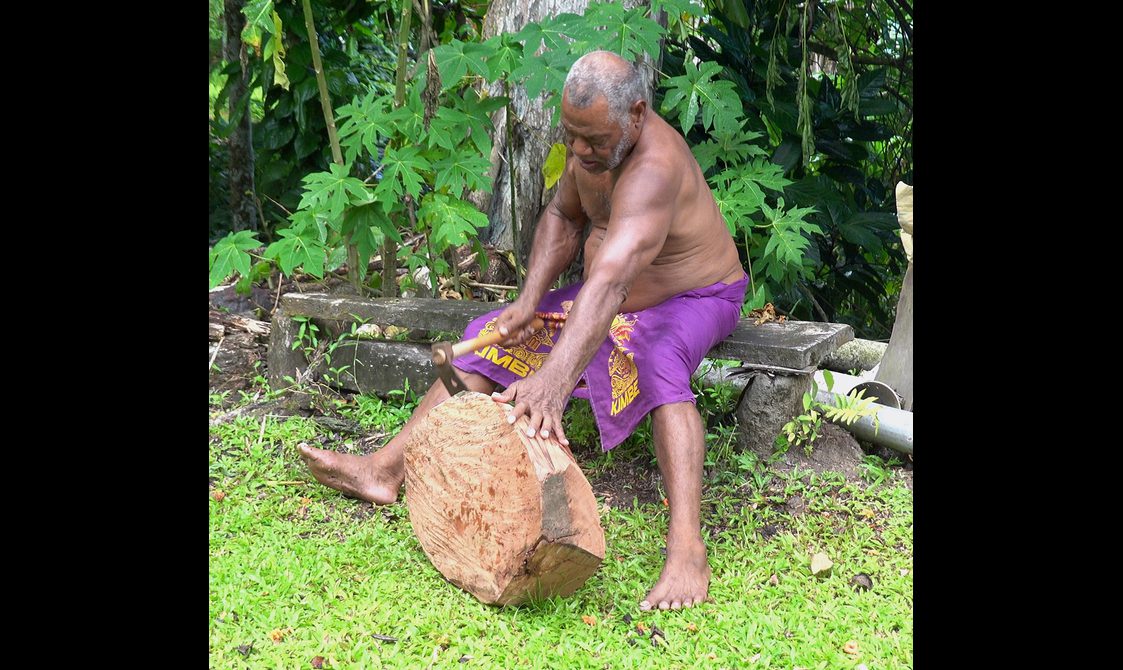
Leslie Pokana carving a bowl, 2026.
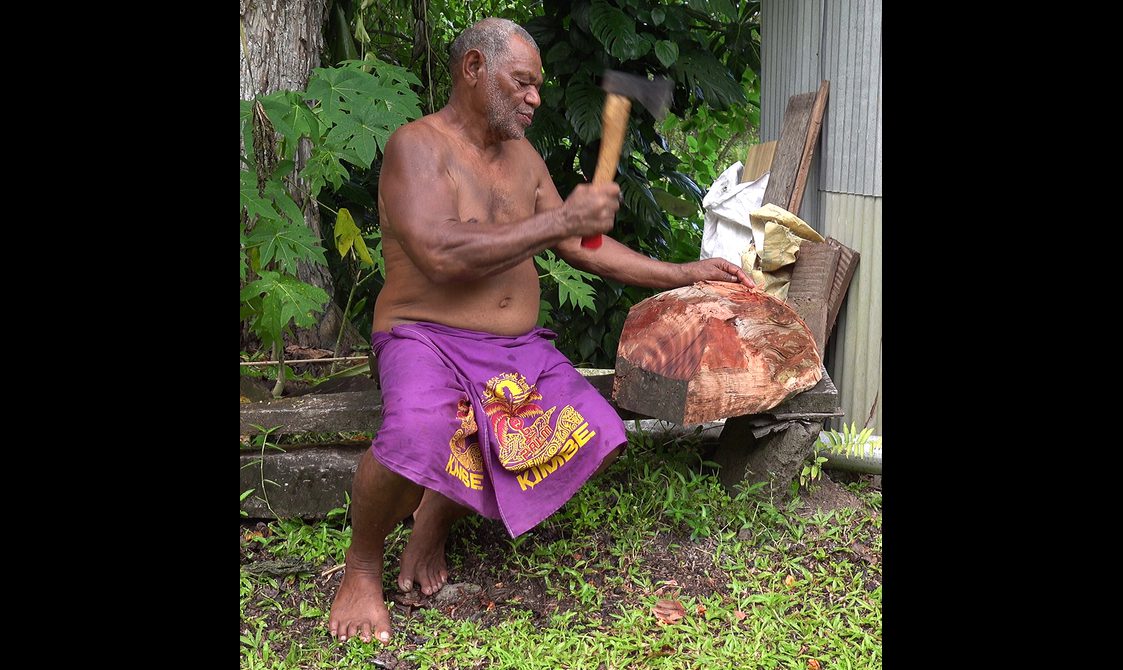
Leslie Pokana carving a bowl, 2026.

Carved bowl in the shape of a bird by Leslie Pokana, 2026.
An image of the Lou Island feast bowl is currently on display on the ‘Museum Tram’ which will operate in Edinburgh until July 2027.
This page was produced as part of the WANBEL project. ‘WANBEL: Connecting Papua New Guinea heritage across the world’ commemorates the 50th anniversary of Papua New Guinea’s Independence by sharing the exceptional and diverse arts, traditions and cultural artefacts that make up Papua New Guinea.
Written by

Dr Ali Clark
Senior Curator, Oceania
You might also like
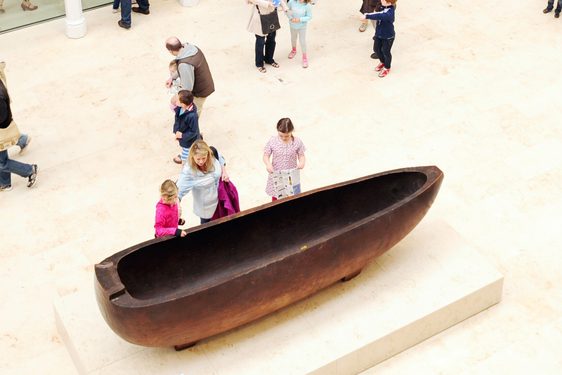
Feast bowl: From the Pacific Islands to Scotland
History and cultures
A massive feast bowl in our collection, known as an umete, comes from Atiu, one of the Cook Islands in the Pacific.Form and functionThis boat-shaped bowl is carved from a single piece of tamanu wood, also known as island mahogany. Tamanu…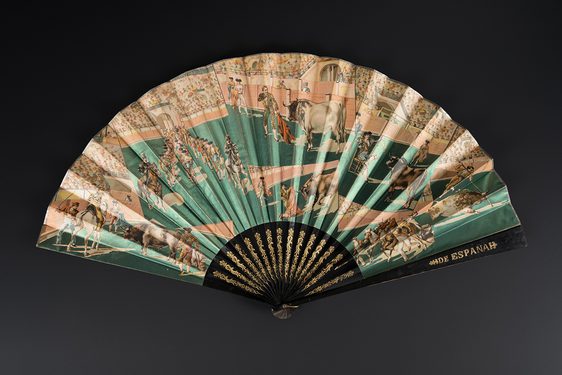
Fan favourites: 5 decorative souvenir fans
Art and design, Fashion and textiles
Written by Dr Emily Taylor & Carys WilkinsHand-held folding fans are a lightweight portable accessory. Although their practical function is to keep you cool, the decoration and materials used to make fans communicate much, much more.Fans make ideal souvenirs, intended to be…
'I am yours': 11 Scottish posy rings
History and cultures, Scotland
Written by Dr Georgia VullinghsPosy rings are some of the most evocative objects of love in National Museums Scotland's collections. These finger rings are named for the short inscriptions engraved on the inside of their band.