
Footwear lost and found
In the National Museums Scotland European footwear collections, there is a small but vital group of items that have been found in different places across Scotland and London. To understand why they are important aspects of British culture, we’ll explore their stories.
Whatever the style, footwear is an extension of people’s bodies. Footwear becomes shaped by individual movements and to individual feet, telling highly personal stories - carrying meaning beyond a wearer’s use.
The footwear collection
The European footwear collection holds examples from the late 14th-century to the present day. Most items date from circa 1750 to 1970, and the collection is mostly women’s footwear from wealthy households.
Children’s footwear largely dates to the 19th and early 20th-centuries. Men’s footwear is often activity specific, such as Highland suit shoes and riding boots. Most men’s footwear examples connect to professions in the Military History, Aviation and Rural Life collections.
European footwear has usually been collected because of the design of the shoe. The collection shows how shoe shape has changed over the decades, or through an association with a specific person.
Working class footwear rarely survives and is less frequently offered to museum collections. A founding Director of the the Industrial Museum of Scotland (later the National Museum of Scotland) – George Wilson – even had difficulty in persuading tradespeople that their tools and trade were of value to a collection, including shoemakers:
‘… one of the chief, and I confess unexpected, obstacles which I encounter in seeking to fill the Industrial Museum with examples of Art, is the humble estimate which men form of their own callings. I cannot persuade a shoemaker that shoes are of interest to any but shoemakers and the barefooted public, although he looks with eager curiosity at my collection of hats in all their stages.’
This is what makes the small group of found footwear important to preserving our cultural history. Many of our found shoes are worn, patched and representative of industrious feet from the past.

Child's shoe found in London, 1500s. Museum reference A.1907.188.

Shoe found in London, dating to circa 1545-1560. Museum reference A.1906.473.
Found footwear
There are around 46 objects in the collection which have been recorded as found or ‘dug up’ in a non-archaeological context. 26 of these are items of footwear.
Nine items are recorded as ‘found’ or ‘dug up’ in London, mostly from Worship Street in Finsbury. These were acquired by the Museum in 1906 and 1907 from the well-known antiquarian, collector and dealer George Fabian Lawrence (1861-1939), popularly referred to as ‘Stoney Jack’.
Lawrence cultivated relationships with tradespeople in London, and paid them for finds of interest to him (and posterity). The shoes Lawrence sold on to National Museums Scotland are the only shoes from the 14th-17th-century in the collections. They are individual shoes: six men’s and three children’s.

Shoe found in London, dating to the 1570s. Museum reference A.1906.470
The date of these finds and rarity of survival of personal items before 1650, is likely why the Museum acquired them. Although the area of their discovery was noted, the specific context of the finds was not. Objects from the same excavation and building works can be found in the Museum of London.

Uncovering footwear
The group of found footwear in the collection includes a pair of leather brogues found at Culloden field and dated to 1746. It's likely that their owner participated in and perhaps died on the battlefield on 16 April that year, when around 1,500 Jacobites were killed.
The brogues have been extensively cleaned, probably by the dealer, without a record of their condition when they were found. Yet there are areas where the leather has worn and the sole carries a foot shape from use. These brogues are a unique find as very little pre-1750 regional dress from the Scottish Highlands survives.

A woman's boot found in a canal near Ratho. Museum reference V.2023.143
Also found outdoors, in the muddy depths of the canal near Ratho on the outskirts of Edinburgh is a woman’s boot. Uncovered during work on the dry dock, the boot is in very poor condition which allows us to see the layers of leather and construction. Originally a robust boot, the small size makes it likely to have belonged to a female who worked on or near the canal – someone who would have needed a strong, waterproof boot with double-walled leather. The context of how the boot was lost will never be known.
Buildings in luck
The remaining ‘found’ footwear pieces are associated with buildings. They were concealed in chimneys, under floors and in roof spaces. Most were found as single items, but the collection also includes three pairs.
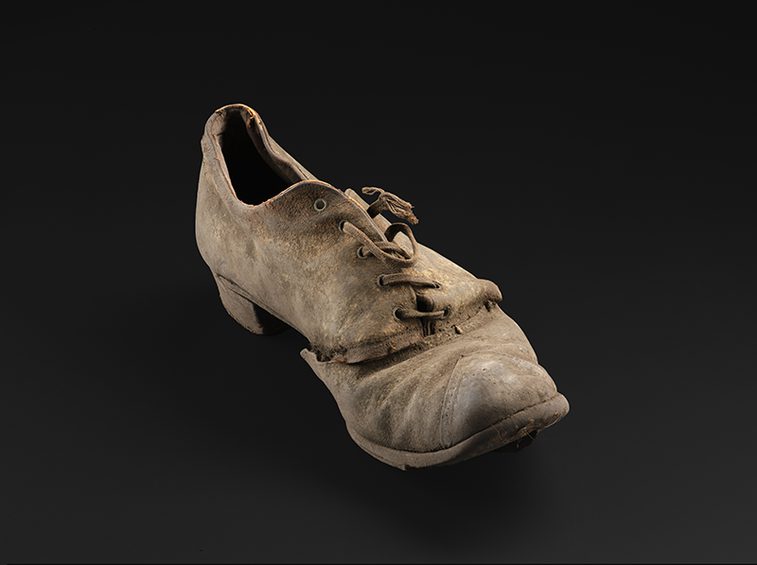
Shoe concealed in a chimney, 1863. Museum reference V.2023.134.
The deliberate concealment of footwear in buildings has intrigued scholars and curators since around 1957. The late June Swann MBE, then curator at Northampton Museum, began recording finds after concluding that not all examples could be explained as accidental.
June began the Concealed Shoes Index, which continues to record shoe finds. If you ever find a similar concealed shoe in your property, please contact the index.
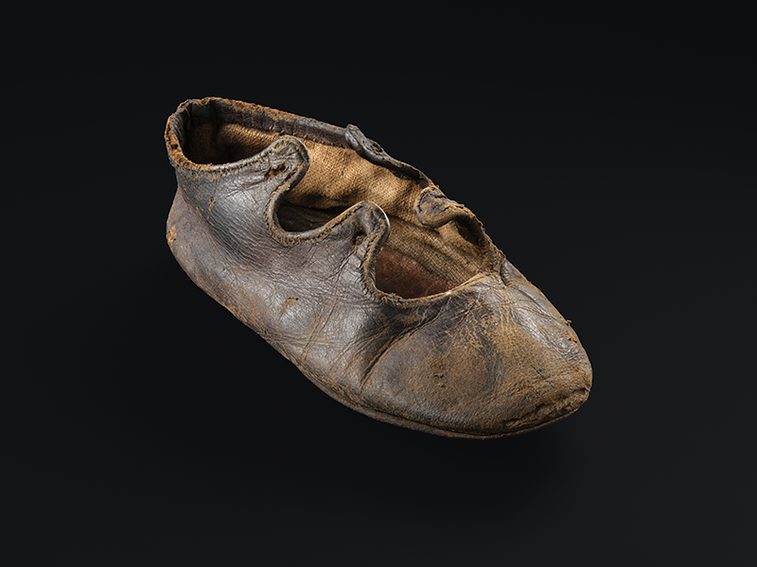
Concealed shoe of c. 1810 found at Bristo Port Buildings. Museum reference A.1986.94.
In 1986 National Museums Scotland joined the process of tracing concealed shoes. Renovation work at Bristo Port buildings uncovered a child’s shoe in the roof, circa 1810, and a public call for information went into the local news.
The curator Naomi Tarrant passed information to June Swann and helped to establish that concealing shoes was practiced throughout the British Isles.

Shoe found at No.4 The Cross, Cupar, Fife c.1800. Museum reference A.1989.203.
In his publication Magical House Protection: The Archaeology of Counter-Witchcraft, researcher Brian Hoggard has suggested that the depiction of unofficial Saint, John Schorn (died 1313), generated a belief or superstition that malevolent spirits and demons could be capture in a boot or shoe.
Beliefs around bringing luck and warding off the ill-intended become layered with different regional and cultural practices - especially when a cultural tradition is not spoken about. June Swann’s early research suggested that concealing shoes was a predominantly male tradition in the UK. It's thought to often have been men who insisted that a found item be left within a building. This may be due to the building trades being a predominantly male occupation. However, many items are concealed after a building has been finished, so they were not always concealed by tradesmen.

A shoe with elastic and lacing, c.1860. Museum reference V.2023.135.
After Naomi Tarrant’s public call for information on concealed shoes, she received messages and ideas. One was from a carpenter who she noted as sounding elderly on the telephone; he told her that shoes were concealed for luck. He preferred to remain anonymous.
The association with specifically ‘old’ shoes as lucky was very strong in the 19th and early 20th-centuries. On 18 April 1861 The Scotsman republished an announcement on the marriage of Lord John Russell’s daughter:
‘The happy pair left about two o’clock for Lord John Russell’s seat, Rodborough Manor, near Stroud, Gloucestershire, and from the crowd of fashionables who were assembled to witness their departure, at least half-a-dozen old satin shoes were thrown after the carriage, as an omen of good luck.’
The Scotsman, 18 April 1861
This tradition would lead to tying shoes to the back of a wedding carriage or car. The wedding shoe tradition was of interest to historians in the 1860s too. On 1 July 1869, The Scotsman published extracts from 'The Wedding Day in All Ages and Countries', including a reference to Jules Michelet’s book ‘Life of Luther’.
In it, Luther tells a bridegroom, 'that, according to common custom, he ought to be master in his own house when his wife was not there; and for a symbol he took off the husband’s shoe and put it upon the head of the bed'.

Boot found on top of the box bed at Charlesfield Croft, Auchterlees. Museum reference H.TA 117.

Pair of boots found under the floor of a tenement in Hillside, Edinburgh. Musuem reference K.2019.38.1 & 2.
The number of children’s shoes found concealed may sadly relate to high infant and child mortality rates in the past. It’s impossible to know whether those shoes were concealed in relation to a specific person, or because they were used and no longer needed.
Footwear forensics
Footwear and footsteps have featured within crime scene forensics since their scientific recording in the 19th-century. In her article First Impressions: Footprints as Forensic Evidence in Crime Fact and Fiction, Alison Matthews David noted that close analysis of material culture by historians is similar to police detection.
A pair of concealed boots found under the display cases of National Museums Scotland’s galleries in 1977 lend themselves to a detective reading.

Pair of concealed boots found under the display cases of National Museums Scotland's galleries in 1977. Museum reference A.1977.307 A.
The boots were found in part of the building finished in 1875, but the date of the display cases they were under is unknown. Their condition also leaves uncertainty for stylistic dating, but they are considered to date between 1875-1914.
The boots are in the Balmoral style, created by Prince Albert in the mid-19th century for use around the Highland estate. Boots were expensive because of the materials used, but they wore well. A pair that both looked good and functioned for work would have appealed to any working man with a sense of style.
The boots show that the wearer’s occupation meant their right foot was often bent. The toes and sides have been ‘revamped’ with patches, and it's clear from leather condition that the boots were worn in the wet. There are lines suggesting that the laces were sometimes wrapped around the ankle from the lowest hooks, instead of tied to the top. This would have been helpful if the boot needed to flex when the wearer knelt. The top of the boots are generally rubbed by trouser cuffs.
The context of where the boots were found allows us to make a reasonable assumption these belonged to a workman involved with the Museum case building. These boots give us a rare example of working men’s stylish treads.
Footwear stories
The condition of these found shoes and boots has a lot to tell us about people’s feet, young and old. We can see how footwear wore out, was repaired, discarded and kept across social classes and age groups. The context of where the footwear was found tells us about life, death, cultural beliefs and character. Knowing how shoes were concealed, it’s tempting to consider whether those ‘dug up’ in London had once protected chimneys, floors and ceilings.
However, a word of caution if you are considering removing your shoes to evade detection:
‘Alexander Mackay […] pleaded not guilty [to intent to commit theft]. In evidence it was stated that a policeman saw a pair of men’s shoes on a gravel path at the entrance to the house in question. On picking them up he discovered that they were warm. While examining the shoes the constable saw a man jump over a wall. […] about half an hour after midnight Mackay was met walking without shoes. He explained that a man much bigger than himself had stopped him, and commanded him to part with his footwear […]. At the conclusion of the hearing Bailie Wilson remarked that, as the accused was a former member of a Highland regiment, he hardly believed that a man, even if he was seven feet tall, would put him into such a state of “funk” as to make him part with his shoes. He passed sentence of thirty days’ imprisonment.’
The Scotsman, 26 May 1927
Further reading
Hugh Cheape, ‘Charms against witchcraft’: Magic and Mischief in Museum Collections’ in Witchcraft and Belief in Early Modern Scotland, edited by Julian Goodare, Lauren Martin and Joyce Miller (Palgrave Macmillan, 2008)
Alison Matthews David, ‘First Impressions: Footprints as Forensic Evidence in Crime Fact and Fiction’ in Costume, 53.1 (2019): 43-46
Jenny Hockey et al., 'Worn Shoes: Identity, Memory and Footwear’, in Sociological Research Online, 18:1 (2013)
Brian Hoggard, Magical House Protection: The Archaeology of Counter-Witchcraft (Berghahn Books, 2019)
Emily Taylor, ‘Accidental Remainders: Working men’s fashion c.1730-1880 in National Museums Scotland’ in Everyday Fashion Interpreting British Clothing Since 1600, edited by Bethan Bide, Jade Halbert & Liz Tragenza (Bloomsbury, 2024)
June Swann, ‘Shoes in Concealed Buildings’ in Costume, 30:1 (1996): 56-69
Geoffrey N. Swinney, ‘George Wilson’s Map of Technology: Giving Shape to the ‘Industrial Arts’ in Mid-Nineteenth-Century Edinburgh’, in Journal of Scottish Historical Studies, 36.2 (2016): 165–190
Written by

You might also like

Old square toes: A rare pair of British jack boots
Fashion and textiles
Written by Dr Emily TaylorIn 18th century Europe, developing trends in male footwear made sure that riding boots were – in Nancy Sinatra's words – 'Made for Walking'.
The lost sock: An ancient Egyptian textile
History and cultures
Written by Miriam McLeodIn 2019 National Museums Scotland opened a redeveloped Egyptian gallery. Many of the objects chosen for the new space had never been on display before. Among them were some fascinating textiles that intimately connect us with the ancient…
Fan favourites: 5 decorative souvenir fans
Art and design, Fashion and textiles
Written by Dr Emily Taylor & Carys WilkinsHand-held folding fans are a lightweight portable accessory. Although their practical function is to keep you cool, the decoration and materials used to make fans communicate much, much more.Fans make ideal souvenirs, intended to be…