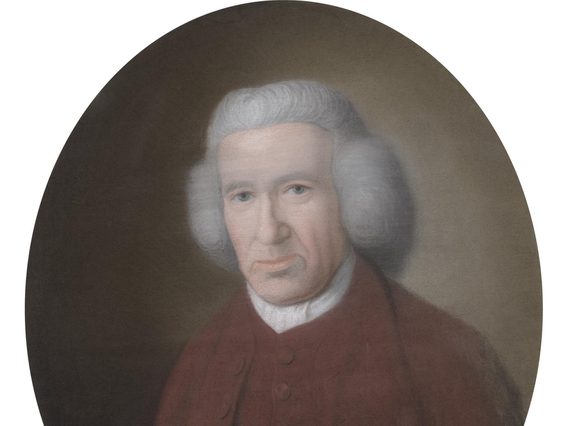
James Ferguson in 13 objects
James Ferguson was born into a working family in a rural hamlet in Banffshire in April 1710. He had little formal education, saying that he taught himself to read by listening as his father taught his elder brother.
His father later taught him to write and, at the age of seven, enrolled him for three months in the school in Keith. As was typical of schools of the time, all students would have been taught in a single room. At age 10, Ferguson started work as a shepherd lad, watching sheep and the stars.
Despite this less academic start to his life, by the time he died in 1776, he had earned many accolades. He was a Fellow of the Royal Society of London and a Member of the American Philosophical Society. He was also acknowledged as an astronomer, lecturer, inventor, author and artist.
A considerable amount of varied material associated with James Ferguson survives. This reflects both his own efforts at self-publicity and the enduring interest in his success as a self-educated scientist.
1. Bonnie Prince Charlie portrait
James Ferguson made his living in many different ways over his life. He watched sheep as a boy, was employed as a servant and for many years supported himself as an artist. This involved drawing miniature portraits for 9 to 10 ½ shillings (about £1500 in today’s wages). In his memoir, he wrote that by 1743 he ‘began to be tired of drawing pictures, in which, I confess, I never strove to excel, because my mind was still pursuing things more agreeable’.
However, he continued to need this source of income until about 1760. From that time, he gradually increased his earnings from work he found more interesting.
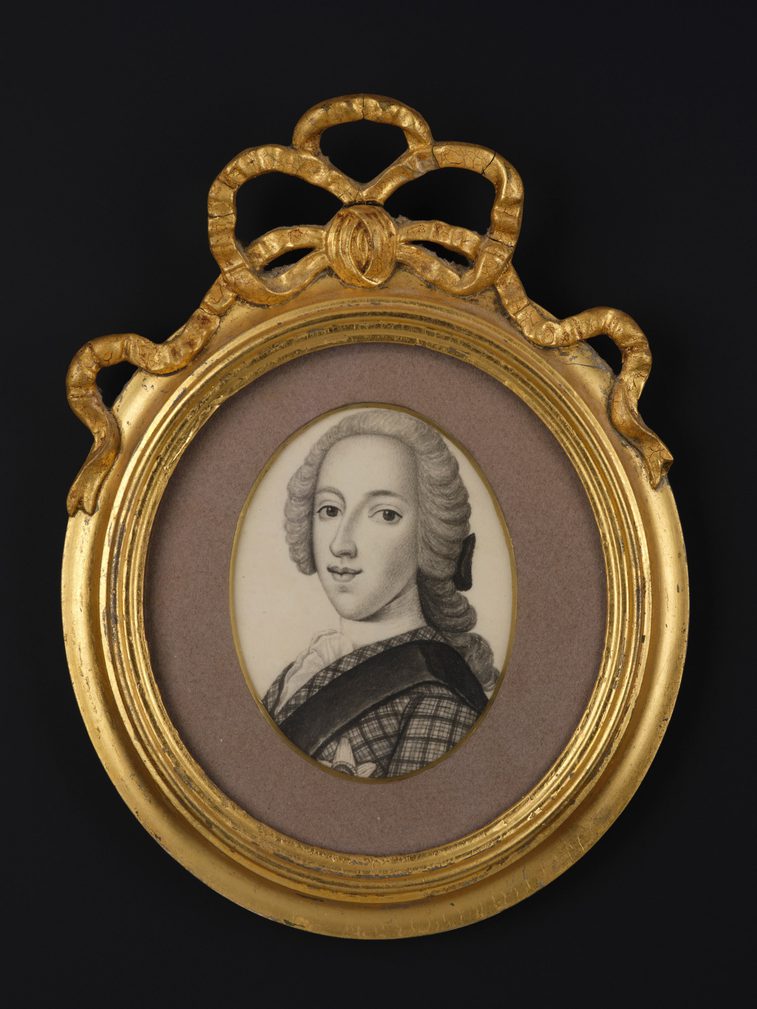
Miniature portrait of Charles Edward Stuart (Bonnie Prince Charlie), following another artist’s image rather than drawn from life, by James Ferguson, c. 1750. Museum reference: X.2021.37.
2. Astronomical instrument
Ferguson became known as an astronomical lecturer and demonstrator. We would now call him a science communicator for an adult audience. During this time, he developed many diagrams and demonstrations. This was his first published device, in 1742. It has rotating paper disks and shows eclipses, tides, phases of the moon and much more. It was well received by professionals, but Ferguson’s later designs were often simpler, showing fewer things at a time, in a way which was a bit more accessible to a wider audience. The good condition of this paper instrument suggests that it may not have been used very much.
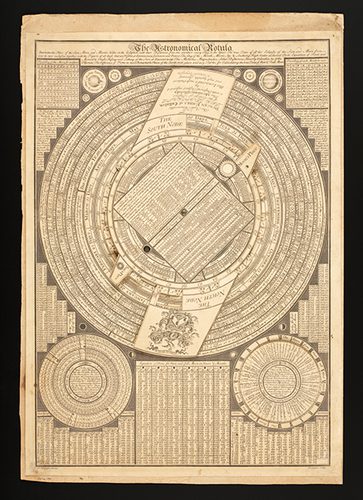
Printed paper instrument with rotating dials and instructions, called the astronomical rotula, by James Ferguson, Edinburgh, 1742. Museum reference: T.1974.186.
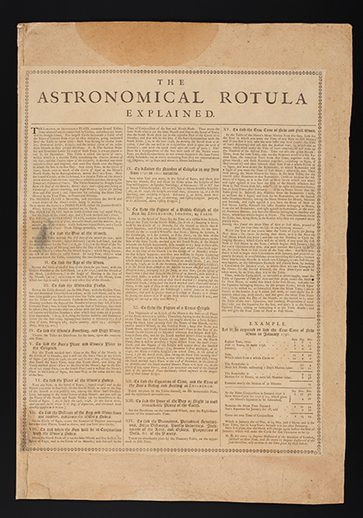
3. Luminarium
In 1752, the United Kingdom changed from using the Julian calendar to using the Gregorian calendar. In doing so, 11 calendar dates were skipped to make the switch. Ferguson published his Luminarium in mid-1751, and this scarce example shows the Gregorian calendar. It could either have been engraved in anticipation of the date change, or have been a second edition. As Ferguson would have been aware of the date change coming up, and the Act of Parliament governing it, it seems less likely he would have gone to the effort and expense of having a dial printed which would so soon be out of date.
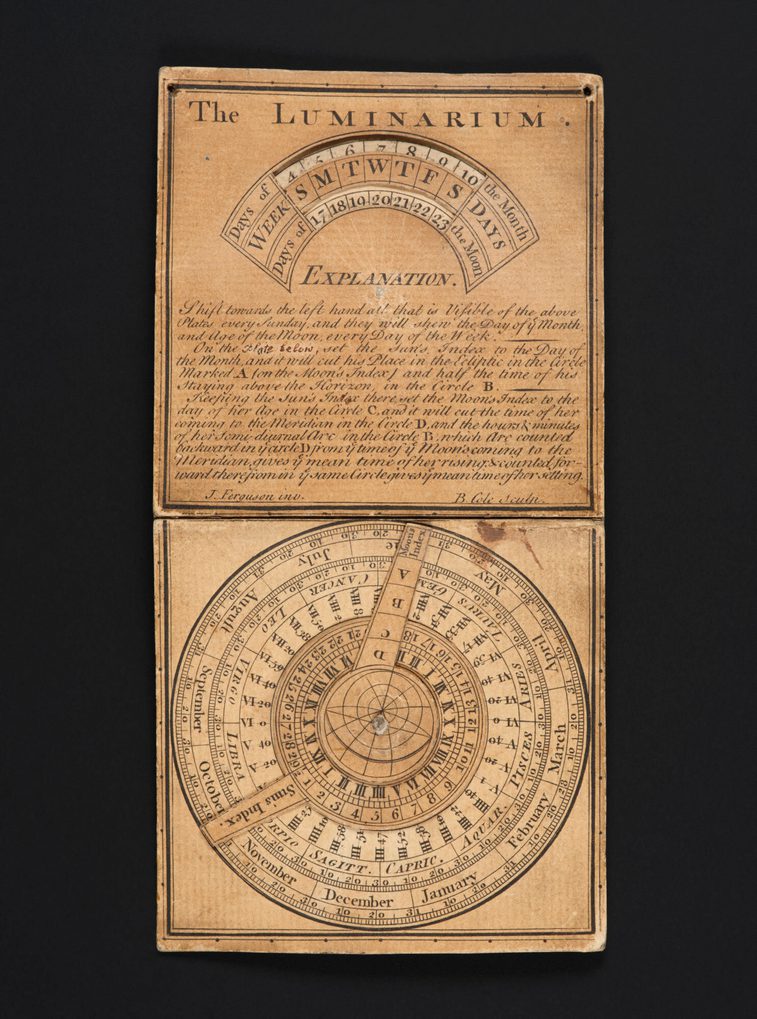
Ferguson's luminarium, a card giving information about the sun and moon, including their rising and setting times for any day of any year, probably 1751. Museum reference: T.1962.110.
4. Clock dials
In about 1757, Dr Benjamin Franklin of Philadelphia devised a clock with a very simple mechanism that only had three wheels. This design was published only by his friend James Ferguson. To read the clock, you needed to know roughly what time of day it was. This was because the single hand, which indicated both hours and minutes, completed a revolution every four hours rather than every twelve hours on a common analogue clock. Ferguson’s development of this mechanism still had only three wheels. However, it also showed the 12 hours on a rotating dial with a fixed pointer and had a conventional minute hand.
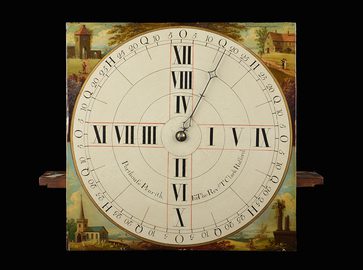
Dial of 'Franklin' longcase clock as published by James Ferguson, signed by Porthouse of Penrith, c. 1810 Showing 4:18, or 8:18, or 12:18. Museum reference: T.1982.174.
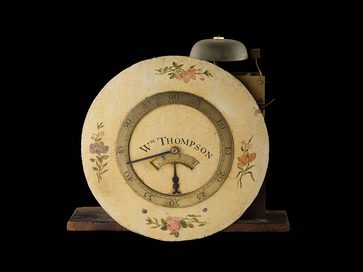
Dial of longcase clock, with 3-wheel clock movement to the design of James Ferguson, signed by William Thompson, c.1775 showing 9:42. Museum reference: T.1982.58.
5. Pocket globe
In October 1755 Ferguson bought moulds and printing plates for making globes from Mary Senex. However, he sold them on in 1757. In this brief time in the globe business, he produced plates for printing these revised ‘pocket’ globes. The continents are shown on the globe and the case is lined with the constellations.
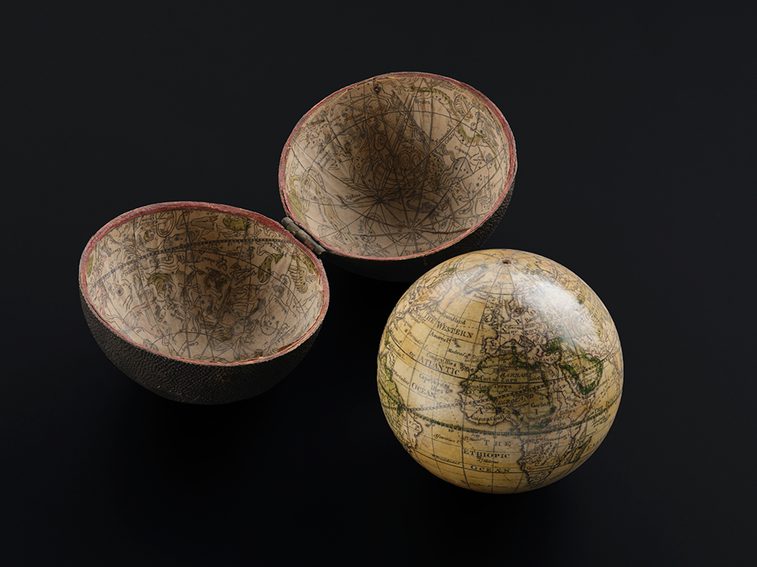
3-inch (7.6 cm) pocket terrestrial globe in a hinged black sharkskin case with a celestial map on the inside by James Ferguson, 1750s. Museum reference: T.1962.18.
6. Lecture ticket
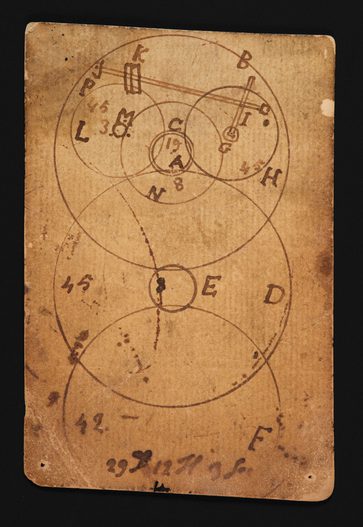
James Ferguson gave popular lectures to interested audiences. This included giving demonstrations and showing apparatus that he had designed or improved. He charged a guinea to attend a course of 12 lectures. Most of these lectures were held in London, but he also toured with all his demonstration equipment. He toured to Edinburgh in 1768. Faded ink reveals that this ticket was for the fourth course he gave in Edinburgh that year. On the back of this particular ticket is a diagram of a complicated clockwork mechanism for adding the phases of the moon to a clock or watch. This had recently been invented by his friend the clockmaker Thomas Mudge.
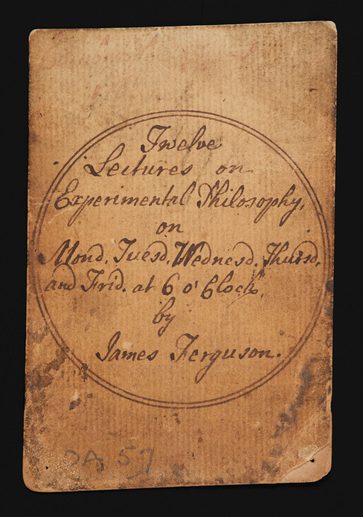
Ticket of admittance to a course of twelve lectures on Experimental Philosophy by James Ferguson, dated 6 June 1768, in Ferguson's own handwriting. Museum reference: H.OA 57.
7. Snuff box
This snuff box was made by James Ferguson from silver, ivory and two colours of wood. He made at least two other similar boxes, which were given as presents to members of his family. It is likely this one was also made as a gift rather than as part of one of his businesses. Snuff, finely ground tobacco for inhalation, was carried in airtight boxes to prevent it from drying out.
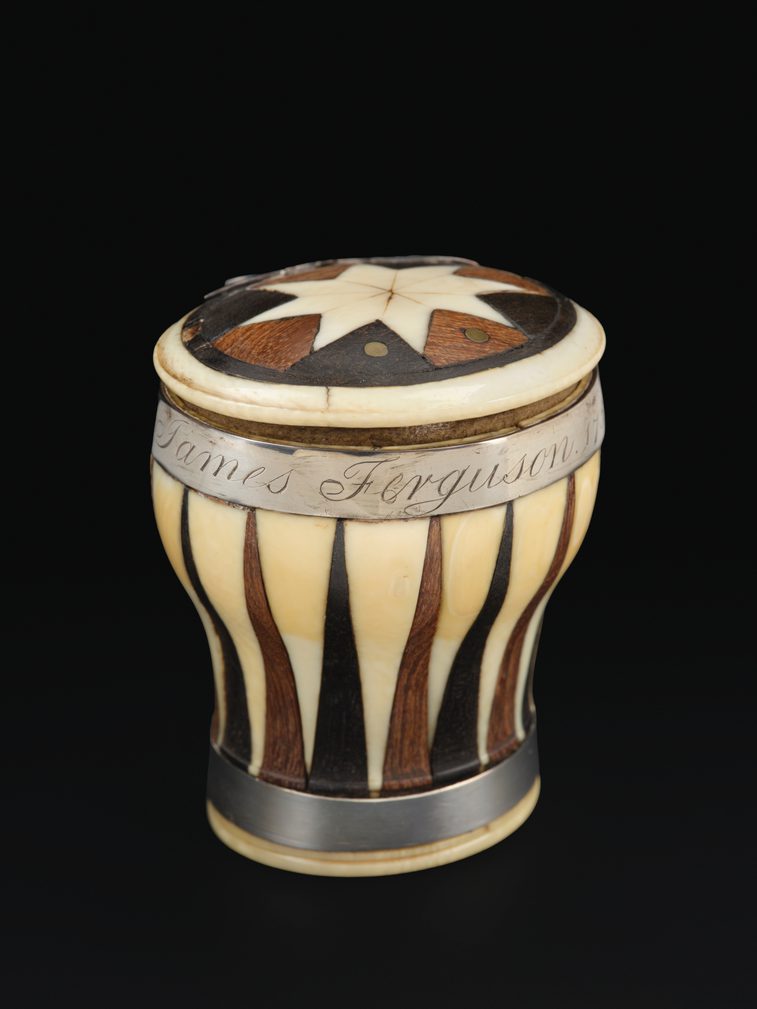
Silver-mounted snuffbox of ivory and wood, inscribed "JAMES FERGUSON, 1754". Museum reference: H.NQ 42.
8. Device for curing toothache
Later in his career, Ferguson took an interest in the ongoing medical experimentation in the excitingly new and developing scientific field of electricity. This object exactly matches a diagram in his 1770 book 'An introduction to Electricity'. The device was designed to deliver an electric shock across a painful tooth or gum. This is what we now call static electricity.
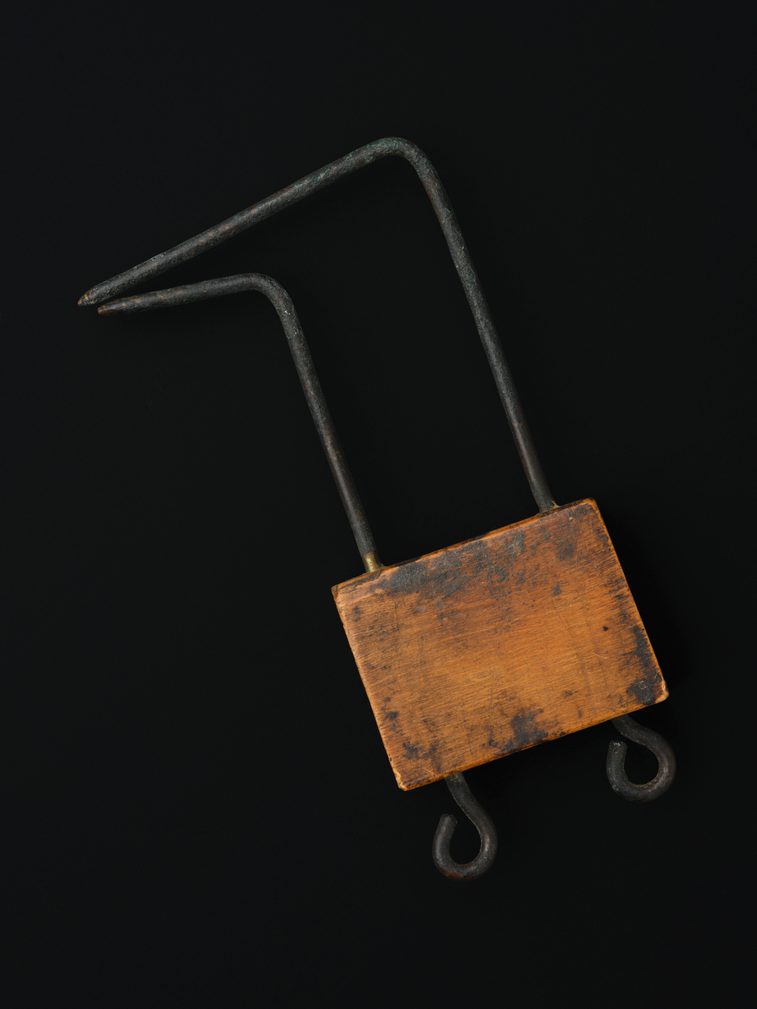
Electrical device for curing toothache by electric shock, boxwood block with 2 brass wires through the block, bent at one end to clamp tooth, designed by James Ferguson c. 1770. Museum reference: T.2013.56.
9. Demonstration apparatus
Ferguson advertised his expertise and lectures through the publication of books which included diagrams of his apparatus. These publications also formed another source of income. This demonstration apparatus is an example of a piece made to his design but not made by Ferguson himself. It shows the small weight in the centre holding up the two large weights at the sides of the apparatus, thanks to the angle of the wedge. It is a bit fiddly to set up so that it balances. This fine example was owned by the wealthy collector of scientific apparatus Charles Nicoll Bancker of Philadelphia.
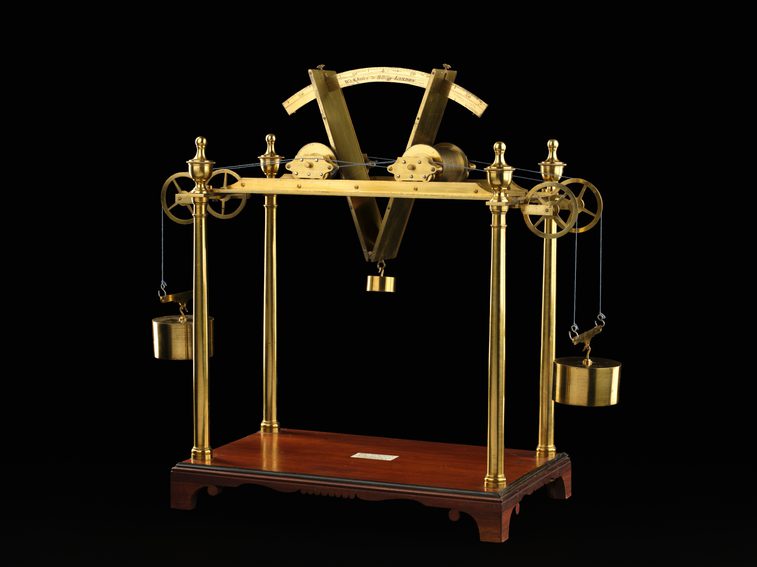
Ferguson's mechanical powers apparatus in a mahogany case, by W. and S. Jones, Holborn, London, c. 1800, probably commissioned by Charles Nicoll Bancker of Philadelphia. Museum reference: T.1984.1.
10. Pyrometers
Ferguson devised two demonstration pyrometers. These make visible the expansion of metal bars when they are heated. This example of Ferguson’s simpler first version (published 1759) was probably commissioned for the chemistry lectures of Edinburgh University. The more elaborate second version (published 1764) is from the same private collection and maker as the mechanical powers apparatus.
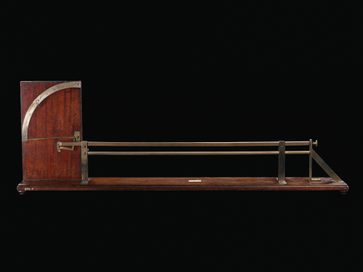
A Ferguson's pyrometer from Edinburgh University made by J Dunn, Edinburgh c.1820-40. Museum reference: T.1858.275.7.
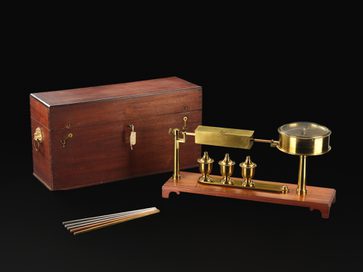
Ferguson's pyrometer in a fitted wooden case, by W. and S. Jones, Holborn, London, c. 1800, probably commissioned by Charles Nicoll Bancker of Philadelphia. Museum reference: T.1987.354.
11. Orrery
In 1764, James Ferguson published a simple but counterintuitive gear system for an orrery. This showed the relative motion of the Earth around the Sun and the origin of the seasons. Orreries, ranging from the simple to the highly elaborate with all the planets, were popular demonstration pieces for explaining our place in the solar system and how we experience the motion of the Earth, Moon and planets. Few individuals, who were not astronomical lecturers, would have owned one. This example doesn’t use the exact gear work from his publication, but was based off Ferguson’s original design.
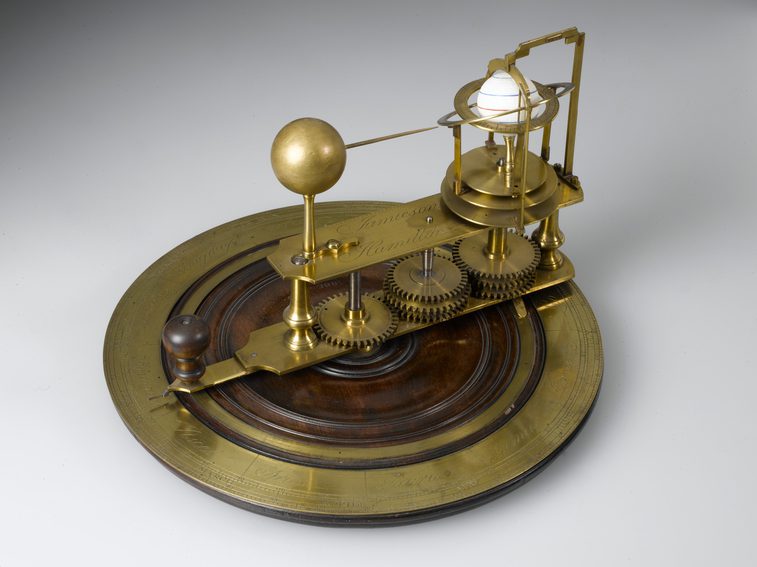
Orrery after James Ferguson by George Jamieson of Hamilton, c. 1780. Museum reference: T.1885.130.
Full text description of orrery
An interactive 3D model of an orrery. It is composed of a flat round base turned out of dark wood with brass rings around the outside. It is engraved with the year and the signs of the zodiac. Mounted from the centre is a brass construction with a dark wooden handle and a pointer for the year scale at one end. The main body of the brass mechanism has two brass plates between which are mounted three sets of gears. These gears would turn if the whole top were rotated around by the handle. On the top is a gold coloured ball, just offset from the centre, which represents the sun. It also has a spike, representing sunlight, pointing at a white painted ball which represents the Earth. Around the Earth ball is a brass framework of angled rings that indicate among other things the angle of the moon’s orbit. On the underside is a paper label with the museum object number.
12. Model of a pile driver
The building of Westminster Bridge from 1739-50 was a grand spectacle of civil engineering. During the building work, the award-winning pile driver which pounded foundations into the bed of the river Thames was highly visible. The original pile driver raised a 770 kg weight up to 3 m before letting it fall. It was powered by four horses on the platform that is represented by the polished wooden base of this small model. Several people made working models of this pile driver, and published explanations. While this example is unsigned, it most closely resembles the plate published by James Ferguson.
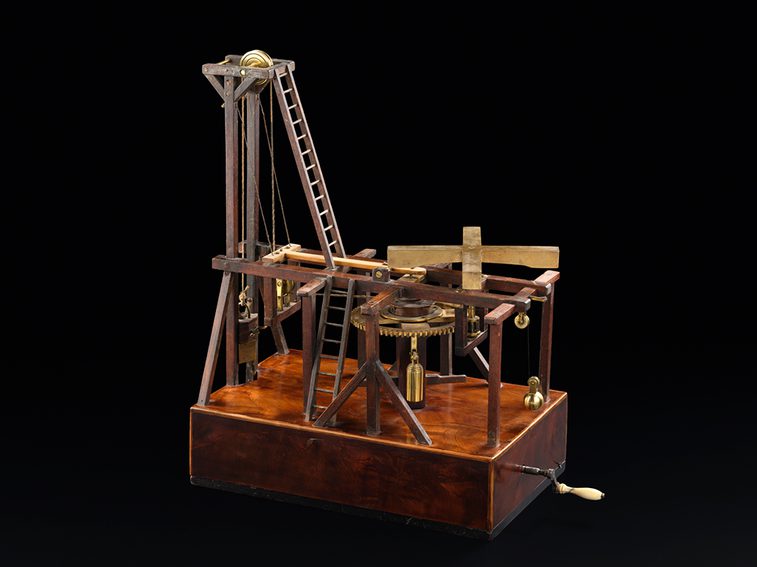
Demonstration model of a pile driver based on the design of James Valoue for Charles Lobelye's pile driver for the caissons of Westminster Bridge, London about 1740. Museum reference: T.1986.15.
13. Sundial
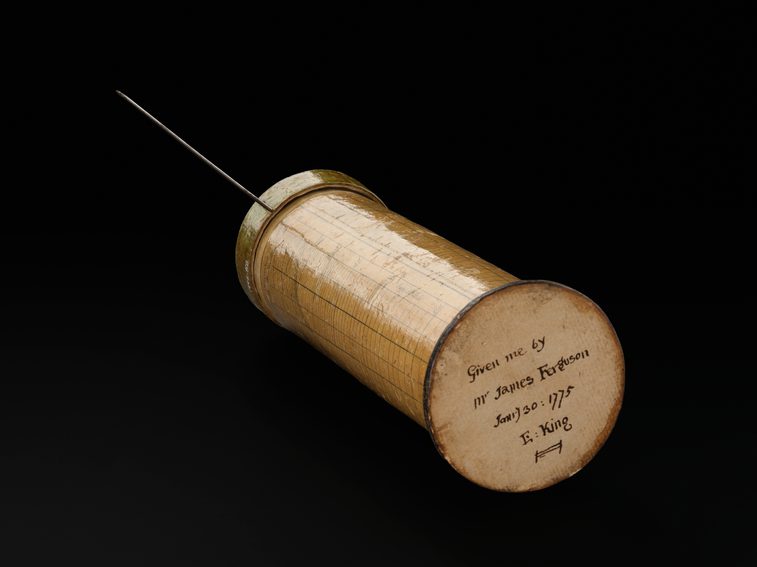
Sundials were the most common way of setting clocks and watches to the correct time. They use the motion of the Earth relative to the Sun to determine the time. This sort of sundial is a bit harder to use than a simple garden sundial, but also can show more about the rotation of the Earth. It was made by taking a printed plate from one of Ferguson’s books which was wrapped round the cylinder and varnished. We don’t know who E. King, the recipient of this dial, was. However, the inscription shows that it was valued for the personal association with Ferguson, and not simply as a sundial.
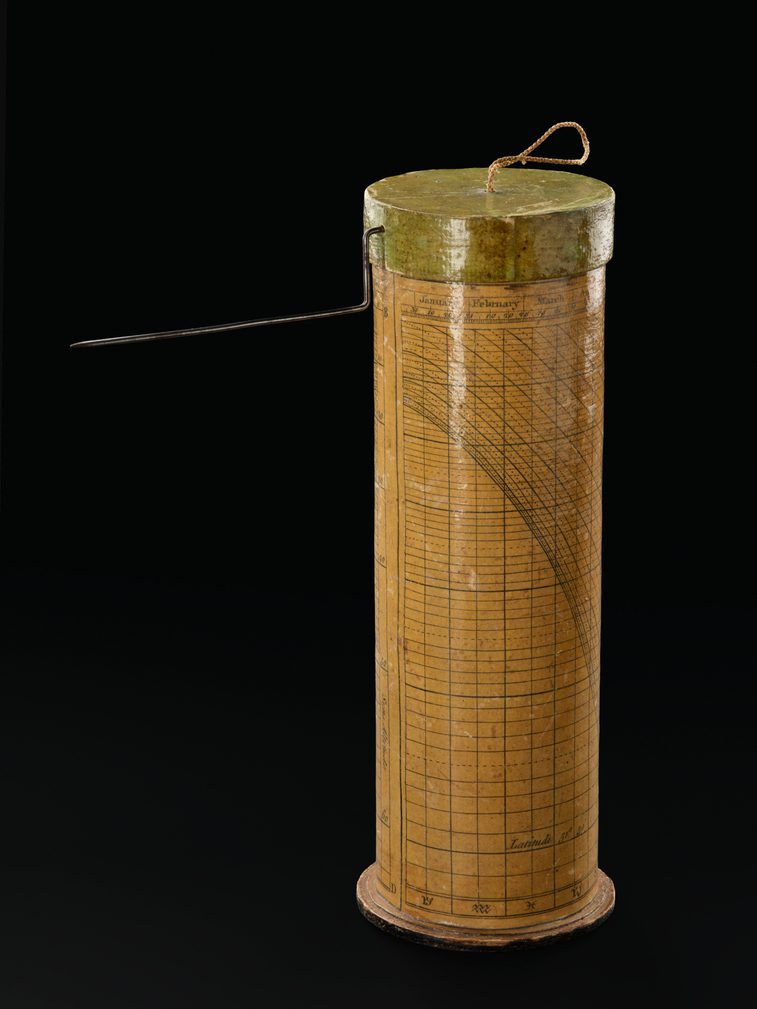
Demonstration pillar sundial, made from Plate XI of the Supplement from James Ferguson's "Lectures on Select Subjects" 2nd edition, (London 1770), presented by James Ferguson to E King in 1775, 1770 – 1775. Museum reference: T.1995.58.
Header image credit: James Ferguson, 1710 - 1776. Mathematician, astronomer and miniature painter. National Galleries of Scotland collection. Photo, National Galleries of Scotland.
Written by
You might also like

Forging a path - Scotland's iron industry
Science and technology, Scotland
Written by Georgina GrantIn July 2025 one of the last iron foundries in Scotland closed its doors. Ballantine Castings Ltd, based in Bo’ness, had been in operation for 200 years. The foundry supplied decorative, architectural and engineering ironwork across…
The Roaring Game: Scotland's curling stone island
Natural world
Written by Dr Bob GoodayDid you know that all curling stones are quarried on a small, uninhabited island in the Firth of Clyde called Ailsa Craig?
What's in a firework? Minerals that bang
Natural world
Written by Emily BrownSo, you light a firework, you stand back and WHOOSH, off it shoots into the air. A few seconds wait and then BOOM, the firework explodes in a shower of coloured sparkles raining down from the sky. To get this sequence of events, you need…