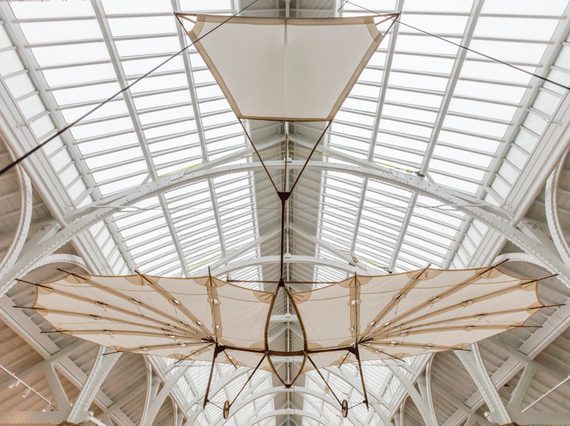
The Hawk: Percy Pilcher's altitude cut short
British aviation pioneer and inventor Percy Pilcher built this glider, the Hawk in 1896.
Way ahead of the competition, he was set to be the first person ever to make a heavier-than-air powered flight, but it was never to be. This glider and Pilcher's fate were tragically intertwined.
Reaching for flight
Technology had conquered land and sea by the Age of Steam but for early Victorian adventurers, the skies remained unreachable.
It was in this time of exploration and innovation that Percy Sinclair Pilcher was born, in 1867. After a childhood spent in England and Germany, and a period in the Royal Navy as a cadet, Pilcher moved to Glasgow in 1887 to serve an engineering apprenticeship with the shipbuilders Randolph, Elder & Co. of Govan, Glasgow. This was to be the start of his love affair with flight.
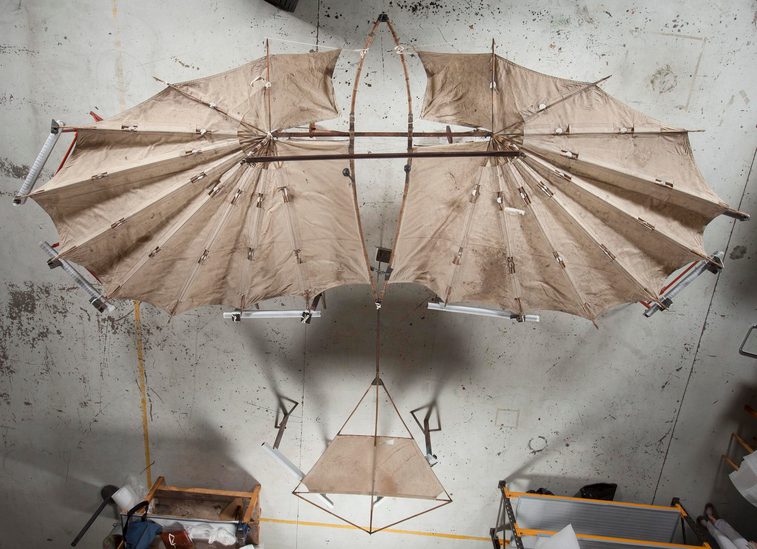
Monoplane glider, Hawk, built by Percy Sinclair Pilcher, principally of bamboo braced with wire and covered with fabric. Wingspan of 7.51m, length of 5.64m 22.7kg. (IL.2001.222)
Pilcher ingenuity
By 1890, Pilcher was taking classes at University College, London and publishing articles on the art of gliding. He returned to Glasgow a year later to lecture on naval architecture and engineering, although his main focus remained the pursuit of the skies.
With his older sister, Ella, herself a pioneering aviator, Pilcher would spend the next eight years making a detailed study of gliders and planes. During this time he corresponded with leading aviation pioneers of the day, including German hang-glider flyer, Otto Lilienthal.
Helped by his sister, Pilcher built four unpowered gliders: the Bat, the Beetle, the Gull and this last one, the Hawk. While the Hawk is the most famous of Pilcher’s flying machines, it was not the first to soar. That honour belongs to the Bat, which Pilcher tested at Cardross near Helensburgh during 1895. With the Bat, he became the first person in the United Kingdom to make repeated flights in a contraption that was heavier than air.
During 1896-97, Pilcher and Ella were often to be seen in Glasgow’s green spaces testing what would become his most successful glider.
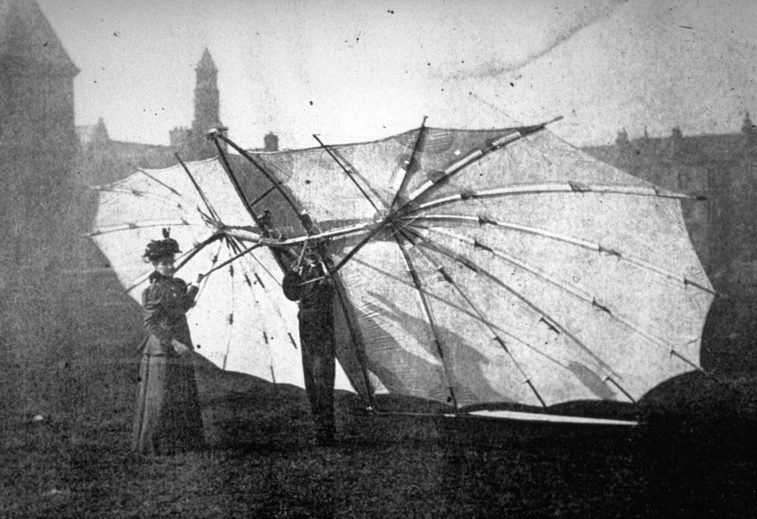
Percy and Ella test the Hawk at Kelvingrove Park, Glasgow, 1896
The Hawk
In 1897, six years before the Wright brothers took to the skies at Kittyhawk, near Dayton in Ohio in December 1903, Pilcher had broken the world distance record for heavier-than-air flight with this very glider. Made of fabric, bamboo, and wire, the Hawk was equipped with the world's first sprung-wheeled undercarriage which helped Pilcher to break the world distance record in that year.
He spent time mastering the concept of lift and air flow, and with the help of an American fellow pioneer, Octave Chanute, then went on to design a triplane capable of powered flight. He intended to demonstrate it to the world, but fate took a different turn.
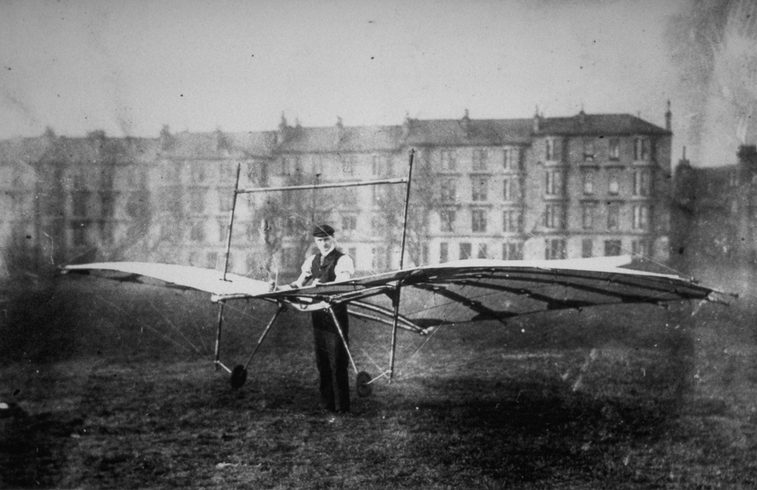
Pilcher tests the Hawk at Kelvingrove Park in 1896.
Tragedy
The pursuit of flight was extremely unpredictable and dangerous, and Pilcher's mentor Otto Lilienthal tragically died in 1896 on a test flight of one of his own gliders.
Three years later, aged just 32, Pilcher was killed after crashing the Hawk. He was due that day to test his designs for powered flight but owing to a logistical hitch, he performed what should have been a routine test flight with the Hawk instead. Earlier stormy weather affected the material integrity of the Hawk, and he plunged 10 metres to the ground. He never regained consciousness and died on 2 October 1899.
The damaged Hawk was repaired and then displayed on loan at the Royal Scottish Museum, now the National Museum of Scotland.
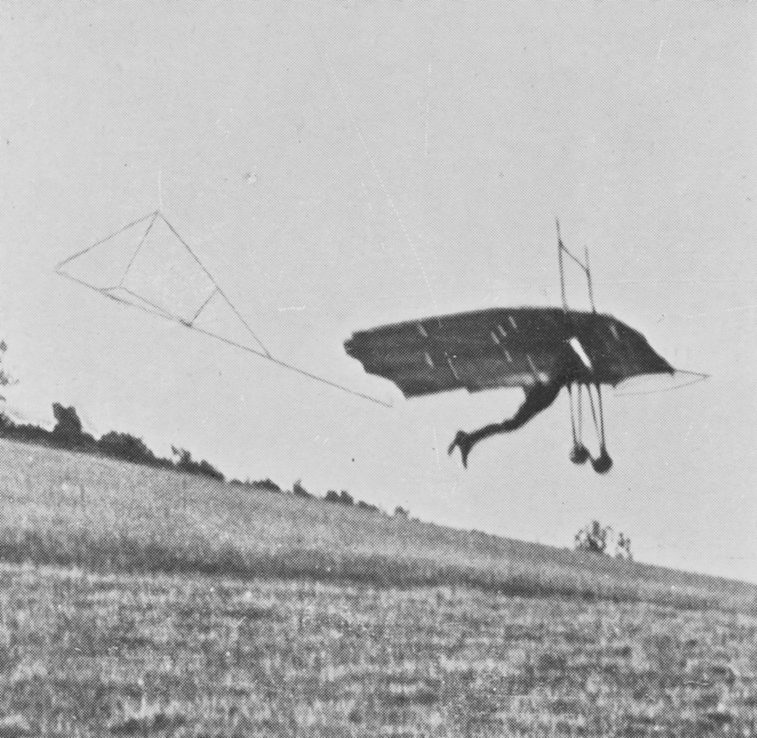
The Hawk in flight at Eynsford, Kent.
Pilcher's contribution to the advancement of flight cannot be overestimated.
In 2003, Pilcher's designs for a powered triplane were tested during a BBC Horizons documentary. With some modern safety modifications, the triplane flew. This leaves us with the question: Would a Briton have invented the first aeroplane?
The Hawk is on display in the Science and Technology galleries at the National Museum of Scotland.
Written by
Ian Brown
Assistant Curator of Aviation
You might also like
The story of the Spitfire: An iconic British combat aircraft
Science and technology
The Spitfire is the most famous of all British combat aircraft, and played a vital role in the Battle of Britain in 1940.
An introduction to Red Arrows Hawk
Science and technology
This iconic Red Arrows Hawk T.1A was flown by the Royal Air Force (RAF) Aerobatic Team, the Red Arrows.The aircraft was donated by the Ministry of Defence through RAF Heritage. It is on permanent display at the National Museum of Flight,…
Sheila Scott: The first British pilot to fly around the world
Science and technology
In 1966 Sheila Scott became the first British pilot to fly around the world. In May and June 1966 Sheila Scott flew solo around the world in a Piper PA-24-260B Comanche, registration G-ATOY, named 'Myth Too'. This was the first solo round…