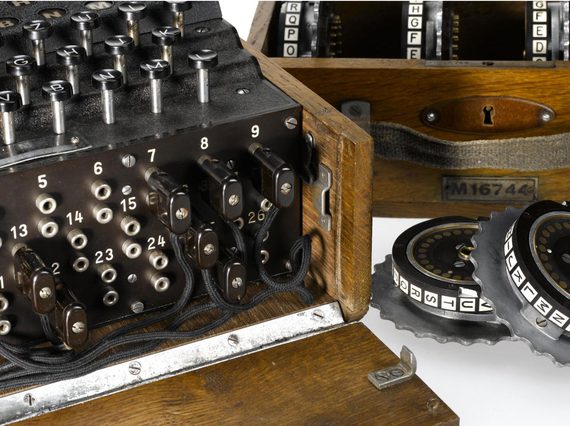
The role of the Enigma encoding machine in World War 2
News Story
This model of Enigma machine was the most famous device used by the German Navy to encode and decode military messages during World War 2. At the time, it was considered a very complex device, and the code it produced, unbreakable.
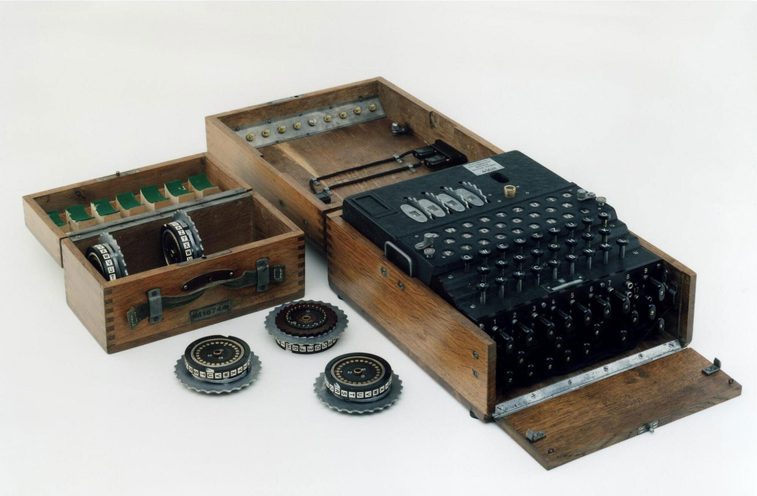
A 4-rotor Enigma machine with a box of spare rotors. Museum reference T.1994.63.
This particular machine was made in 1944 and uses four code rotors and is housed in a wooden case. It is a rare example as it has with it a smaller case containing five interchangeable spare rotors. This machine is the most advanced Enigma machine, used by the German Navy in World War 2; those used by other military forces only had three rotors, and two spares.
Similar machines were first made in the early 20th century, and the first ‘Enigma’ was invented by German engineer Arthur Scherbius in 1918, who sought to sell it for commercial rather than military purposes. During the following years, the Enigma was redesigned and improved several times.
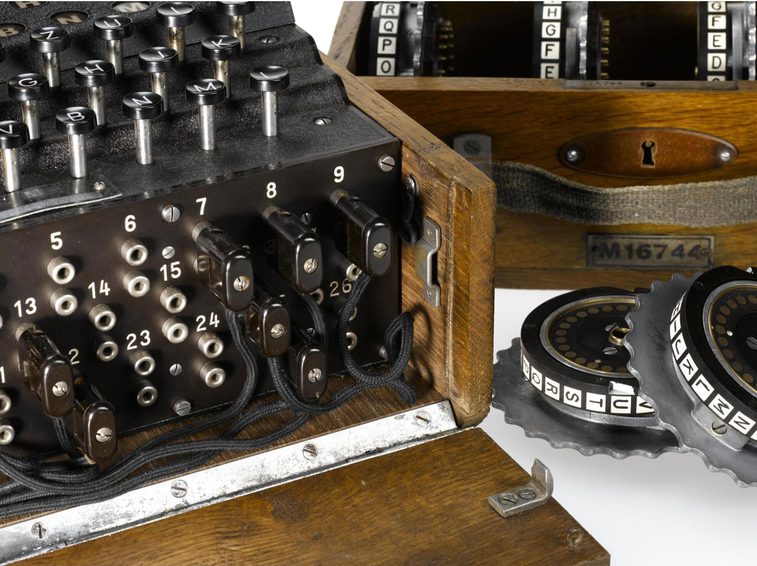
A close up of the 4 rotor Enigma machine and extra rotors. Museum reference T.1994.63.
How Enigma machines worked
The machine is an electro-mechanical cipher device that relies on a series of ‘rotors’ to convert plain text messages into scrambled coded text. What made the code system very secure was that messages were sent out using a different daily password and other settings, that were taken from a secret key list. In order to decrypt a message, the receiver would need to know that day's settings from that key list.
This short video demonstrates how a Swiss Enigma machine translates messages into cipher, and how this can then be deciphered.
Cracking the code
The Enigma code was eventually cracked by British Intelligence officers working at Bletchley Park, near London, and is thought to have significantly helped to bring the war to a swifter end.
The aim was to work out the daily settings and allow the messages to be read. The machines devised in the decoding work were called Bombes, developed using existing methods designed by Polish mathematicians.
The fact that messages could be deciphered had to be kept a closely guarded secret to prevent the Germans changing any encryption methods. Information received from deciphered material was codenamed 'Ultra'. Ultra secrets were the highest form of classification, even more valuable than information classified ‘Most secret’.
Decades of secrecy delayed the recognition of the work carried out at Bletchley Park, which is now a museum commemorating those top secret activities.
The Enigma encoding machine is on display in the Communicate gallery at the National Museum of Scotland.
Written by
Dr Tacye Phillipson
Senior Curator of Science
You might also like
Souvenirs of service: Mementoes from the First and Second World Wars
Scotland
Written by Dr Julie HolderWe all collect souvenirs throughout our lives connected to different people, places and events. These objects were collected as souvenirs of service in both the First and Second World Wars.
Congreve rolling ball clock: Zigzagging through time
Science and technology
Discover a fascinating yet temperamental clock that keeps time in an unconventional way, and learn how our former Conservator of Technology, Darren Cox, worked tirelessly to improve its accuracy.This mechanical clock was built in 1804. At…
Napier's bones: The logarithmic genius who revolutionised calculations
Science and technology
Written by Dr Tacye PhillipsonFind out how this brilliant Scottish mathematician and occultist invented a method of calculation that accelerated scientific discovery.In 1614, Edinburgh-born Renaissance scholar John Napier (1550-1617) invented logarithms. A means of…