About James Hutton at 300: A Celebration of Geology

Discover the legacy of James Hutton, the ‘Father of Modern Geology’. Celebrate his Tercentenary with free, drop-in short talks, mini tours and object handling.

Learn about ‘deep time’, Hutton’s greatest contribution to science and philosophy. Dr Rachel Walcott, our Principal Curator of Earth Systems will present short talks in the Auditorium.

As part of the celebrations we have created a temporary display reflecting Hutton’s own personal geology collection. Join a mini tour with Dr Bob Gooday, our Earth Systems Analyst, to find out about how Hutton used his geology specimens as evidence to prove his theories.

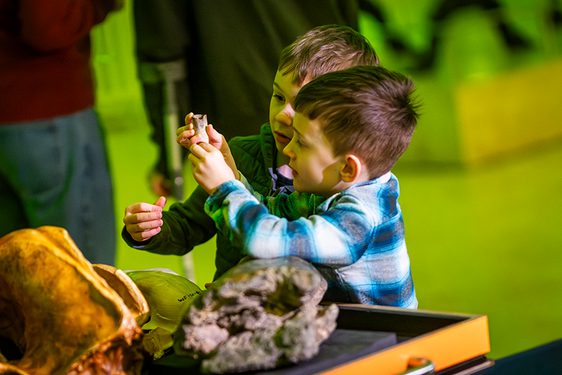
Learn to see rocks in the way that Hutton saw them. Get hands-on with our geology collections in the Grand Gallery with Emily Brown, our Assistant Curator of Earth Systems.

Detailed session information

Short talks in the Auditorium

Short talks on James Hutton's impact on Geology and the collections at National Museums Scotland. The same talk will be repeated at the times listed below.

Location: Auditorium, Level 1

14:00-14:15
15:00-15:15
16:00-16:15

Mini tours of the James Hutton Tercentenary display

Location: Sign up on the day with our Learning team at the Object Handling station in the Grand Gallery on Level 1.

13:30-13:50
14:30-14:50
15:30-15:50

The Tercentenary display is located at the entrance to Animal Senses and Restless Earth galleries on Level 3. 

The mini tours will each last 20 minutes. There will be portable stools available if required. The Tercentenary display can be accessed via stairs, escalator or lift. 

Drop-in Geology-themed object handling

Location: Grand Gallery, Level 1

13:30-16:00

About James Hutton

James Hutton was born on 3 June, 1726 in Edinburgh, Scotland. He was a Scottish geologist, chemist and naturalist who developed one of the fundamental principles of geology. He recognised that the Earth's surface was constantly renewing itself through the erosion of old rock and the formation and uplift of new rock. This process is now known as the 'Rock Cycle'.

He also realised that this happened over an incredibly long period of geological time. This proved that the Earth was far older than 6,000 years old, which had been widely believed until this point.

Hutton was an astute observer whose theories were grounded in fieldwork across Edinburgh and Scotland and in the rock specimens he collected. Though not visually striking, his collection was scientifically significant. After his death, it passed to the Royal Society of Edinburgh. Shortly before 1808 the collection was transferred on to the College Museum of the University of Edinburgh. Unfortunately, its significance was not fully appreciated and it was promptly lost. The collection displayed at the National Museum of Scotland in June 2026 represents the specimens described in his landmark paper, 'Theory of Earth'.

Accessibility and facilities

We want everyone who comes to our museums to enjoy their time with us and make the most of their visit. 

How to get to the space

You can make your way to the Auditorium by walking through the Collecting Stories gallery. Go through the glass doors and the Auditorium will be on your left.

The door to the Auditorium is not automatic and cannot be opened by a push pad. During an event it may already be open or you can open it by pulling it towards you. 

Wheelchair access

There are four designated spaces for wheelchairs in the Auditorium. Two are at the front on Level 1 and two are at the back on Level 2. You can access the upper spaces by taking the lift next to the Auditorium. A staff member will be available to give directions to the lift. 

These spaces can be booked in advance. Please contact publicevents@nms.ac.uk to book a designated wheelchair space.

There is significant space to use a wheelchair in the Auditorium. 

You can borrow a wheelchair from the information desks at the Entrance Hall and Tower Entrance. They cannot be booked in advance.

Seating

Seats in the Auditorium are fixed and tiered. There are steps and handrails on either side of the seating rows. 

The seats are cushioned and have arm rests on either side. 

There is 18cm of leg room between rows. 

If you require a seat at the front or near the front, please contact publicevents@nms.ac.uk. 

Hearing induction loops

There is an induction loop in the Auditorium. 

Toilets and baby changing facilities

The nearest toilets are on Level 1 next to the Lothian Street Entrance. There are standard toilets and an accessible toilet. A baby changing table is located in the accessible toilet. 

If you require a changing places toilet, please ask a member of staff. 

Visit our accessibility page for general access information for the National Museum of Scotland.