6 highlights from our library
Founded by the Society of Antiquaries of Scotland, the library at National Museum Scotland received its first book in 1781 – which is still on our shelves.
Over the past 234 years, the library has gathered a wide-ranging and often surprising collection. From Archaeology to Aztec art, zircon to zebras, and history to haute couture, we have a little bit of everything in our library!
With a growing collection of more than 300,000 items and a variety of e-resources, our long history means that down in the depths of our museum we also hold some very important, unusual and beautiful items in our collection. As well as a modern working library, we hold a large collection of pre-1800s items and extensive museum archives.
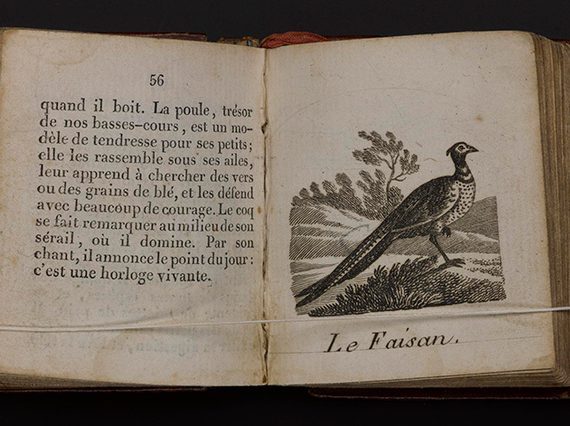
1. Histoire naturelle en miniature de 48 oiseaux: avec des descriptions, c.1816
This is the smallest book in our collection and apparently the smallest ornithology book ever published: only 6.7 x 12.5cm when open!
This miniature book of 48 birds is an 1816 French edition of a volume published in England six years earlier, with the plates copied straight from the original and therefore reversed.
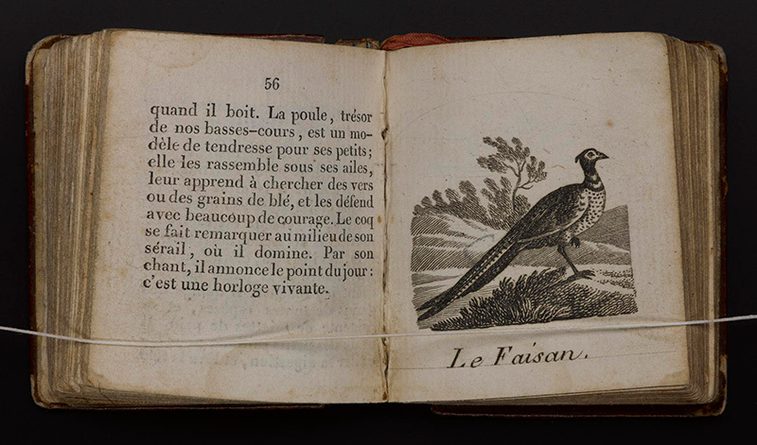
Open pages from Histoire naturelle en miniature de 48 oiseaux: avec des descriptions, c.1816. Museum reference LIB.2016.47.
2. Genealogia deorum gentilium, c.1487
This is the oldest book we have in the library.
Giovanni Boccaccio, who was an Italian author and poet, completed the first edition of this book in 1360. We’re not sure exactly when our copy was printed – probably about 1472.
This book was a key reference work on classical mythology for more than 400 years, examining the genealogy of the pagan gods. Our edition is one of the first examples of printed text, with hand-drawn illustrations in the margins showing mythical characters such as Pan and Minerva.
The inscription tells us that this book was at one point in the library of William Scheves, Bishop of St Andrews (1478-1497) who was known as the king of Scots collectors.
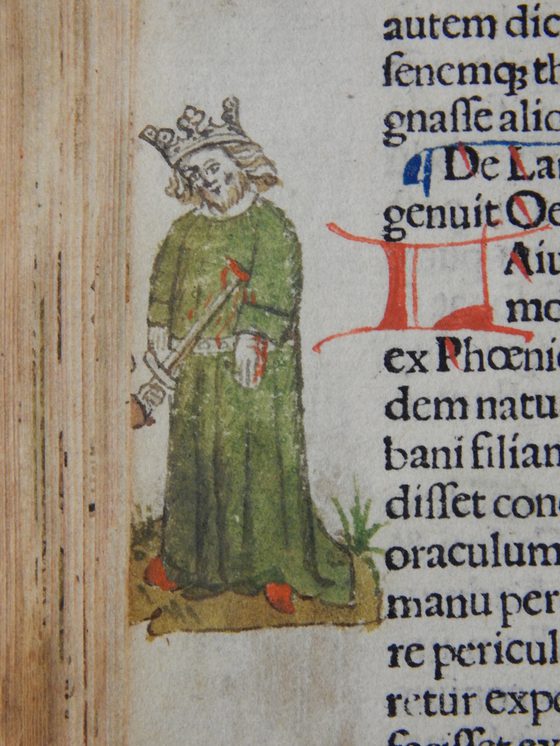
Illustration in Genealogia deorum gentilium, c.1472. Museum reference LIB.196583.
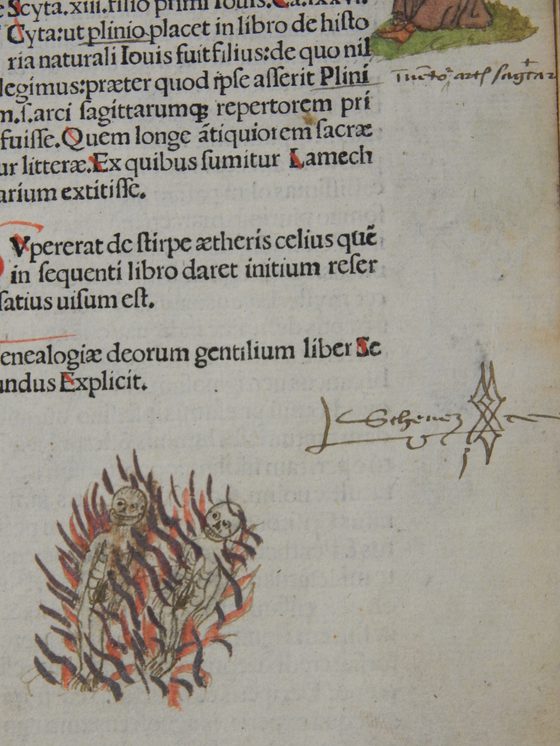
Detail of the inscription of William Scheves, Bishop of St Andrews. Museum reference LIB.196583.
3. Isaac James, Providence Displayed, 1800
Here we have Alexander Selkirk of Lower Largo, the inspiration for Robinson Crusoe. The full title of the book is Providence Displayed or the remarkable adventures of Alexander Selkirk of Largo, in Scotland; who lived four years and four months by himself, on the Island of Juan Fernandez.
Written by Isaac James, this was published in 1800 and sold for three shillings. It was obviously intended as a best-seller.
This hand-coloured wood cut shows Selkirk, marooned on the island of Juan Fernandez in the Pacific Ocean in September 1704, with only the sea lions for company. The accompanying text says “his heart yearned within him, and melted at parting with his comrades and all human society at once.”
Note the sea chest on which he is looking so worn – we have a similar chest belonging to Selkirk in the Museum collection.

Woodcut illustrating Isaac James, Providence Displayed, 1800.
4. John Napier, Rabdologiae, 1617
The inventor and mathematician John Napier developed what is believed to be the world’s first mechanical calculating device.
A series of numbered ivory rods now known as ‘Napier’s bones’, his Rabdologiae, written in Latin, describes the use of this invention.
This 1617 Edinburgh edition was presented to the Society for its library on 6 November 1786 by Dr David Spence. The book is only 14cm high and was bound by James Scott with oval green leather onlays and lovely peacock blue endpapers, neither of which were common to his work.

The cover of Rabdologiae, 1617. Museum reference LIB.175305.
5. The Rocket, 1956
A more unexpected and surprising item we acquired specifically for display in the National Museum of Scotland. Not an archaeological item of course… As you can see, this is the 1950s comic The Rocket, edited by the hero Pilot Douglas Bader.
We have all 32 issues of this short-lived weekly comic – no. 1 appeared on 21 April 1956 and the last issue came out on 24 November the same year.
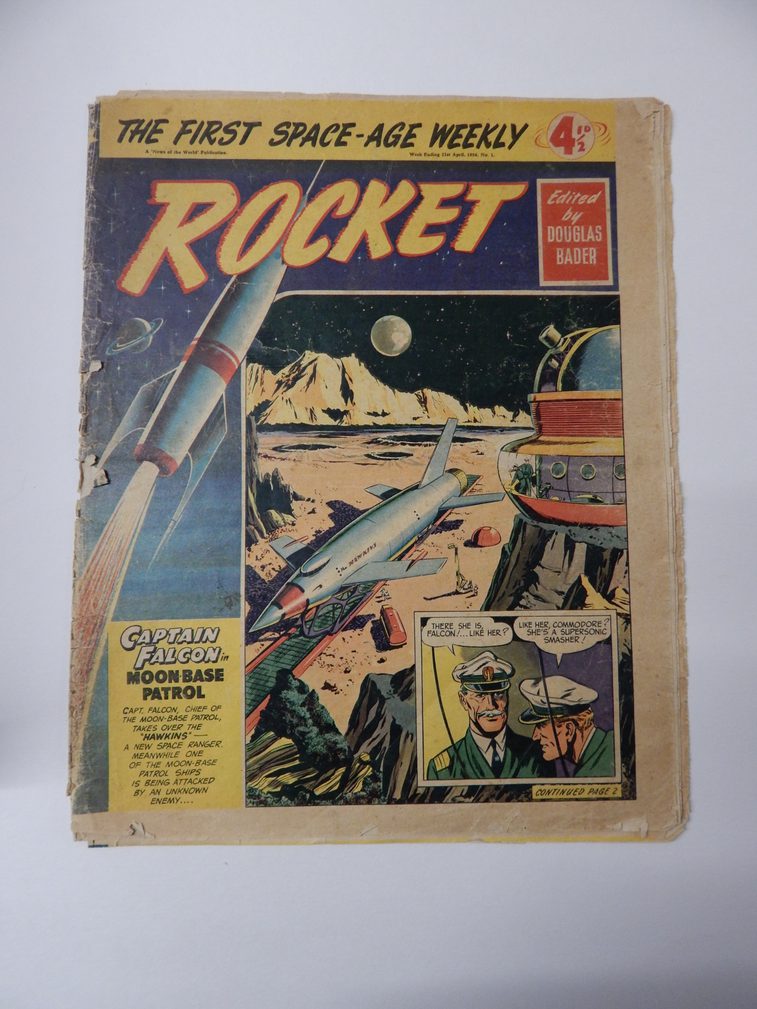
Cover of The Rocket, 1956.
6. Book Sculpture, 2011
An anonymous book sculpture – Arthur Conan Doyle’s Lost World – was the ninth of ten sculptures which were left by the artist in a number of Edinburgh libraries and cultural centres in 2011. The book sculpture, with a fearsome Tyrannosaurus Rex springing out of the pages, is on display in the library.
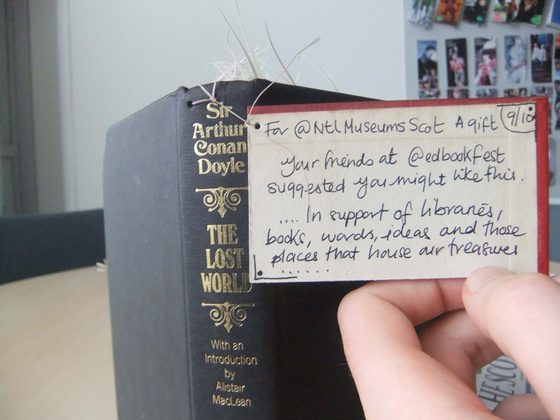
A tag on the mysterious book sculpture, reading, "For National Museums Scotland - a gift. Your friends at Edinburgh International Book Festival suggested you might like this. In support of libraries, books, words, ideas and these places that house our treasures."
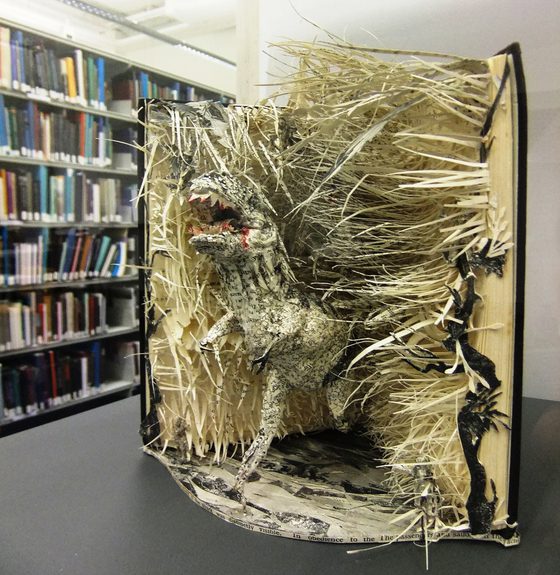
The book sculpture, with a dinosaur clawing out of its pages.
A growing collection
Today, the library supports the research, conservation and collecting activities of the Museum staff. We also act as public reference library and welcome visitors. We are definitely the people to visit if you are interested in Scottish clockmakers, bird eggs, spiders, fossils, African carvings or indeed any of the objects in the Museum galleries. You can find out more about our library collections by searching our online catalogue, or by sending us an email.
Written by
Morven Donald
Assistant Librarian
You might also like
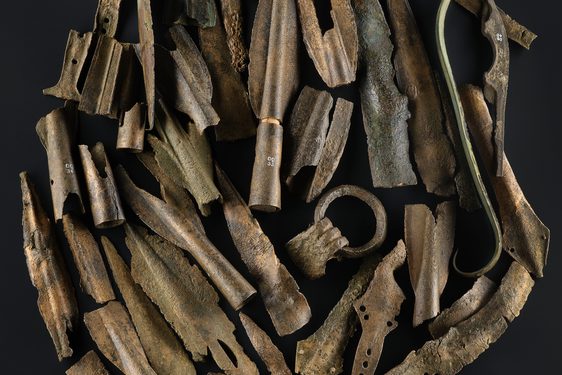
Sacrifice or scrap? The Bronze Age weapons from Duddingston Loch
Archaeology
Written by Dr Matthew KnightWhy was a 3000-year-old hoard of objects deliberately destroyed and sunk into a loch in Edinburgh?
Forging a path - Scotland's iron industry
Science and technology, Scotland
Written by Georgina GrantIn July 2025 one of the last iron foundries in Scotland closed its doors. Ballantine Castings Ltd, based in Bo’ness, had been in operation for 200 years. The foundry supplied decorative, architectural and engineering ironwork across…
What is the Blyth Hoard?
Archaeology, Scotland
Written by Dr Matthew KnightA unique discovery from the Scottish Borders is shedding new light on the making of Bronze Age objects in Scotland.