A 1000-year-old star catcher
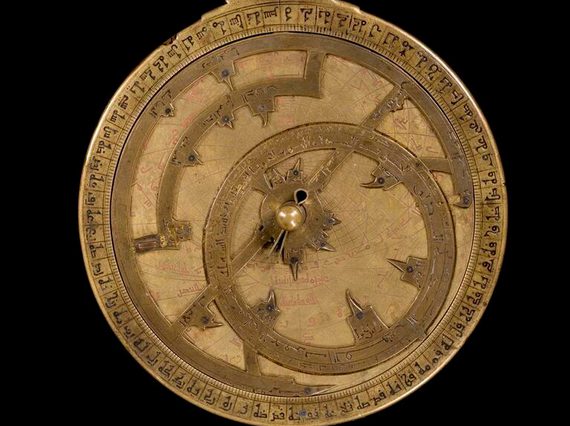
This astrolabe was made by Muhammad ibn al-Ṣaffār in Córdoba in Al-Andalus (now Spain) during the period of Umayyad rule. It dates to the year 417 in the Islamic lunar calendar, which equates to 22 February 1026 to 10 February 1027 CE.
This means that in 2026 we are celebrating its 1000th anniversary.
Image gallery

Astrolabe made by Muhammed Ibn al-Ṣaffār in 1026/27 AD (T.1959.62). Front.

Astrolabe made by Muhammed Ibn al-Ṣaffār in 1026/27 AD (T.1959.62). Back.
Date information can be found in an inscription in 'Kufic', a form of Arabic script, on the back of the instrument. This makes the astrolabe one of the earliest dated European-made astrolabes.
The inscription reads “Work of Muhammad bin [ibn] al-Ṣaffār in Córdoba in the year 17 and 400”.
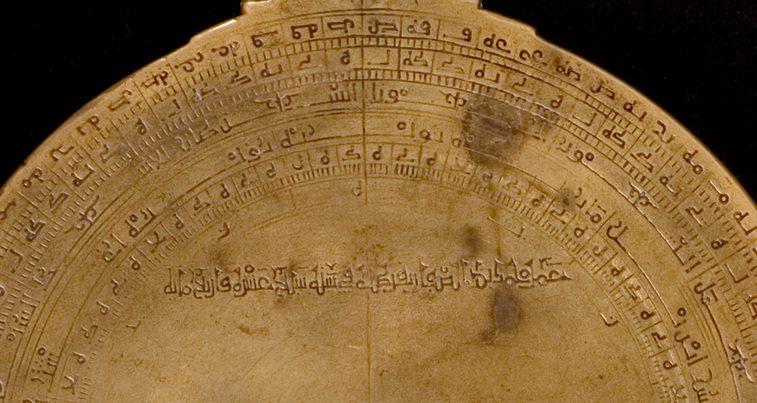
The horizontal inscription, recording maker, place and date, on the back of the astrolabe. (T.1959.62).
What are astrolabes?
The origin of the astrolabe was probably ancient Greek, but the instrument as we know it dates to around the 8th century.
Astrolabes are a model representing the motions of the Sun and stars, as seen from the perspective of Earth. They are used to observe, calculate and predict the position of Sun and stars. Common purposes include time-keeping, wayfinding and astrology.
The word ‘astrolabe’ comes from the Greek 'astrolabes' (star-holder/taker). The 'rete' (net or web in Latin) is the rotatable front part of the device which points to stellar positions on the plate below and shows the ecliptic (annual path the Sun appears to take through the sky). The main body of the astrolabe is called the 'mater' (mother in Latin). This can hold several plates, engraved with stereographic projections of the celestial sphere as seen from different latitudes.
Astrolabes are 2D versions of the 3D model of the celestial sphere, known as an armillary sphere. They also have some similarity to planispheres, which are circular star charts. However, the changeable plates mean the astrolabe can be used at several different latitudes, and the additional lines and scales provide many more functions.
Astrolabes are used to observe the position of the stars to help calculate the time, date or position of the observer. For example, as well as establishing the correct time for daily prayer, the astrolabe could be used to work out the direction of Mecca. They can also be used to calculate the timing of celestial events, in the present, past or future, and to measure heights and angles on Earth.
To get a better idea of how an astrolabe works, you can play with this simulation, created by data scientist Alex Boxer. In this YouTube video, historian of science Taha Aslan shows how to calculate the time.
Anatomy of an astrolabe
There are two other surviving astrolabes signed by the same maker, Muhammad ibn al-Ṣaffār. One is dated 411 AH / 1020 CE and is now at the Islamic Arts Museum in Malaysia. The other is dated to 420 AH / 1029 CE and is at the Staatsbibliothek zu Berlin.
The 420 AH astrolabe, made in Toledo, includes added Hebrew script. This underlines the cultural and scientific interchange that took place in medieval Spain. The instrument is also the only one of the three to have its original rete.
The rete on our instrument was made later, likely in the 13th century.
The rete is used in conjunction with changeable plates kept inside the body of the instrument. In the case of our 417 AH astrolabe, there are seven plates, engraved on both sides to be used at 14 different latitudes. These latitudes include locations such as Mecca, Medina, Córdoba, Tangier and Constantinople.
The engraving on the plates includes:
- latitudes and place names
- stereographic projections of the celestial sphere
- lines indicating times for the five daily prayers
The back of the astrolabe is engraved with a shadow square, used to measure heights and calendrical scales, as well as the sighting vane, or 'alidade'.
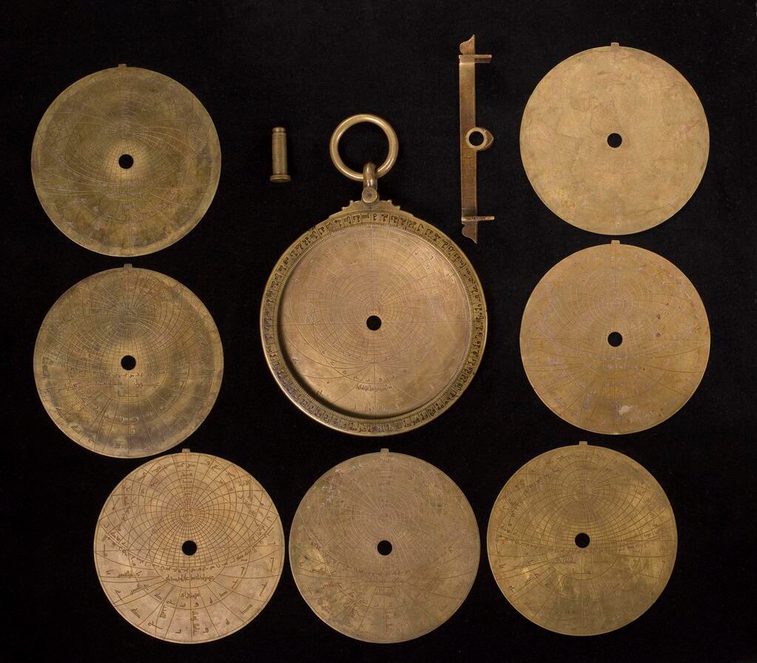
The astrolabe unpacked to show the seven plates, the reverse of the mater, the central pin and the alidade. (T.1959.62)
The Ibn al-Ṣaffār brothers
The maker’s brother, also known as Ibn al-Ṣaffār, was a teacher of astronomy and geometry in Córdoba. He wrote a treatise on the use of the astrolabe, which was translated into Latin, Hebrew and Old Spanish. It was in use in Europe until the 15th century.
The brothers’ name is literally, and aptly, translated as 'son of a copper smith'. Brass is an alloy of copper and zinc, and in this case, the main body of the astrolabe has been calculated as around 80% copper and 20% zinc. This is a higher proportion of copper than became common in later brass objects.
A second-hand shop find
Before National Museums Scotland acquired it, this astrolabe belonged to James H. Farr, who ran Wardie Garage on Ferry Road. In 1959, Farr attended a lecture on astrolabes by Robert Plenderleith, Keeper of the Royal Scottish Museum’s Technological Department. This prompted him to have his astrolabe dated. On learning quite how old his astrolabe was, Farr decided to give it to the National Collection. He told The Scotsman that he “bought the astrolabe about ten years ago in a second-hand shop in Edinburgh’s Lawnmarket”.
The astrolabe was originally displayed with horological collections at the Museum. Today, it sits in the Earth in Space gallery, which shows how stars and planets have been observed and used for timekeeping and navigation.
In 2024-25 it was loaned to the British Museum’s Silk Roads exhibition. There, it was displayed with other artefacts from Córdoba during the period of Umayyad rule, showing its cosmopolitan nature and cultural flourishing.

The National Museums Scotland Ibn al-Ṣaffār astrolabe with other objects from the British Museum’s Silk Roads exhibition in 2025.
Table of places and latitudes on the plates
The seven plates serve the following latitudes.
| Latitude | Place name | Notes (including modern values) |
|---|---|---|
| 0⁰ | [Equator] | This marks the line of the horizon |
| 14⁰ 30’ | Sana‘a | Sanaa, Yemen – 15°20′54″N |
| 17⁰ 30’ | Saba’ | Ancient Kingdom of Sheba, in what is now Yemen, perhaps marking its northmost expansion |
| 21⁰ 40’ | Mecca | Mecca, Saudi Arabia – 21°25′21″N |
| 25⁰ | Medinah | Medina, Saudi Arabia – 24°28′12″N |
| 28⁰ | Qulzum | Ancient city in Egypt, also known as Clysma; Suez – 29°57′16.6″N |
| 30⁰ | Cairo | Cairo, Egypt – 30°2′40″N |
| 32⁰ | Qayrawān | Kairouan, Tunisia – 35°40′38″N |
| 34⁰ 20’ | Surra-man-raa | Samarra, Iraq – 34°11′54″N |
| 36⁰ | Tanja | Tangier, Morocco – 35°46′36″N |
| 38⁰ 30’ | Cordoba | Córdoba, Spain – 37°53′24″N |
| 40⁰ | Toledo | Toledo, Spain – 39°51′24″N |
| 42⁰ | Saragossa | Zaragoza, Spain – 41°39′N |
| 45⁰ | Constantinople | Istanbul, Turkey – 41°00′49″N – the high value of 45⁰ was traditionally used |
| 66⁰ | [Ecliptic] | The ecliptic represents the apparent annual path of the Sun, its poles are +66⁰ and -66.5⁰, also seen as the ends of the inhabited world |
These places are paired on the plates:
- Sanaa and Mecca
- Medina and Samarra
- Kairouan and Córdoba
- Zaragoza and Equator
- Sheba and Cairo
- Clysma and Tangier
- Toledo and Constantinople.
The Ecliptic plate is engraved inside the mater.
Table of stars carried by the rete
The pointers on the 13th-century rete have been calculated as pointing to 21 bright stars:
- 11 in the northern celestial hemisphere
- 12 in the southern celestial hemisphere
Here they are listed by position on the rete, east to west.
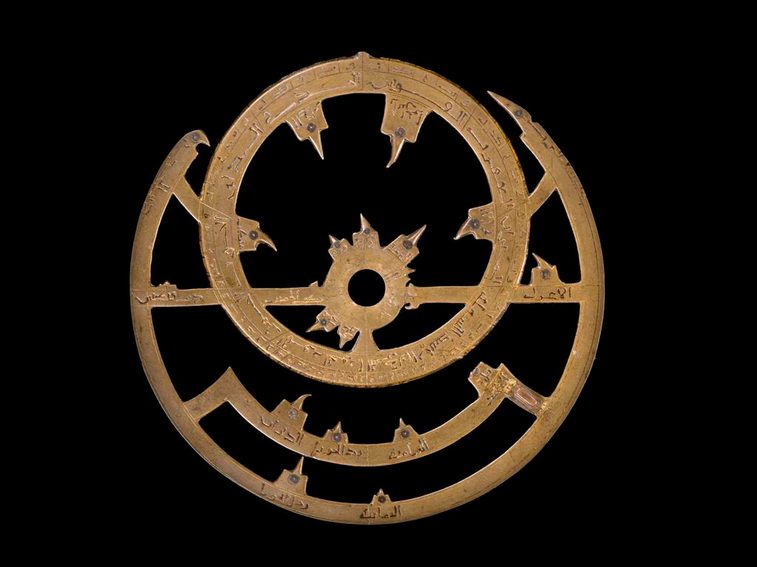
The 13th-century rete. (T.1959.62)
| Star name | On rete | Translation | Bayer designati |
|---|---|---|---|
| Algol | ghūl | Arabic: [head of] the ogre | beta Persei |
| Aldebaran | al-dabarān | Arabic: the follower | alpha Tauri |
| Capella | ‘ayyūq | Arabic: the goat Latin: little goat | alpha Aurigae |
| Rigel | rijl al-jawzā | Arabic: foot of al-Jawzā (Orion) | beta Orionis |
| Betelgeuse | yad al-jawzā | Arabic: hand of al-Jawzā (Orion) | alpha Orionis |
| Sirius | al-yamāniya | Greek: glowing or scorching Arabic: Yemeni [i.e. to the south] | alpha Canis Majoris |
| Procyon | al-sha‘āmiya | Greek: before the dog (Sirius) Arabic: Shamiya [i.e. to the north] | alpha Canis Minoris |
| Regulus | qalb al-asad | Latin: prince or little king Arabic: heart of the lion | alpha Leonis |
| Spica | al-a‘zal | Latin: [the virgin’s] ear of grain Arabic: the unarmed | alpha Virginia |
| Alkaid | banāt [nash] | Arabic: the leader of the daughters of the bier | eta Ursae Majoris |
| Arcturus | al-rāmih | Greek: guardian of the bear Arabic: the lancer | alpha Bootis |
| Alphecca | al-fakka | Arabic: [the brightest of] the broken [ring of stars] | alpha Coronae Borealis |
| Antares | qalb al-‘aqrab | Greek: rival to Ares Arabic: heart of the scorpion | alpha Scorpii |
| Rasalhague | r’as al-hawwā | Arabic: the head of the serpent collector | alpha Ophiuchi |
| Vega | al-wāki‘ | Arabic: the falling [eagle] | alpha Lyrae |
| Altair | al-ta’ir | Arabic: the flying [eagle | alpha Aquilae |
| Deneb | ridf | Arabic: tail Arabic: hindmost or follower | alpha Cygni |
| Deneb Algedi | dhanab al-jady | Arabic: the tail of the goat | delta Capricorni |
| Markab | mankib | Arabic: saddle (markab) or shoulder (mankab) [of the horse] | alpha Pegasi |
| Caph | kaff al-khadīb | Arabic: the stained hand | beta Cassiopeiae |
| Diphda | dhanab quaytus | Arabic: frog Arabic: the [southern] tail of the Cetus (sea monster) | beta Ceti |
The astrolabe is on display in the Earth in Space Gallery on Level 1 at the National Museum of Scotland.
Written by

You might also like

Forging a path - Scotland's iron industry
Science and technology, Scotland
Written by Georgina GrantIn July 2025 one of the last iron foundries in Scotland closed its doors. Ballantine Castings Ltd, based in Bo’ness, had been in operation for 200 years. The foundry supplied decorative, architectural and engineering ironwork across…
The Roaring Game: Scotland's curling stone island
Natural world
Written by Dr Bob GoodayDid you know that all curling stones are quarried on a small, uninhabited island in the Firth of Clyde called Ailsa Craig?
What's in a firework? Minerals that bang
Natural world
Written by Emily BrownSo, you light a firework, you stand back and WHOOSH, off it shoots into the air. A few seconds wait and then BOOM, the firework explodes in a shower of coloured sparkles raining down from the sky. To get this sequence of events, you need…