
An introduction to Robert Burns
News Story
The humble ploughman-poet Robert Burns is one of Scotland's most enduring literary figures. His poems – Auld Lang Syne, Tam o' Shanter, Scots Wha Hae, and many more – put the Scots Language in the minds and hearts of people all around the world.
Known to many simply as 'The Bard', Burns was born into a farming family in Alloway, near Ayr, and was introduced to popular Scottish tales and ballads in childhood. A tenant farmer, often struggling, he still found time to write and in 1786 he published his first collection of poetry, Poems, Chiefly in the Scottish dialect, which became known as the 'Kilmarnock edition'. This included one of his most famous poems, 'To a mouse'.
The book was immediately successful, and Burns set off for Edinburgh, where he found himself lionised by society.
Burns' legacy
Burns died in Dumfries at the age of just 37. But although he never left Scotland in his short lifetime, his influence is still felt around the world. His poetry has been translated into over 25 languages and his unique voice, combining lyricism, cynicism, satire, comedy and political comment, has had a lasting, if sometimes sentimentalised, appeal. Statues and monuments dedicated to him can be found in America, Canada, New Zealand, Australia and France, as well, of course, in Scotland.
Personal relics of the poet started to be scattered after his death: Burns’s wife, Jean Armour, was generous to visitors. Burns clubs and Burns suppers soon followed. The first major commemoration was held in 1844. The 85th anniversary of Burns’s birth, timed so that his three sons could be present. There were other large events in 1859, 1896 and 1909. The 1844 procession and dinner centred on Alloway, but in the other years there were celebrations all over the country.
Robert Burns has more statues dedicated to him around the world than any non-religious figure aside from Christopher Columbus and Queen Victoria.
Learn more about Robert Burns

Get to know Robert Burns through 10 objects
History and cultures, Scotland
A variety of objects relating to the life of Scotland's bard can be found in National Museums Scotland's collection. Read on to learn more about Burns' life, legacy, and his depictions in objects and popular culture.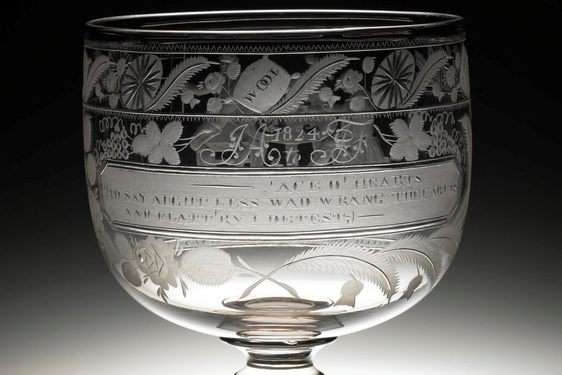
Celebrating Robert Burns: Glass goblet engraved with words by Burns
History and cultures, Scotland
A large glass goblet such as this would have been used as a punchbowl. Clues about its use can be found amongst the words and images engraved into the glass.On one side there is a quote from Robert Burns’ poem ‘Epistle to Davie, A Brother…
The 'tappit hen': A drinking vessel used during the lifetime of Robert Burns
History and cultures, Scotland
These pewter drinking vessels were common in eighteenth century Scotland’s public houses because they were relatively cheap to make and could withstand use and, perhaps, abuse.The name ‘tappit hen’ is derived from the distinctive…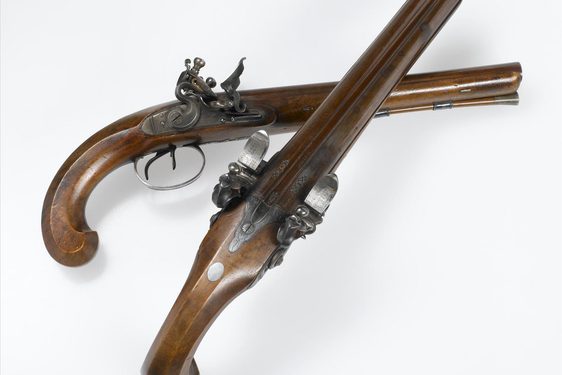
Pistols belonging to Robert Burns
History and cultures, Scotland
This prized set of pistols belonged to Robert Burns, Scotland's national Bard. But why would the poor and struggling poet have needed such handsome weapons?
You might also like
A Viking Age boatyard on Eigg
Archaeology
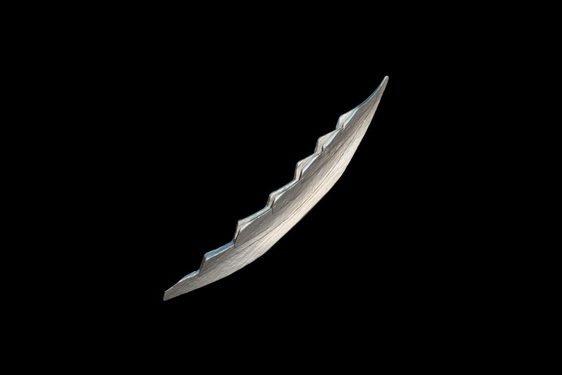
Written by Dr Adrián MaldonadoTwo oak boat stems dating to 880-1050 AD from the isle of Eigg show the arrival of Scandinavian seafaring technology to Scotland.These rare survivals reveal how the Viking Age forever changed Scotland's seaways.Vikings and the seaWe tend…
'I am yours': 11 Scottish posy rings
History and cultures, Scotland
Written by Dr Georgia VullinghsPosy rings are some of the most evocative objects of love in National Museums Scotland's collections. These finger rings are named for the short inscriptions engraved on the inside of their band.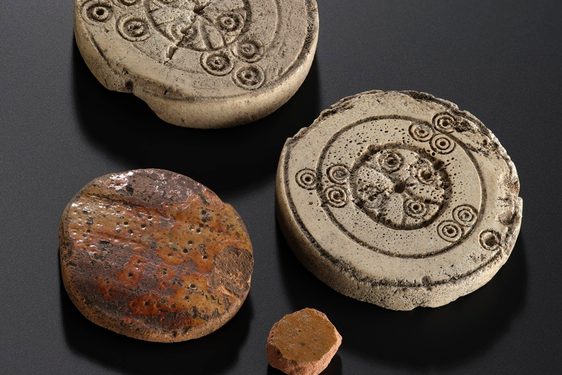
Excavating medieval Eilean Donan / A’ cladhach Eilean Donnain Meadhan-aoiseil
Archaeology, Scotland
Written by Dr Alice BlackwellExcavations have revealed fascinating insights into the people who lived and worked at medieval Eilean Donan.