Bog Born: 12 objects from Scottish peatlands
Peat bogs have been central to Scotland’s landscapes and communities for thousands of years. They are dynamic environments that grow and move, erode and entomb. Peatlands reflect our human presence. They are archives of social and environmental history.
The historical associations of peat are well documented. Around 11,000 archaeological sites on Scottish peatlands preserve records of interactions between peoples and places. Across the country, many of us inhabit landscapes etched by historic peat extraction. Evidence of these histories survive in museum collections. National Museums Scotland holds extensive collections of peat-related objects, from prehistoric textiles to modern peat irons.
Discover 12 objects that narrate the relationship between people and peatlands through time.
1. Peat corer
This corer was used by Roxane Anderson, Professor of Peatland Science with the University of the Highlands and Islands, and her students, for sampling peat. She has used it for many years, fostering a deeper understanding of the depths, decomposition and plant make-up of peat, particularly in the Flow Country. This special place was designated a UNESCO World Heritage Site in July 2024 and is widely considered to be the largest and most intact area of blanket bog in the world, covering some 4,000 square kilometres.
Today, bogs cover more than a fifth of Scotland’s total land area. New understandings of these environments are forming, as important carbon sinks have transformed how we think about peatlands. Restoring peat bogs is necessary because damaged and drying peatland accounts for 4% of Britain’s greenhouse gas emissions. Healthy peatlands are also home to layers of specialised flora and fauna. They also host an abundance of invertebrates and act as vital breeding grounds for birds. Doing this restoration work requires its own apparatus and knowledge.
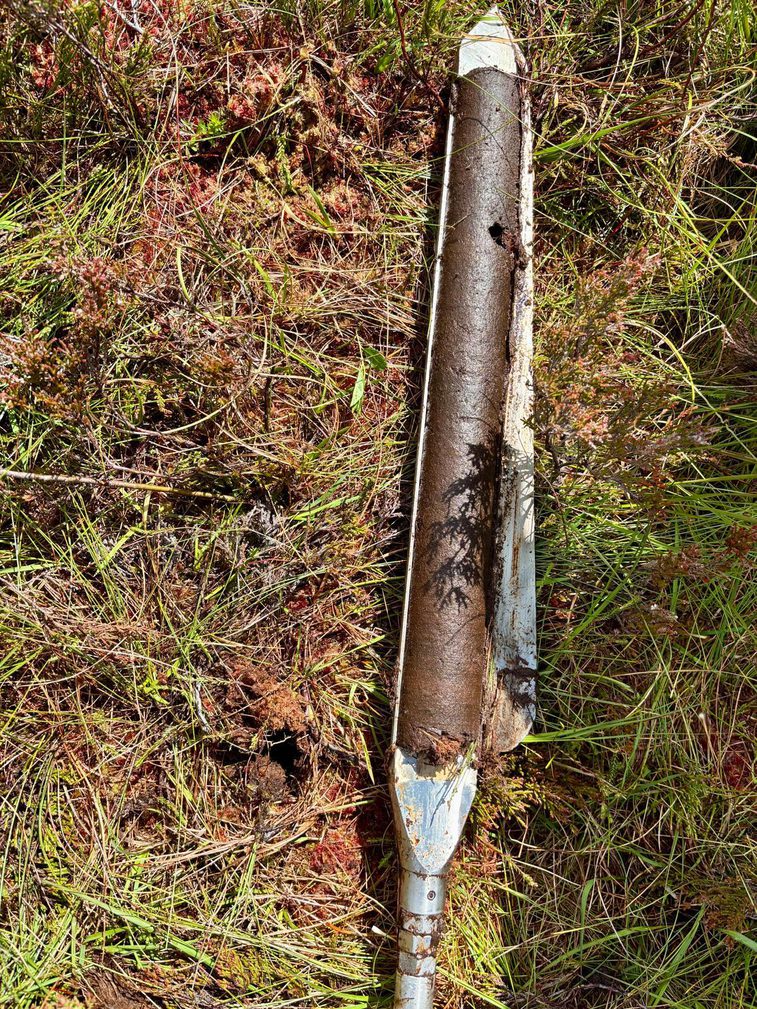
Newly acquired peat corer from Professor Roxane Anderson, shown in use in the Flow Country.
2. Peat spade / peat iron
In many ways, the peat spade is a humble object. Made by a blacksmith, it has a wooden handle (sometimes a footstep) and a winged blade made of iron. This was a crucial tool when peat was a fuel of necessity in parts of Scotland for thousands of years. The earliest peat spade in our collection is around 2,000 years old. It was found at Blackburn Mill farm in the Scottish Borders in 1852.
But this simple tool has facilitated landscape scale change. Peat was cut away, little by little, layer by layer, each year. Over several millennia, this has created profound change in the landscape as we see it today.
There are many different names for a peat spade in Scotland. It is a tuskar or tushkar in Shetland and Orkney. In Gaelic-speaking areas, names and spellings vary. A taraisgeir (or toirsgeir, tairsgeir, tarasgeir) in Lewis, treisgeir in Barra, troighsgeir in Uist, tairsgeil in Skye and Sutherland, toraicinn in Arran, sleaghan in Coll and Tiree, iarann mònach in Harris, a fàl-mòine in Islay.
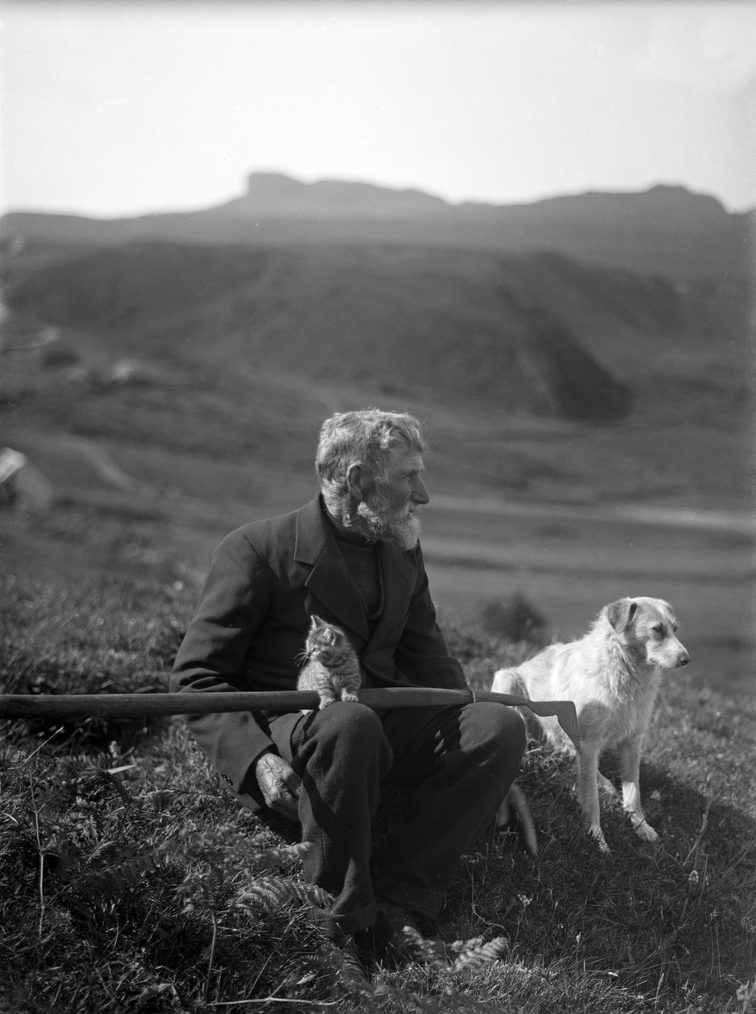
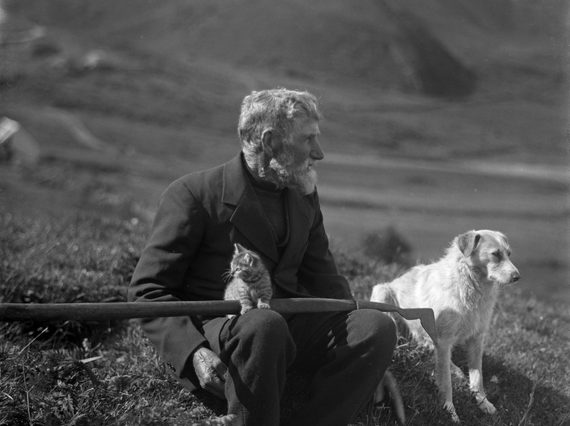
Lauchlan MacAskill photographed with a peat spade and his pet dog and kitten, Isle of Eigg c. 1920s. Part of the M.E.M Donaldson Collection. Museum reference SLA.C.18266.
3. Cliabh
After cutting the peat into blocks, they were left to dry on the moor or hill. Once dry, these dried peats were then taken home to be burned as fuel to heat the home and to cook. This photograph shows a woman in the Isle of Skye, seen carrying a cliabh, or peat basket made of willow. Like the peat spade, these baskets were made of different materials, and had different names across different parts of the country. In Shetland, they are made from oat straw rather than willow and are known as the kishie. Making these baskets was a skill in itself, and carrying these heavy loads – often across significant distances – was hard work, often done by women.
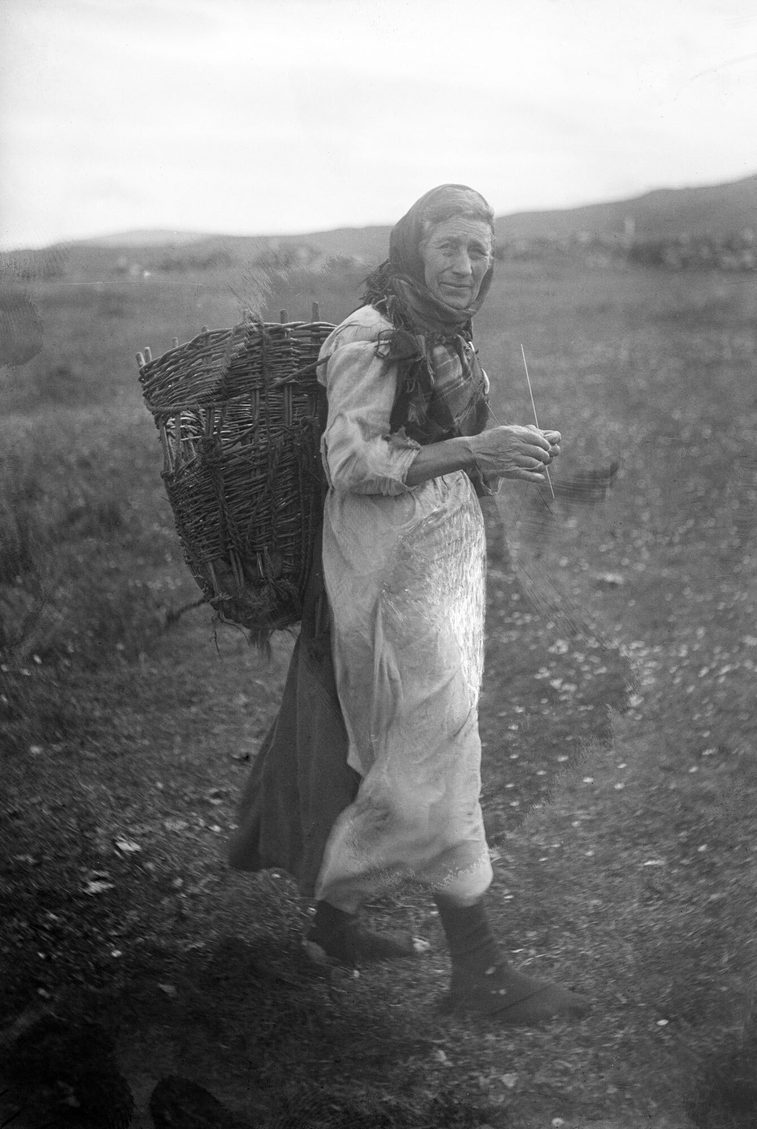
A woman in Skye, photographed carrying a full cliabh, or peat basket, c. 1905. Part of the M.E.M Donaldson Collection. Museum reference SLA.C.18400.
4. Model of the Great Wheel of Blair Drummond
In some areas, peat was removed on a large scale in attempts to transform the bog into fertile farmland. This model is a miniaturisation of a piece of equipment developed to aid that process – one that is very different to the peat spade, in both scale and function. The Great Wheel of Blair Drummond was devised by George Meikle of Alloa in the late 18th century. It was used to drain the peat bog of Blair Drummond in Stirlingshire and wash the peat away into the nearby River Teith.
This process 'reclaimed' two thousand acres of land for the estate of Henry Home, Lord Kames. The work continued over decades, into the nineteenth century and extended across 10,000 acres. Hundreds of people who had been dispossessed elsewhere in the Highlands were given leases to help clear the peat and farm this new agricultural land.

Model of Great Wheel of Blair Drummond Caption, on display in the National Museum of Rural Life. Museum reference IL.2005.29.
5. Gunnister Man’s purse
Preserved for centuries, sometimes millennia, in the airless, waterlogged environment of the bog, organic matter that would otherwise decay has survived to the present. This includes things like human remains, textiles and wood. Partial human remains and the clothing of a man from the late 17th century, now known as the ‘Gunnister Man’ were discovered by men cutting peat in Shetland in the 1950s. Among his belongings was a small purse containing coins, including from the Netherlands and Sweden, which point to international trade in the islands at the turn of the eighteenth century. Look closely at the purse itself, and you will see patterns in coloured bands (now darkened by the peat that has penetrated the object). This is the first evidence of coloured, double-stranded knitting found in the Shetland Isles. This is significant given the islands’ later reputation for being the home of Fair Isle knitting.
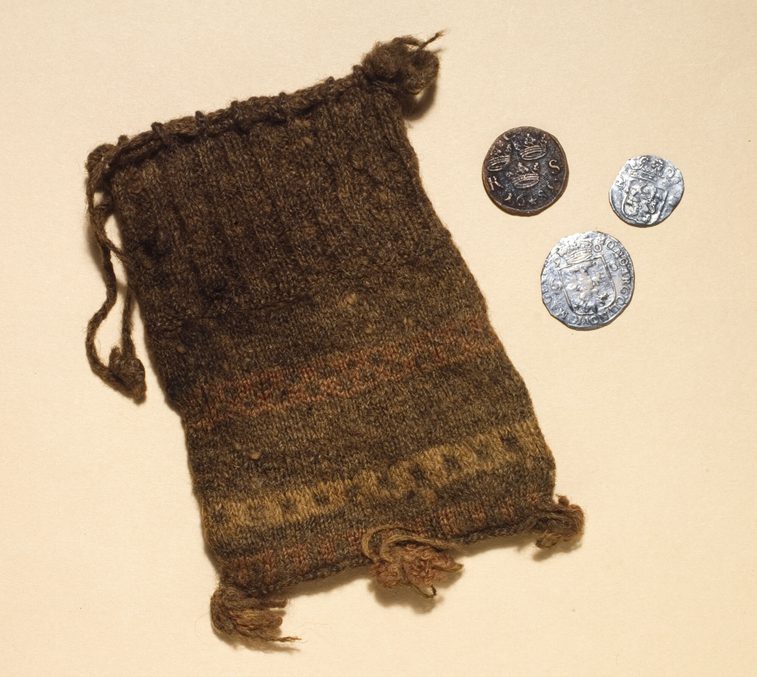
Purse and coins found with the ‘Gunnister Man’, preserved for 300 years in peatland in Shetland. Museum reference H.NA 1045.
6. Knitted hat found at Arnish Moor
A decade later in Lewis, the clothing and possessions of a man were discovered at Arnish Moor. After 300 years in the ground, his clothing – along with a little purse, a quill pen, a double-sided wood comb and a horn spoon – were wonderfully intact. Of the clothing that survives, the hat stands out. It connects us directly to the person who wore it, out on the moor. Like the Gunnister Man, these objects raise questions about who this person was and the life they led. These traces of individuals and their stories remain, but their names do not survive in the documentary record. This absence of detail often invites speculation, stories and myth that have endured in these communities.

A hat and small personal objects preserved for 300 years at Arnish Moor in Lewis. Museum reference K.1997.1115.
7. The Orkney Hood
A remarkable garment was preserved for 1,500 years in the peat bogs of Orkney. Now known as the Orkney Hood, it is the only complete piece of clothing to survive from before the medieval period in Scotland. Radiocarbon dating places its making sometime between AD 250-640. It’s small, probably worn by a child and research shows it was made from carefully re-used woven cloth, with one simple band and another more elaborate one with a fringe of tassels. The hood was treasured, put together carefully, and looked after.
Why it ended up in a bog is a question that will remain. Was it accidental, or was it deposited there deliberately, as an offering or an object of mourning? Thanks to the preservation in peat of a complete garment, we can imagine a living person wearing it. The fringe would have twirled and bounced, exaggerating the quick movements of a child.
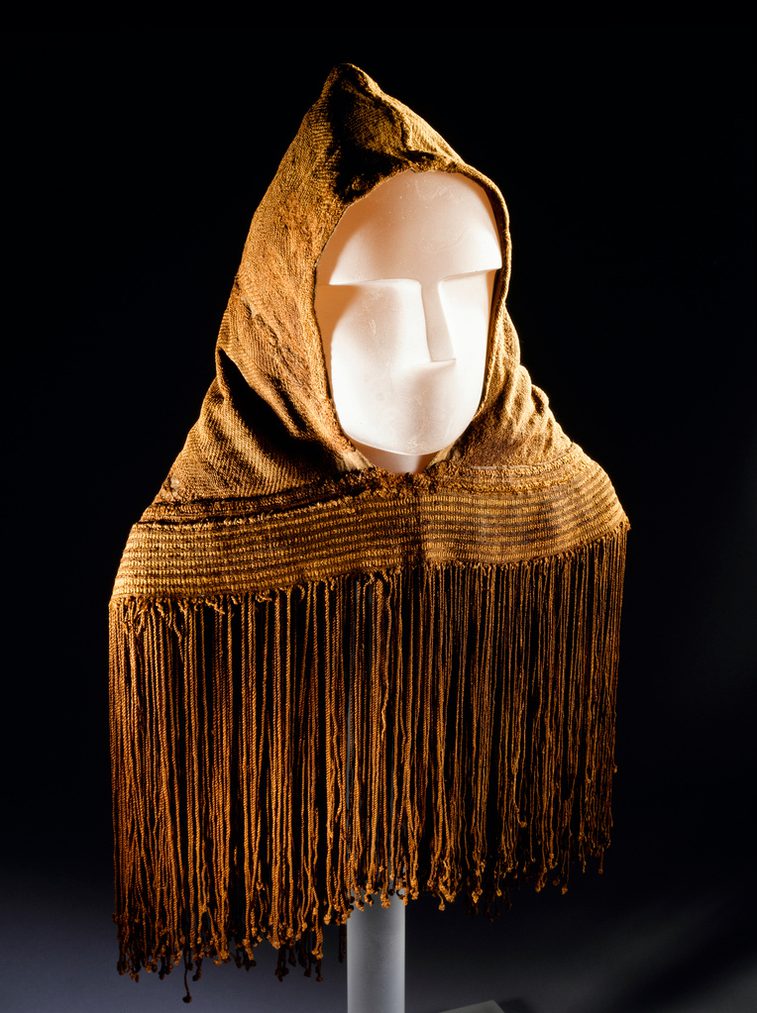
The Orkney Hood, the only complete piece of clothing to survive from before the medieval period in Scotland, radiocarbon dated to AD 250-640. Museum reference X.NA 3.
8. The Shulishader Axe
The Shulishader axe was made some 5,000 years ago and found at Shulishader in Lewis. Its wooden haft survives with a notched butt and oval opening for a stone axehead made of porcellanite that was quarried in Ireland. That this object still exists in the 21st century is astonishing. Axe heads, made from stone or metal, survive from different time periods across Scotland – but it is incredible rare for these wooden parts to survive. It is only because of the preservatory powers of peat that we can understand how the haft and butt were constructed and used thousands of years ago.

The Shulishader axe, made some 3,000 years ago, and discovered in Lewis. Museum reference X.AF 1097.2 .
9. Bog Butter
In bogs across the country, lumps of butter have survived for thousands of years, like this example from Durness. Some examples still look much like butter – transformed into solid lumps of matter – such as two pieces, discovered in Borve, in the Isle of Lewis, during peat cutting by a Mr Mackenzie. Radiocarbon dates suggested these examples from Lewis were deposited sometime between AD 1020 and 1160. Today, they are pale yellow in colour, and slightly glossy, with a mottled layer of dark brown peaty staining. They are now fossilised, but when you get up close to these incredible objects, they still have the (not unpleasant) whiff of dairy product, like slightly stale buttermilk.
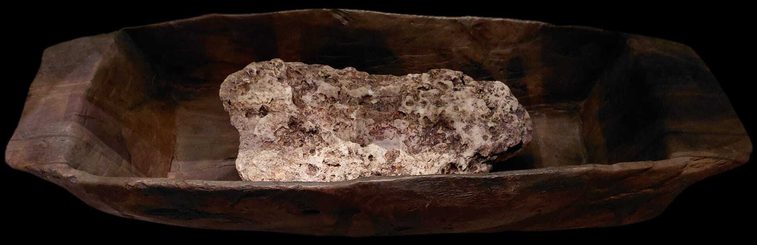
Bog butter preserved for 1000 years in a wooden trough, found in peatland near Durness. Museum reference: X.SHC 9 & 10.
10. The Ballachulish figure
Bogs were no doubt sacred places in the ancient past. A spectacular carved wooden sculpture was found in a bog in Ballachulish, Highland. It represents the oldest sculpted figure from Scotland. Dating to the Early Iron Age, around 600 BC, the figure depicts a naked woman with her hands on her belly, a top-knot of hair on her head and quartzite pebbles for eyes. When found, the Ballachulish figure was covered by the remains of a wickerwork structure. What did this figure represent? A symbol of fertility? Or a goddess of the straits? Often finds from bogs throw up more questions than answers.
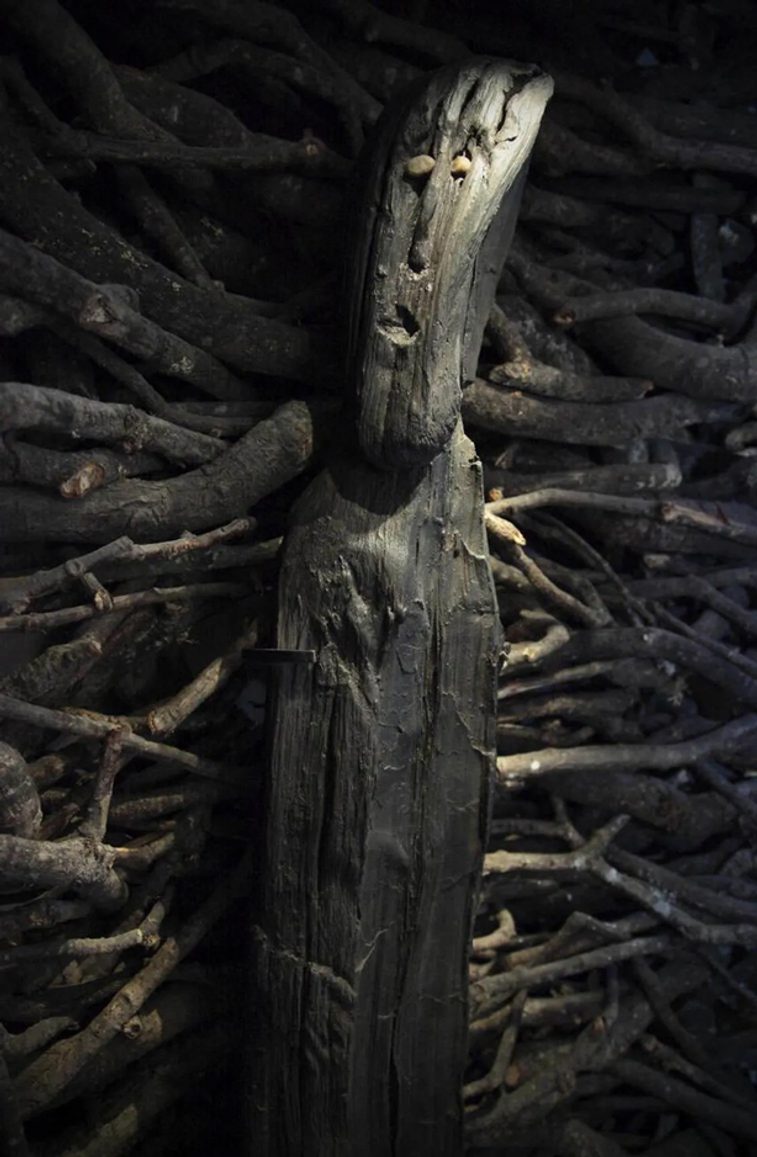
Figure of a female in alder, from Ballachulish, 790 - 410 BC. Museum reference X.KL 54.
11. Torrs pony chamfrain
Organic objects provide glimpses of the everyday lives of people in the past. But the bog has also preserved objects of status, prestige and power, such as the magnificent Torrs cap. This is a bronze head-piece (or chamfrain) for a chariot pony found in 1812 near Castle Douglas in Dumfries and Galloway. Dating to around 200 BC, it is beautifully crafted with skilful decoration of early Celtic art, combining insular and international styles. It provides a fascinating insight on the elite world of the Iron Age.

The magnificent Torrs cap, a bronze head-piece for a chariot pony found near Castle Douglas in Dumfries and Galloway, and made around 200 BC. Museum reference X.FA 72.
12. The Shuna sword
In the Bronze Age many objects were sunk into watery places, such as bogs, lochs and rivers. This 3000-year-old sword from Shuna is one of three that were found tip down in the bog, as though all three were thrust in. This practice of burying swords in bogs, often vertically, is a wider European phenomenon at this time. Was this a practice of sacrifice or ceremony? Bogs offered places for these events to happen.
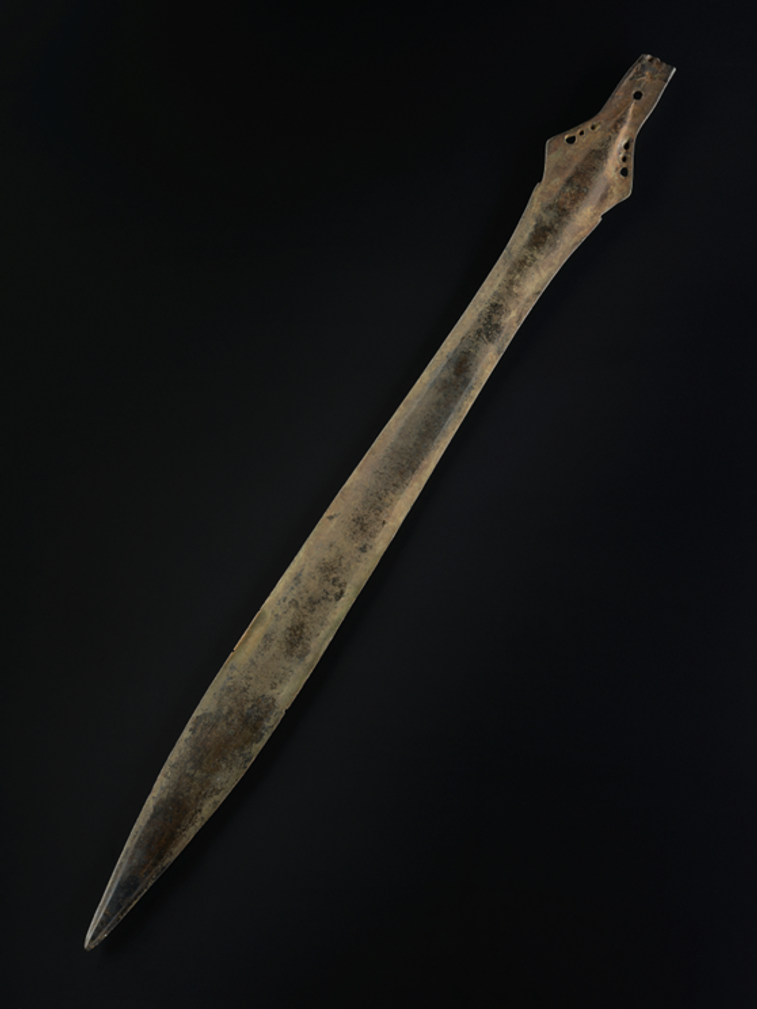
Late Bronze Age leaf-shaped sword, found with two others point downwards in peat at Shuna, Argyll, 1000-800 BC. Museum reference X.DL 21.
Written by

Dr Fraser MacDonald
Senior Lecturer, Historical Geography, University of Edinburgh

Dr Matthew Knight
Senior Curator, Early Prehistory

Dr Anna Groundwater
Principal Curator, Renaissance and Early Modern History

Dr Martin Goldberg
Principal Curator of Medieval Archaeology and History
You might also like
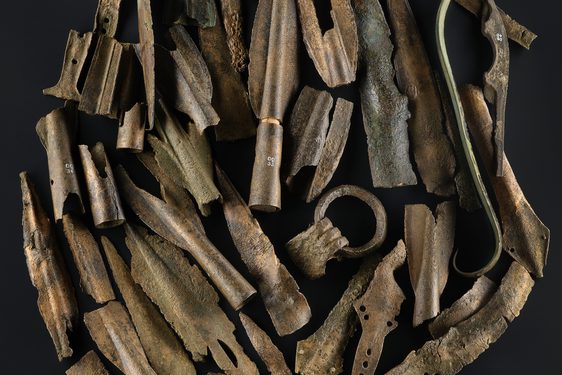
Sacrifice or scrap? The Bronze Age weapons from Duddingston Loch
Archaeology
Written by Dr Matthew KnightWhy was a 3000-year-old hoard of objects deliberately destroyed and sunk into a loch in Edinburgh?
The Second World War and the end of kilts on the battlefield
Scotland
Written by Dr Julie HolderOn 1 June 1940, the last remnants of the 1st Battalion Queen’s Own Cameron Highlanders were evacuated from Dunkirk. By the time the Battalion reformed in Yorkshire, there were only around 150 men left of nearly 700. And yet, as these…
What is the Blyth Hoard?
Archaeology, Scotland
Written by Dr Matthew KnightA unique discovery from the Scottish Borders is shedding new light on the making of Bronze Age objects in Scotland.