Fan favourites: 5 decorative souvenir fans
Hand-held folding fans are a lightweight portable accessory. Although their practical function is to keep you cool, the decoration and materials used to make fans communicate much, much more.
Fans make ideal souvenirs, intended to be carried in a hand, pocket or handbag. They signal places, spaces and events to remember and a gift that doesn’t take up too much luggage space. Here are five themes from National Museums Scotland’s collection.
1. Commemorating events - the eruption of Mount Vesuvius
In the mid-18th century embarking on a ‘Grand Tour’ was a popular method of education and cultural tourism. A tour could take many forms, but for British ‘tourists’ a travel route usually included an alpine crossing into Italy and travel to Rome and Naples. Naples became increasingly popular after excavations in Pompeii in the 1760s. It was further popularised by the appointment of Sir William Hamilton as Envoy Extraordinary to the Kingdom of Naples in 1764.
In 1779 Mount Vesuvius erupted, having become active in the mid-1760s with previous spectacular eruptions in 1767 and 1774. Artists such as Jacob More (1740-1793) and Michael Wutky (1739-1822) witnessed the 1779 eruption and documented the event in their paintings. This commemorative fan may have been created with reference to similar first-hand images. It may have been bought as a souvenir by someone who witnessed the volcanic activity. In the foreground the location is made clear by inclusion of boats anchored in the Bay of Naples.
Other Grand Tour fans document more general experiences. We know from the accounts of Lady Grisel Baillie (1665-1746) that fans were bought in bulk as gifts. As she prepared to return from Naples in February 1733, Lady Baillie paid for a total of 44 fans at a combined cost of 15 ducats (around £480 today). And ‘To James of wages over his fans’ she paid just over 4 ducats (around £130 today).
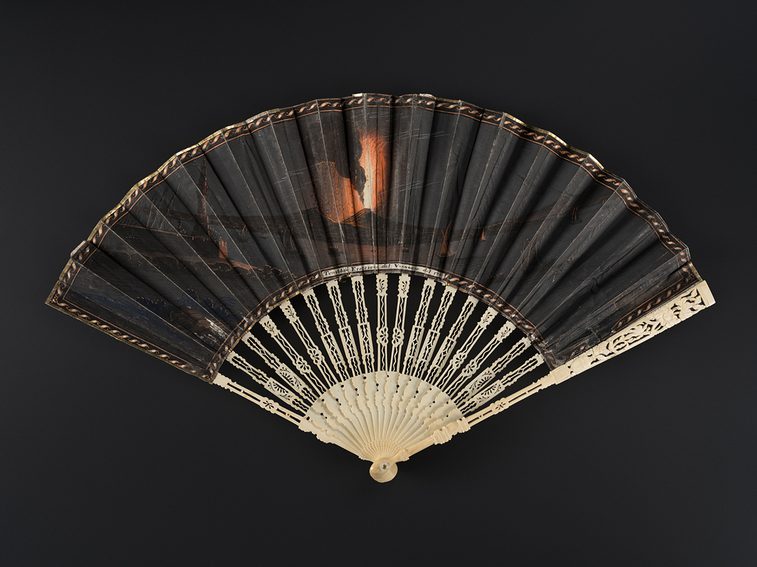
Fan of skin leaf bound with gold paper and mounted on carved bone sticks. Painted with an image of the 1779 eruption of Mount Vesuvius, possibly a Grand Tour souvenir. Part of the Charles W. Stewart Costume Collection: Italian, c. 1780. Museum reference: A.1977.903
2. Celebrity - the golden age of Flamenco
National Museums Scotland has several souvenir fans from Spain. Three of these fans were given to the collection from one private donor. The fans depict flamenco dancing and bullfighting scenes, two cultural traditions which are synonymous with Spain in Britain. The use of fans and shawls in flamenco is likely to have increased their popularity as souvenirs.
The period of 1850 to 1910 is considered a golden age of Flamenco. The early 20th century saw changes in Flamenco culture with the introduction of competitions. This was interrupted by the Spanish Civil War (1936-1939) and Second World War (1940-1945) with competitions resuming in 1956.
The glittering embellishment on fans like A.1983.1327 would have reflected vibrantly when in movement. This fan features a poster with two famous matadors, Lagartijo (Rafael Molina Sánchez, 1841-1900) and Frascuelo (Salvador Sánchez Povedano, 1841-1898).
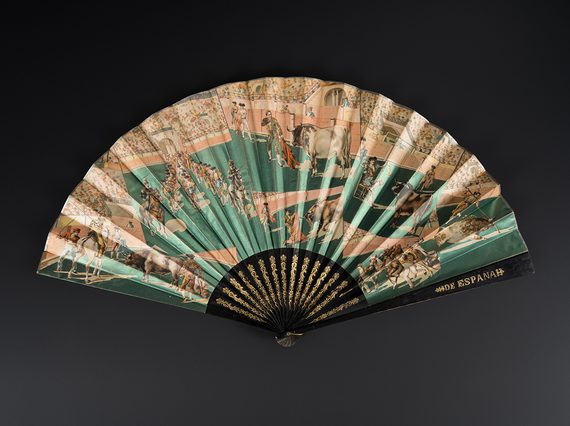
The guards (outer sticks which protect the fan when closed) of A.1983.1328 feature the phrase ‘Recuerdo España’. This broadly translates as 'memories of Spain' or 'remembering Spain'.
Image gallery
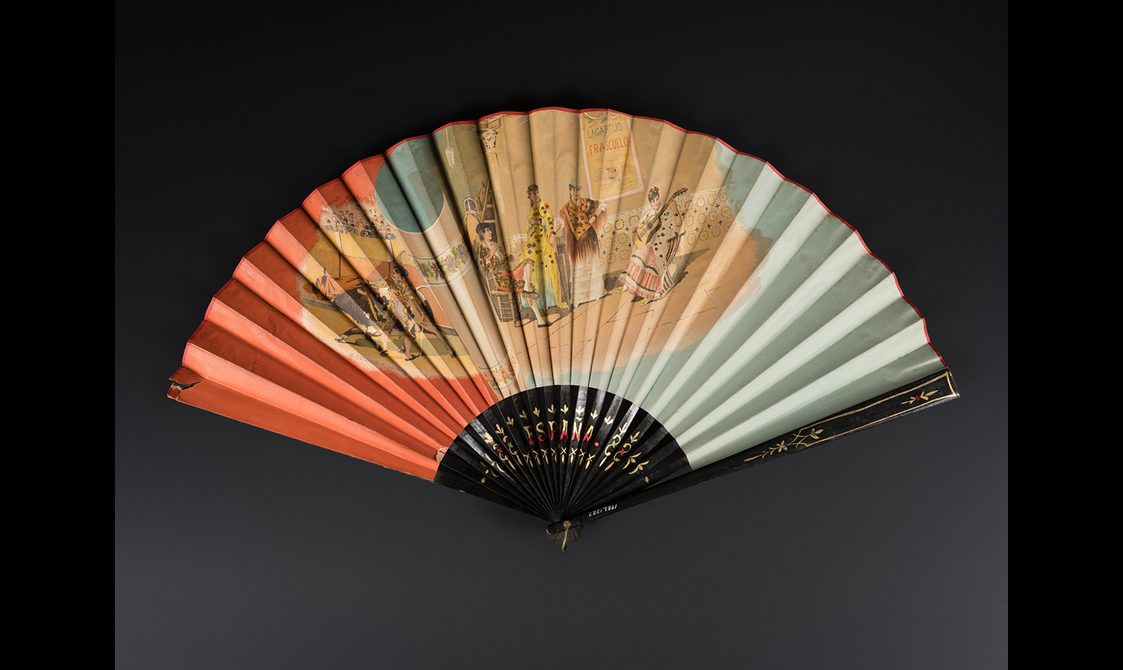
Fan with wood sticks and guards painted black with gilt red and green painted details. Paper leaf printed with a coloured design featuring a bullfighter and three women. Signed M. Albiach, Valencia, embellished with glitter, reverse plain red paper, souvenir: Spanish, c. 1890s. Museum reference: A.1983.1327
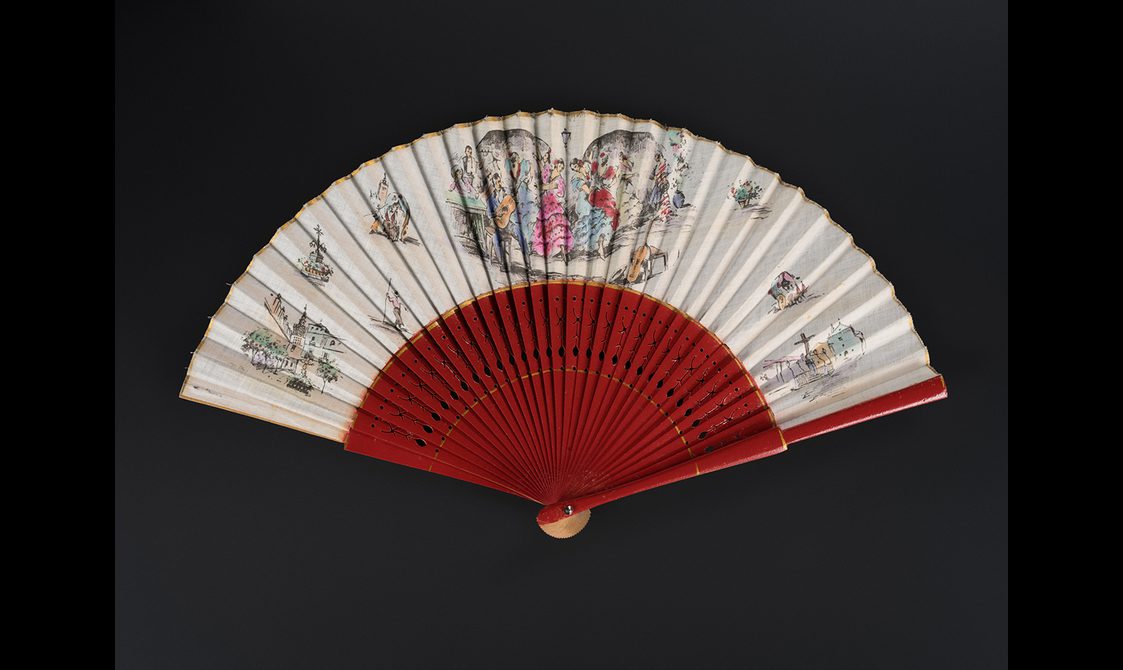
Fan with painted red wooden guards and racks, and cotton leaf. Printed with a scene of flamenco dancers and small vignettes of towns: Spanish, 1950s. Museum reference: A.1983.1323
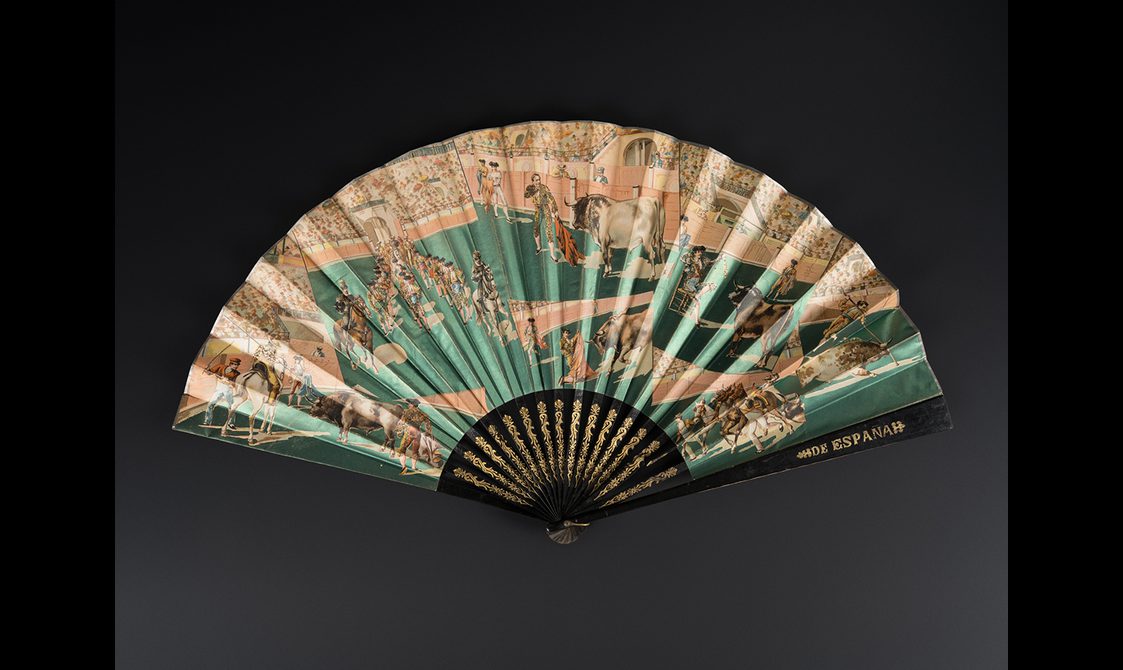
Fan with wooden sticks and guards painted black with gilt detailing. One guard with inscription 'ESPANA', other with 'RECUERDO'. Leaf in metallic paper printed with a bullfighting scene, back with plain pink paper, souvenir: Spanish, c. 1890s. Museum reference: A.1983.1328
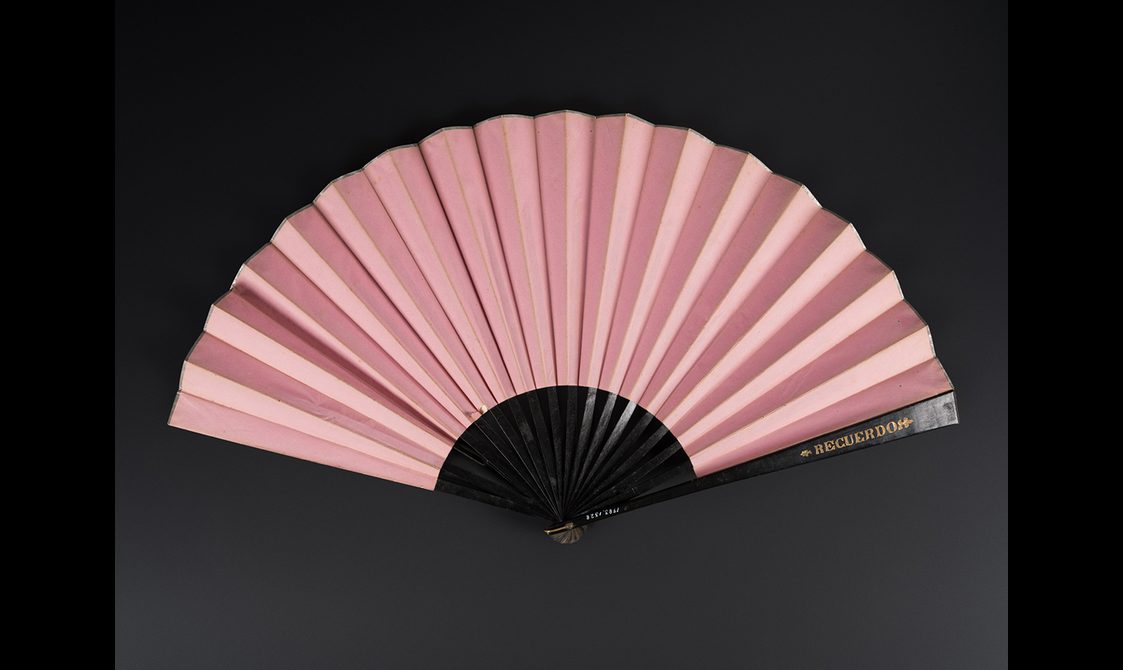
Fan with wooden sticks and guards painted black with gilt detailing. One guard with inscription 'ESPANA', other with 'RECUERDO'. Leaf in metallic paper printed with a bullfighting scene, back with plain pink paper, souvenir: Spanish, c. 1890s. Museum reference: A.1983.1328
3. Sight seeing - the first mass market tourist destinations
The invention of synthetic celluloid plastics in the second half of the 19th century changed the manufacturing of fans. Plastic sticks and guards quickly replaced ivory, mother of pearl and tortoiseshell. Celluloid sheets were initially expensive to produce, but by the early 20th century they could be produced cheaply. They were made in sheets and stamped to create intricate-looking cut out designs on 'Brisé' fans. French for ‘broken’, these fans are made from overlapping fan sticks. These sticks were held together with a ribbon threaded through each blade tip and a rivet at the base. The threaded ribbons would have been hand finished, often by child labour.
In the USA, alongside imports from Europe and East Asia, a domestic celluloid fan industry developed in Massachusetts. Fans were easily customisable as souvenirs to be sold to tourists as mementoes at major landmarks or tourist attractions. This example is from Niagara Falls, one of North America's first mass-market tourist destinations.
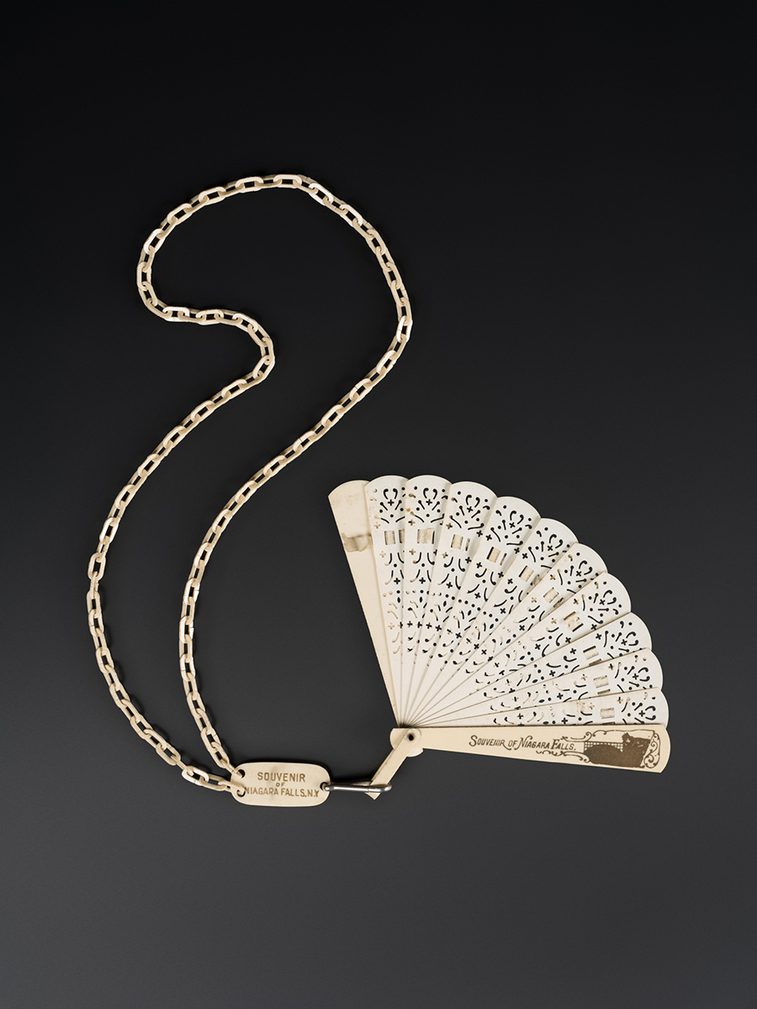
Brisé fan of imitation ivory in celluloid plastic with cream silk ribbon. Guards painted in gold colour with 'Souvenir of Niagara Falls': American, c. 1920. Museum reference: A.1983.1326
4. A sign of social status - the Criterion restaurant
The Criterion restaurant opened its doors in 1873. It was designed as a multi-storey complex in the heart of London’s Piccadilly. The impressive building accommodated several dining rooms and a ballroom, with a theatre in the basement. The restaurant was lavishly decorated and a regular favourite of ladies visiting London's West End to shop. It became a popular high society gathering place for afternoon tea and luncheons to dinner and dancing. The Criterion proved an instant hit as well as a highly profitable venture.
This promotional fan from the Criterion restaurant was likely given to a patron. It is typical of the rise of the advertising fan which emerged in the late 19th century alongside an expansion of middleclass consumers. By the early 20th century, inexpensive advertising fans with wooden sticks and paper leaves served as portable promotional tools for a range of businesses, particularly hotels and restaurants.
Image gallery
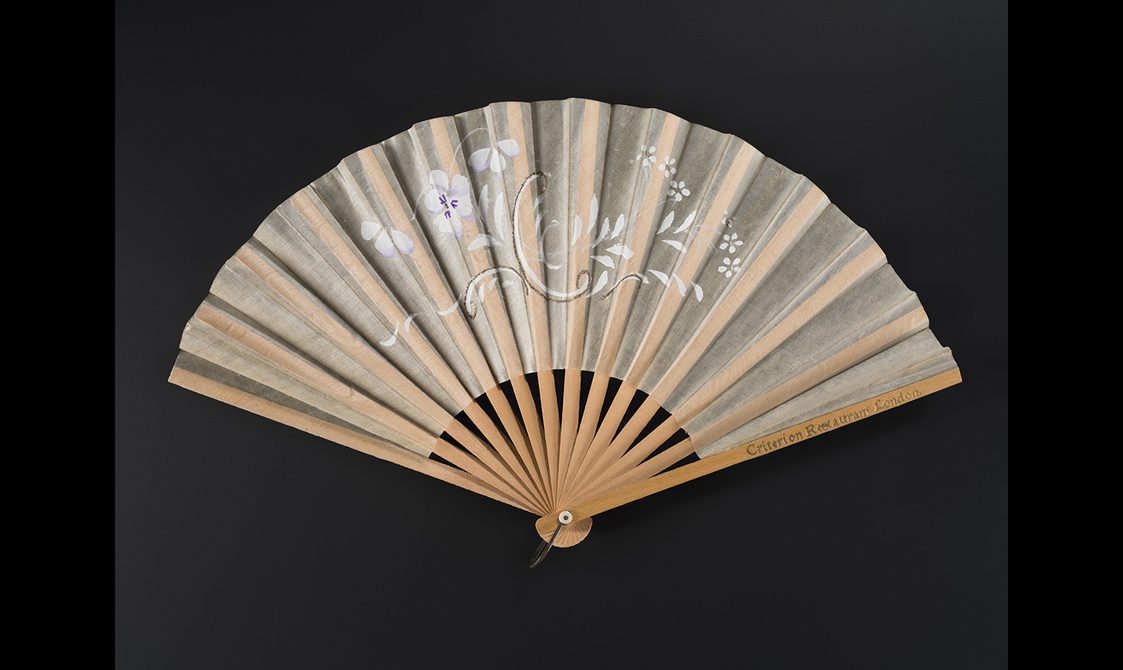
Fan, of paper with wooden sticks and guards. printed in gold with 'Criterion', leaf painted with a purple and floral spray and with glitter highlight swirls. Probably from The Criterion Theatre, London: British, mid-20th century. Museum reference: A.1993.134
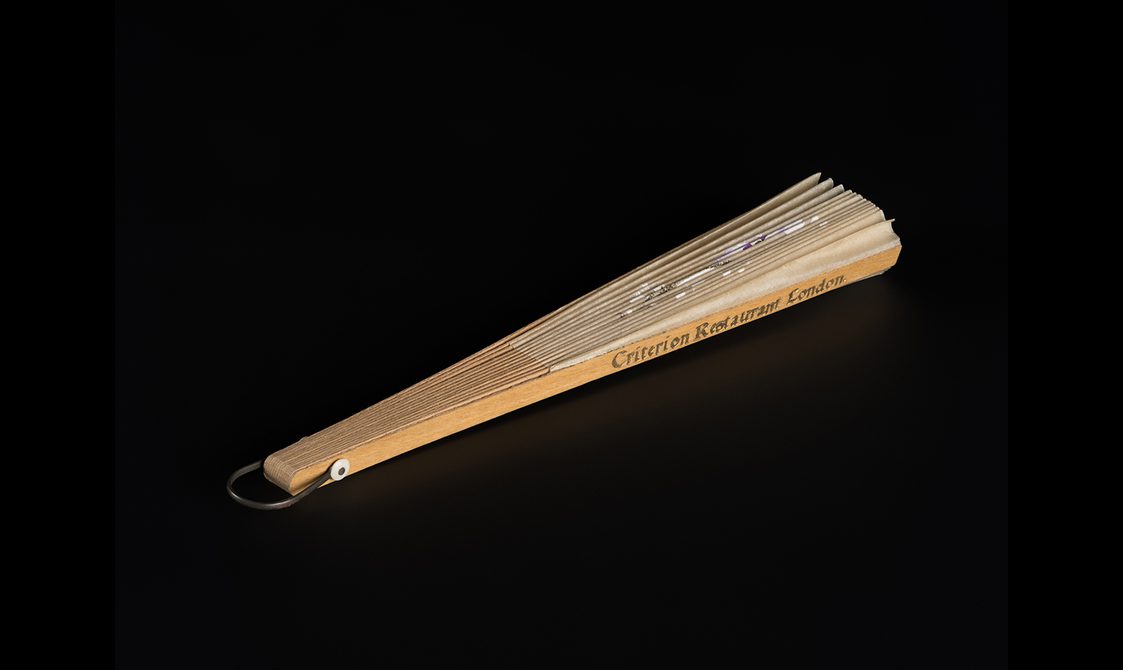
Fan, of paper with wooden sticks and guards. Printed in gold with 'Criterion', leaf painted with a purple and floral spray and with glitter highlight swirls. Probably from The Criterion Theatre, London: British, mid-20th century. Museum reference: A.1993.134
5. Travel - the jet age
The British Overseas Airways Corporation (BOAC) operated all long-haul British flights from the mid-1940s – mid-1970s. The company became synonymous with the glamourous jet age of the post-war era. This promotional folding fan features a world map highlighting BOAC flight routes. It incorporates the classic ‘Speedbird’ corporate logo designed in 1932 by artist Theyre Lee-Elliott.
Airlines commissioned leading designers of the day to enhance the in-flight experience. Design reinforced a strong brand identity, from cabin crew uniforms to branded tableware. Whilst customers couldn’t (or at least weren’t supposed to) take branded tableware home with them, promotional souvenirs were readily available. These included scarves, powder compacts, cigarette cases and lighters, playing cards, posters, and stationary. And, of course, folding fans were readily available. Such souvenirs were issued as part of complimentary welcome packs, available to purchase onboard from the ‘Speedbird gift shop’ or via promotional mail campaigns.
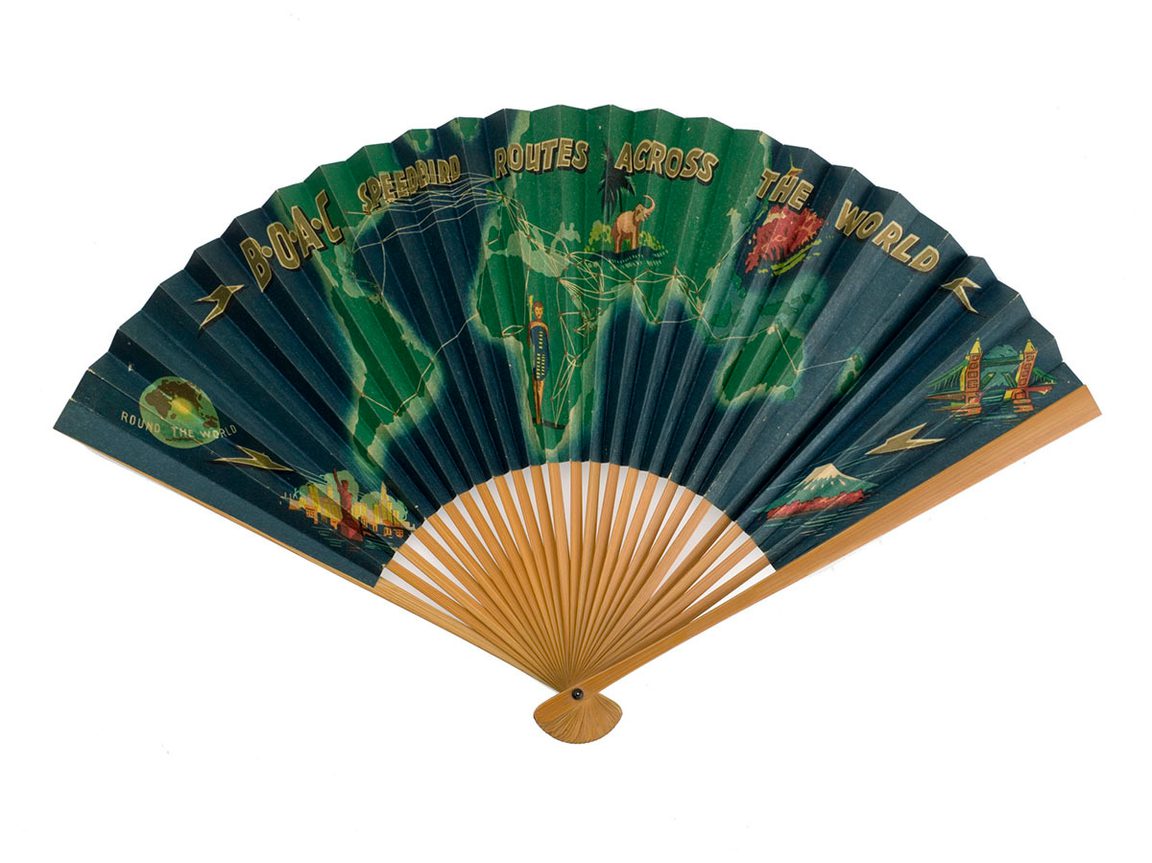
Paper and wood fan. An in-flight item for British Overseas Airways Corporation, 1960. Museum reference: EF.1993.66.1
Written by


You might also like

'I am yours': 11 Scottish posy rings
History and cultures, Scotland
Written by Dr Georgia VullinghsPosy rings are some of the most evocative objects of love in National Museums Scotland's collections. These finger rings are named for the short inscriptions engraved on the inside of their band.
The material lives of ordinary people: rare 19th century Chinese cotton
Fashion and textiles, History and cultures
Written by Dr Rachel SilbersteinWhen you think of historical Chinese dress, what material comes to mind? Most people would probably assume silk. But the majority of the population in Qing dynasty China (1644-1911) actually wore cotton.However, this reality is not…
Fit for a Feast: intricate carved bowls from Lou Island
History and cultures
Written by Dr Ali ClarkThis large wooden bowl is from Lou Island, part of the Admiralty Islands. Used for large feasts it is the most distinctive type of carved bowl from the area due to its decorative carved handles.